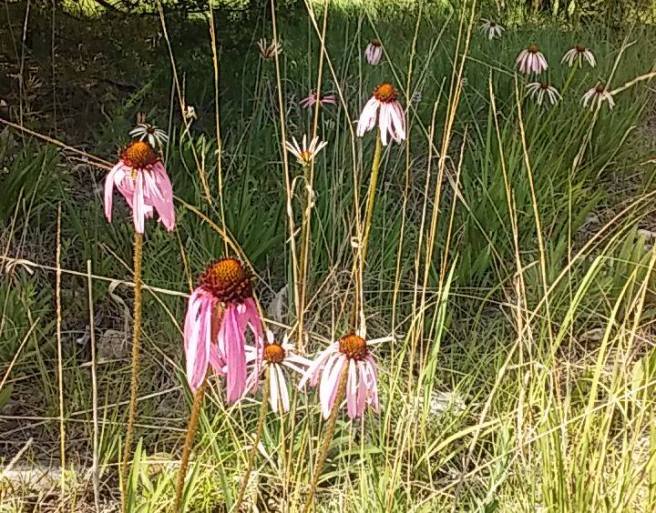
Echinacea simulata, “Glade Coneflower” or “Wavy-leaf Purple Coneflower”
Asteraceae
Picture taken along the driveway at Echo State Park in Missouri, formerly Camp Zoey.
Not ordinarily one used for medicine (others in genus used for acute challenges to immune system, during those hours when you realize you need to immediately take rest if you’re gonna make it out of a stressful week without getting sick), but I imagine it could work similarly. Many commercial root diggers have assumed this too, and sold this species as E. purpurea.
Perennial. Stems (40)60-120 cm tall, sparsely to mod pubescent with stiff, minutely pustular-based hairs.
Alternate leaves, margins entire and usually pubescent with loosely appressed hairs. Leaf surfaces mod to densely pubescent with stiff, mostly spreading, minutely pustular-based hairs. Mod to strongly roughened, 3(5) main veins. Basal leaves 8-35 cm long; stem lvs 4-25 cm long.
Yellow pollen. Pale pink to purplish pink ray flowers
Found on dolomite glades, tops of bluffs, savannas, woodlands.
Compare to Rudbeckia missouriensis (petioles are very fuzzy rather than having a few scattered hairs) and Coreopsis lanceolate (one main vein, leaf edge slightly translucent)
Very similar species to Echinacea pallida (pale purple coneflower), CC=7, which in Missouri is found mostly in prairies in southwest part of the state; pollen white, ray flowers paler.
(Hybrid MOFEP/Park Service Fire Ecology Manual)

 Paradise Ecological Services