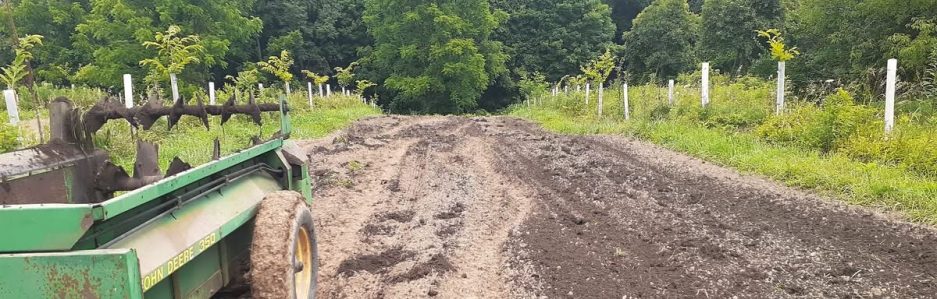
It may sound crazy, but we did this first big planting in June 2020, with very small (2 ft) trees. People thought we were crazy, and some colleagues at a certain local conservation organization actually took bets out that our trees would fail. We had 3 die, and many of them outgrew the 5 ft tree tubes that first year. People in the forestry and permaculture worlds are so resigned to doing tree planting the same way they learned it, and having it not go particularly well in terms of survival rate, that they assumed that planting at the start of the hottest months of summer would surely be a death sentence. But Chris and I had done our due diligence, had a very distinct goal in mind, and a proven strategy. Our colleagues who bet against us lost their bet 😂 How did we do it?
Well, we’re happy tell you, in general terms. We did two passes with a deep (2 foot) subsoil rip to improve drainage and give access to soil nutrients deeper in the solum, we used drip irrigation <which was absolutely clutch>, we fertilized with a broad spectrum slow release fertilizer, we controlled the vegetation around the base of the saplings, we protected the trees from ungulate and insect herbivory. We were at pains to get the best genetics we could to start out with, mostly “Qing” seedlings, grown out for us by Empire Chestnut Company, seeds originally from the Horticulture and Agroforestry Research Center’s collection.
Compared to tilling and spraying the entire field like our wheat farming neighbors do, we did practically nothing, but compared to the consulting forester down the street, we did an ENORMOUS amount of work. And we didn’t do it alone.
We invited our friends to come socially distanced camping with us for a weekend, catered food for them, and bartered with musician friends to entertain us that Saturday night. It was quite magical. We also leaned heavily on friends to help us, in a bunch of small ways. Thanks goes out to Chris McLaughlin for being such a great collaborator on ripping and mowing, Tom Parsons for the forestry mulching, Lisa Brooks for problem solving on water, Dan Divelbiss and Nate Beail-Farkas for plumbing, Benjamin Stewart for the music, Ellie Mae Mitchell for the sun tea, Kelly McHood and Steve Larson for lunch, Mark Kroutel for breakfasts. Thank you Kathy Dice and Tom Wahl for the advice and vending, and Aaron Templemeier, Greg Miller, Amy Miller for the tutelage. Thank you Paul Strauss for lending us your sub-soiler, thank you Kurt Belser for hosting Chris for the time he was in Athens for the planting.
We had another 250+ chestnut trees to plant, but we decided to up-pot them and wait for this year (2021), because we couldn’t quite get water to last field in time. We’ve still been calling that a 1000 tree win; the headline could just as easily been “we planted 1000 trees” because we did, we’re just doing it in a way that pushes their survival and growth rates towards the highest points possible, while minimizing cost. This year we’ll get those last trees in the ground, along with a lot of paw paws inter-planted between last years chestnuts! More on THAT later.
…
In early October, we did a bit of a repeat performance, except we collaborated with Amy Miller at Route 9 Cooperative to host 50 campers in their 40+ year old orchard, to assist in the commercial harvest of nuts and familiarize our band of merry makers with this part of Castanea’s life cycle. It was A LOT of fun. It went surprisingly smoothly.
At least to my way of thinking, what we did that weekend was **time travel**. We were many of the same cast of characters from the planting weekend, but whisked instantaneously far into the 2060’s when the orchard we just planted together is fully mature, and we are all spry septuagenarians picking up nuts. As we were doing this, I was imagining climate refugees from all over the world, working and partying with us. I secretly want my future kids to be able to grow up multi-lingual, what can I say. And in this scenario we have scrapped FSMA, GAP and NOP rules that prevent silvopasture and so there are lots of working animals in the orchard. Other than these factors…. it was very much like time traveling to 2065, and as I said it was a lot of fun.
As usual with this crowd, there was ample bawdy singing. Plenty o’ good conversations between people who were new to the agroforestry world, people who have been in for awhile, and of course the OG himself Greg Miller. Greg was happy to see us and gave a rousing and very informative talk about the origins of the orchards in Carol County. He also shared how much he enjoyed the international, trans-cultural interactions you get to have when you’re growing chestnuts and selling to Asian and European immigrant families, all of whom are delighted to have a taste of the Old Country. I think at some point, that cultural phenomenon will be something we build upon.
There were also several delicious chestnut based recipes at the food table- I hope we all continue to innovate on that front, and I think we well. Just yesterday Chris was sharing pics of a cheesy chestnut dish, which got me salivating pretty hard!

 Paradise Ecological Services