Author Note: this article will be updated with new information as it comes in.
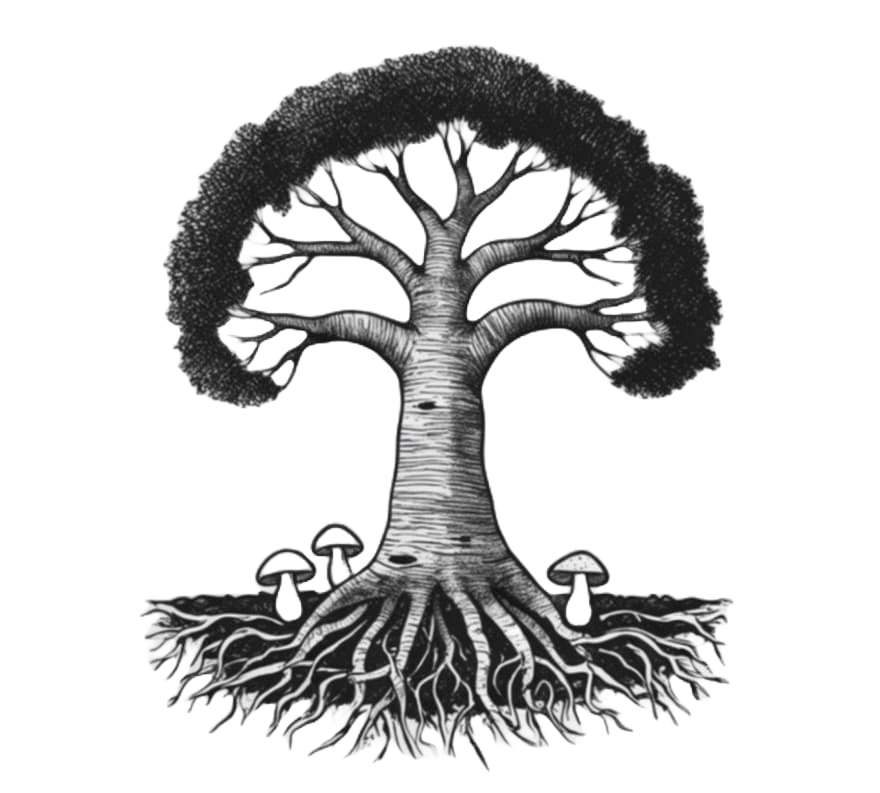
My mom sent me this cool article about pollarded beech trees in Romania. Romanian beech is Fagus sylvatica, rather than the Fagus grandifolia that grows around Athens County. People in Romania use pollarded beech roundwood as a building material. Ohio settlers were accustomed to using beech roundwood to timber-frame large barns. Today, those beech barn timbers get re-used for building modern houses. Romanians use the tiny but nutritious and abundant beech nuts for fattening up pigs. Farms in Appalachian Ohio often have beech as an increasingly dominant component of their woodlot. Maybe farms around here can learn from Romania, and make efficient commercial use of beech trees?
Building houses and barns with beech roundwood may take special consideration. A friend who builds timber framed houses around here had this to say about American beech wood: “Strength-wise it comes close to hickory but apparently beech is very hard to dry properly. It checks and twists and shrinks a ton. Folks recommend using it higher up in the frame, typically only in unfinished spaces like barns. So, cutting in winter when it’s already at its dries would make sense and then letting it air dry for awhile before use, probably stickered and strapped. Because it also reabsorbs moisture more than most woods, it’s critical to seal the end grain when drying.” As this friend points out, not all woods are equally useful in all parts of a timber-framed house. But since most private forestland is lease hunted, retaining beech to fatten up wildlife could be viewed as an additional economic benefit of choosing to protect beech from BLD. For the moment,, American beech seedlings and saplings come up thickly under overstory oaks and hickories. Later I’ll describe how that can sometimes be a problem. Pollarding small sawtimber sized beech stems for later commercial harvest of building materials may result in smaller, more vigorously growing stems. Given the limitations on its use, it would take a particular kind of highly motivated landowner and homebuilder to realize commercial value from beech roundwood. If you’re that person, I want to tell you about a new challenge to consider in 2024. A disease is spreading across Ohio that is severely damaging this species, and it’s almost at our doorstep. Treatment options are available, fortunately.
Beech Leaf Disease (BLF) is a potentially fatal tree disease caused by nematodes from Eurasia. Last year, BLF made it as far south as Muskingum County. That means only Morgan County stands between Solid Ground Farm and these nasty little worms. It may be here within this calendar year. If we think beech can be valuable, and I say that rhetorically because it’s obviously valuable, what should we do to manage it when confronted with high disease pressure?
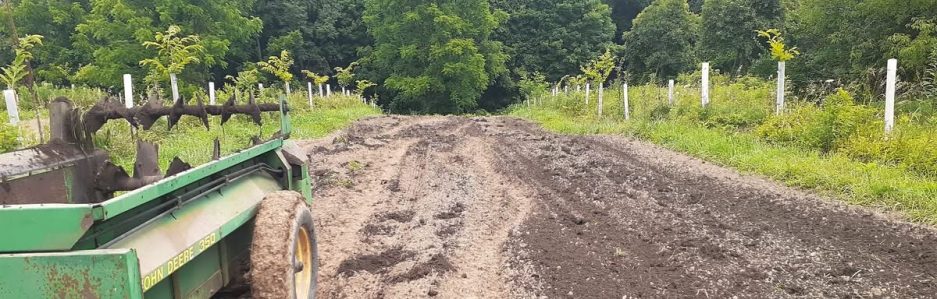
An ounce of prevention is worth a pound of cure. Our hypothetical land owner could establish a stand where there’s a focus on beech trees, and work with them long term. In 2022, Ohio researchers shared encouraging results from a five-year research project. Using an off the shelf type of fertilizer, applied twice as a soil drench or soil injection to soil beneath small diameter American beech stems, the beech tree’s immune system was bolstered enough so that the tree was able to fight off the BLF. Soil injection is regularly conducted by certified arborists. If you are stewarding a forest with beech trees and you have an end use in mind for the nuts and wood, we might need to engage in a little “target hardening” if we’re going to partake of the beech’s gifts into the future. I like this fertilizer option, because we’re not injecting a tree with pesticide, we’re simply nourishing it and letting it do its thing.
The product that was used in the study was PolyPhosphite 30, which bills itself as “The Only True Long Lasting Potassium PolyPhosphite Fertilizer”.
Here are two written resources furthering detailing this Integrated Pest Management option:
Beech Leaf Disease Management Options
Additional options for spot treatment of BLD exist. Bio-SAR Fungicide/Nematicide is a certified organic bio-stimulant product made of Chitosan that has been successful. A synthetic alternative that has also shown effective nematode and symptom reduction is fluopyram, a FRAC Group 7 fungicide. Broadform, a fluopyram plus trifloxystrobin product labeled for ornamental and shade trees, is typically the synthetic product used and has shown good efficacy. It’s good to have different options.
How is American beech doing in southeast Ohio, immediately prior to BLD’s arrival in Athens County? A useful website for looking at that question, which uses Forest Inventory and Analysis data, is maintained by the American Hardwood Export Council. “Forest Inventory Analysis (FIA) data shows U.S. beech growing stock is 348 million m3, 2.6% of total U.S. hardwood growing stock. U.S. beech is growing 4.5 million m3 per year while the harvest is 3.8 million m3 per year. The net volume (after harvest) is increasing 0.7 million m3 each year.” As of 1/31/24, their website was showing that in a region encompassing Athens, Hocking, Meigs, Morgan, Perry, Vinton and Washington Counties, there is 78,000 m3 of American beech that grows every year, and 71,000 m3 of American beech that is harvested each year, for a net increase of 7,000 m3 increase across these 7 counties each year. I’m guessing that number will go down and be reversed after BLD arrives.
According to recent historic trends in American beech growth, how do foresters around here tend to view this species? Beech trees are slowly accumulating in the midstory of many oak and hickory stands, and it looks like beech would replace a greater share of the current overstory, via ecological succession, in the absence of prescribed fire, thinning, or BLD. But that outcome seems in question, now. For people tending the woods, furnishing an increasing amount of oak-hickory timber and nuts is perhaps the most common goal on high, dry sites. In pursuit of that goal, beech dominance of the midstory is widely regarded as problematic. Maybe with the advent of BLD, concerns of beech dominance in oak hickory stands will diminish without any effort at mid-story removal. Maybe some forest managers will consider setting a goal of retaining some healthy beech trees, instead of ignoring or discouraging these from growing. Hopefully this happens on at least a small subsection of site types, where this species naturally grows productively.
Carving out a stand here and there for beech to become co-dominant might be easy, even with the advent of BLD. Maybe this goal doesn’t have to conflict with oak-hickory management, at least in southeast Ohio- even though the oak wants fire, and the beech does not want fire, these mutually contradictory management strategies could be spatially segregated. Our location in Athens is almost exactly in the center of beech’s current natural range. To quote Silvics of North America Volume 2: “At latitudes in the middle of its range… beech is more abundant on the cooler and moister northern slopes than on the southern slopes.” In contrast, oaks and hickories thrive on a bit of deprivation, having a competitive edge on drier sites. I have seen service foresters set aside the driest 1/3 of a landscape to manage oak and hickory, variously calling these sites “oaky dokey”, generally with an Acid Mixed Sedimentary Upland ecological site description. One could manage those sites with fire, while excluding fire and fertilizing beeches on some portion of the shaded side of the hill, thereby supporting habitat diversity and beta-level species diversity.
To dig deeper into this topic, of dry sites with shallow soil being conducive to commercial management of white oaks, check out Trystan Harpold’s 2022 master’s thesis: “Uneven-Aged Management in the Missouri Ozarks: Effects of Site Conditions, Stand Density, and Prior Populations on Oak Regeneration“. Soils are overall more mesic in southeast Ohio than in the Missouri Ozarks, so attempting the same management strategy as Harpold wrote about without the addition of prescribed fire may get different results.
I am not arguing that this fire-excluded, phosphite fertilization of beech is commercially viable across entire stands. But some healthy beech stems could probably be retained for wildlife value, and builders who like using beech lumber in their projects may be motivated to try this. If I dare to speculate, maybe after two treatments with phosphite fertilizer have been applied as a prophylactic against BLD, pollarding some beech stems (as is done in Romania) may be something worth pursuing for such builders.

 Paradise Ecological Services