Introduction
Supported by SARE, the Southern Ohio Chestnut Company has begun a farmer-led research project. “Chinese chestnut seedling mycorrhization with porcini”. This is our first update to the public.
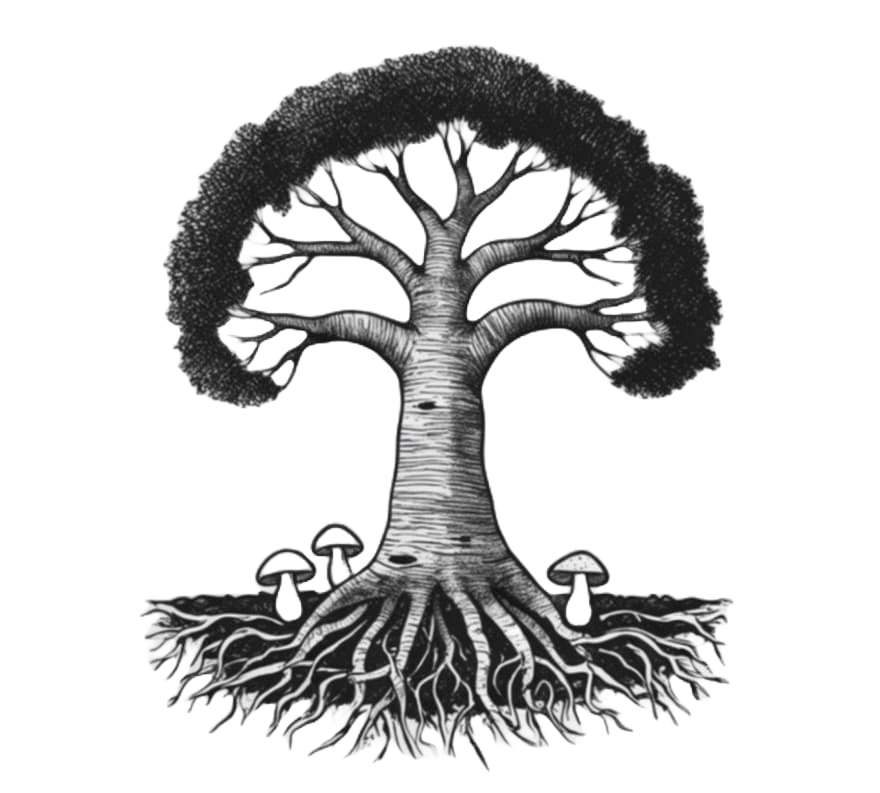
Porcini mushrooms go by many names. This project works with porcini specifically –Boletus edulis– and also a group of other closely related “King Bolete” mushroom species from the Boletus genus. In practice, King Boletes are all harvested, traded and cooked rather interchangeably. They are all high-dollar culinary mushrooms. King Boletes are different from most other cultivated mushrooms in that they don’t normally break down logs or wood chips or bags of grain for their nutrients. Instead, they symbiotically trade resources with host trees- energy from the tree is traded for soil nutrients and water, between the ectomycorrhizae of the King Bolete and the fine roots of the tree. Because of this foraging strategy, would it surprise you to know that most King Bolete mushrooms are harvested from the soil surface? Yes, King Boletes are harvested in chestnut, conifer and oak woodlands, plantations and orchards.
There has been successful inoculation of chestnuts and conifers in Europe and Asia. More research is needed into the basic biology of porcini as it relates to the inoculation of Chinese chestnut seedlings, however. To our knowledge, no chestnut grower in North America has derived significant income by selling the ectomycorrhizal mushrooms from their orchards. We hope to be the first! If this is exciting to you, follow these updates to learn along with us!
What have we learned and accomplished so far?
King Bolete identification and nomenclature
At Martha Bishop’s recommendation, Badger Johnson and Aly Gordon attended a spring 2025 foray with the Ohio Mushroom Society (OMS) in Lake County, OH. OMS is a chapter of the North American Mycological Association (NAMA), and puts out “The Mushroom Log” as a bimonthly newsletter. We suggest to everyone reading this, if you haven’t already, join NAMA and your local chapter! It is of good value, for learning mushrooms on forays, in newsletters, and with many exclusive online classes and lectures. We search the Mushroom Log for King Boletes identification guidelines. Here is some of what we learned:
“Current research indicates that genus Boletus in N. America will eventually be whittled down to include only the “kings” –Boletus edulis, Boletus variipes, Boletus separans, & a few others.” -David Wasilewski
“This group (editors note: this group consists of the King Bolete group referred to above) is characterized by having a pure white pore surface in the young fruitings, which changes to yellow and finally greenish olive. The flesh is white and does not bruise. The stem is typically reticulate but mostly near the top… reticulation is white.”
-Dick Grimm
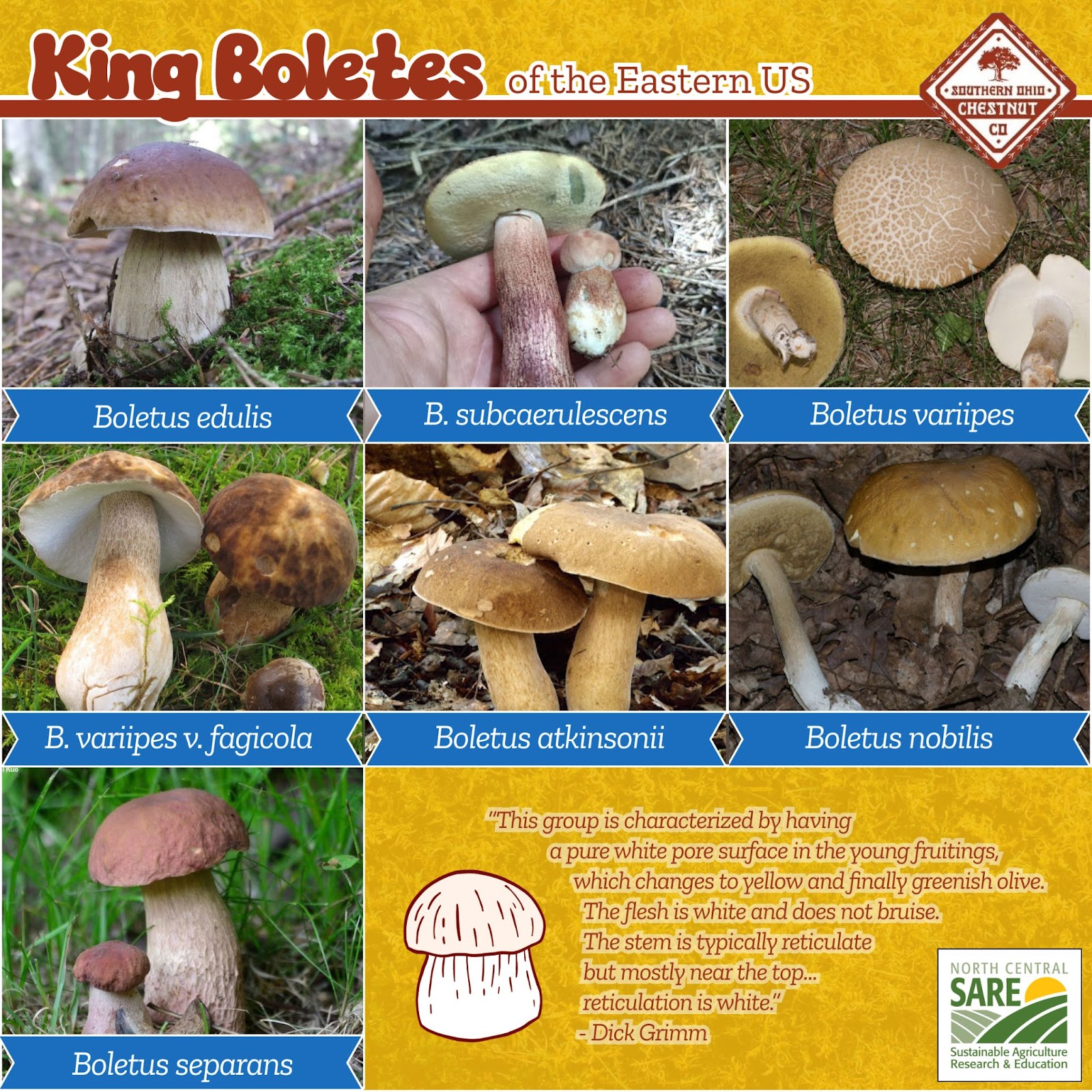
This trend that Mr. Wasilewski described, of geneticists reclassifying every species from genus Boletus that doesn’t look like a King Bolete, has held constant ever since. In the eastern US, genus Boletus now includes only Boletus edulis, Boletus subcaerulescens, Boletus variipes, Boletus separans, Boletus variipes var. fagicola, Boletus atkinsonii and Boletus nobilis– all of which are culinarily considered King Boletes. This is a favorable situation for farmers, field biologists & foragers- all are choice edibles! Dr. Bryn Dentinger lays it out nicely in the chart below in his talk “ Boletus edulis update presented by Dr. Bryn Dentinger (UMNH) via Zoom on November 17 2022”. We made an infographic for the species native to the eastern US.

An accidental successful inoculation and annual harvest of King Bolete in Ohio
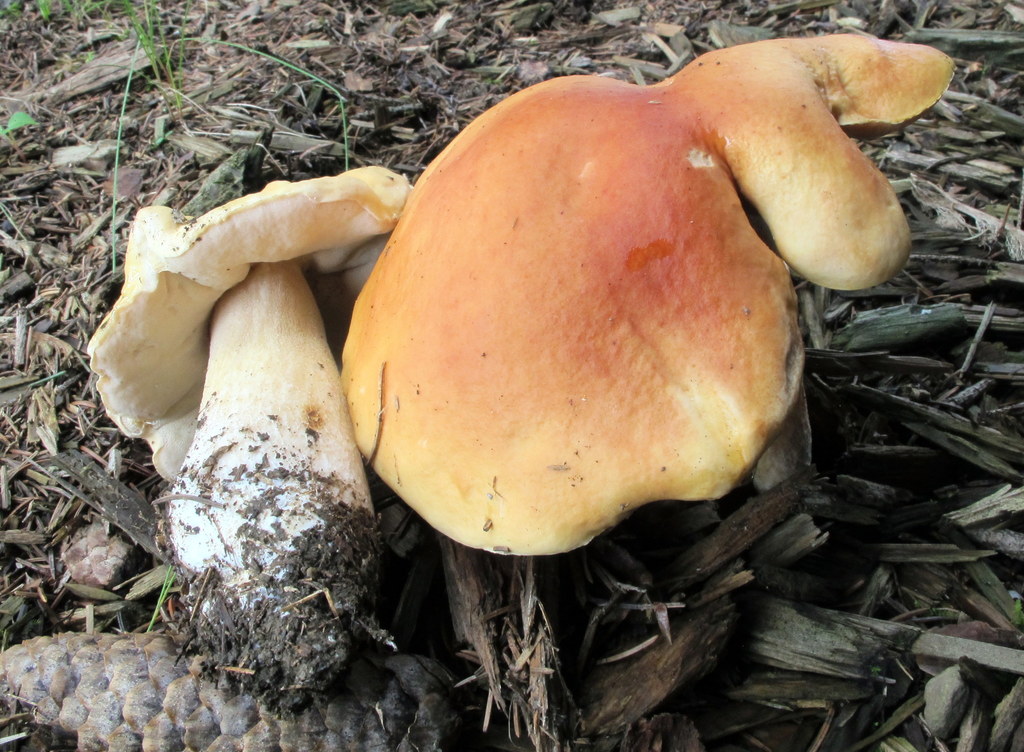
Martha introduced us to Walt Sturgeon. Walt is a mushroom field identifier and teacher of great renown in OMS. Walt is also the author of “Appalachian Mushrooms: A Field Guide”. He is a native of East Palestine, OH. More than 10 years ago, Walt inadvertently inoculated Norway spruce trees in his neighbor’s backyard with King Bolete. The inoculation occurred from spreading shavings and rinse-water outdoors, which he produced from mushrooms that he foraged and ate. Every summer, from under those Norway Spruce, he now harvests King Boletes where there where none before, under just three medium-sized yard trees! These pictures are from Walt’s iNaturalist observations, from this remarkable accident.


Indicator Species
We learned about “indicator species” for King Boletes. Fly Agaric Amanita muscaria mushrooms and ground-growing moss species including Delicate Fern Moss Thuidium delicatulum are good indicator species, if these are growing under host trees for King Boletes. These are used as rapid site compatibility clues by professional Tom Patterson, such that without ground-growing moss, a site is often not worth looking at. Ian R. Hall has said “Boletus edulis is commonly found with Amanita muscaria… in China, England, New Zealand, and the USA, an association also noted… in France and… in Austria. This may be because (Amanita) have similar ecological requirements and fruit at similar times of the year or it might reflect a biological association.” Tom said something like “When you see that Amanita muscaria is coming up in your King Bolete honeyholes, come back every three days to check for King Boletes.” Dr. Giovanni Gamba (University of Turin, Italy) told us about a Boletus edulis liquid mycelial inoculation for Castanea sativa (Myco Chest), which includes the edible Amanita caesarea. Mentioning edible Amanita should not detract from the “scare factor” of the deadly poisonous Amanita mushrooms that do exist, and which every forager should learn to identify and avoid. Take-away: King Boletes travel with Amanita mushrooms and ground-growing moss.
Timing Tips and Foraging for King Boletes on Abandoned Christmas Tree Farms
“The best months to forage for King Boletes in Southeast Ohio vary year to year. It depends on having enough rain (1-2 inches/week) and temps in the 80’s. On an average year, from best to worst: September, October, August, May/June, July.” -paraphrasing Homer Elliot
In May, these conditions occurred in Athens County, OH. With permission, we visited a 20+ year old Norway spruce planting, a commercial Christmas tree farm. We found Amanita muscaria had been flushing for week+, and that Boletus subcaerulescens was coming up.


Starting Chinese Chestnut seedlings, foraging King Boletes for inoculum
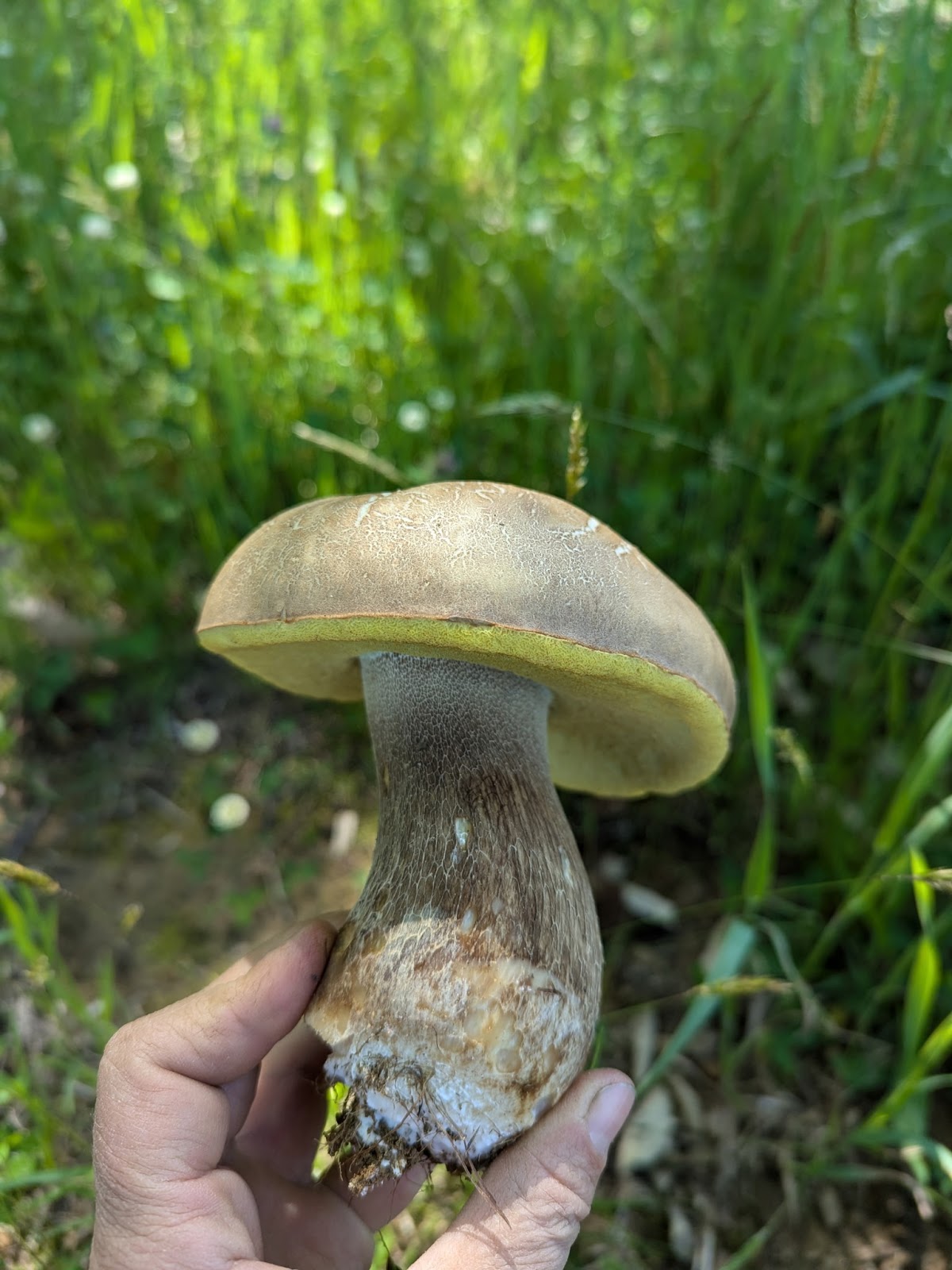
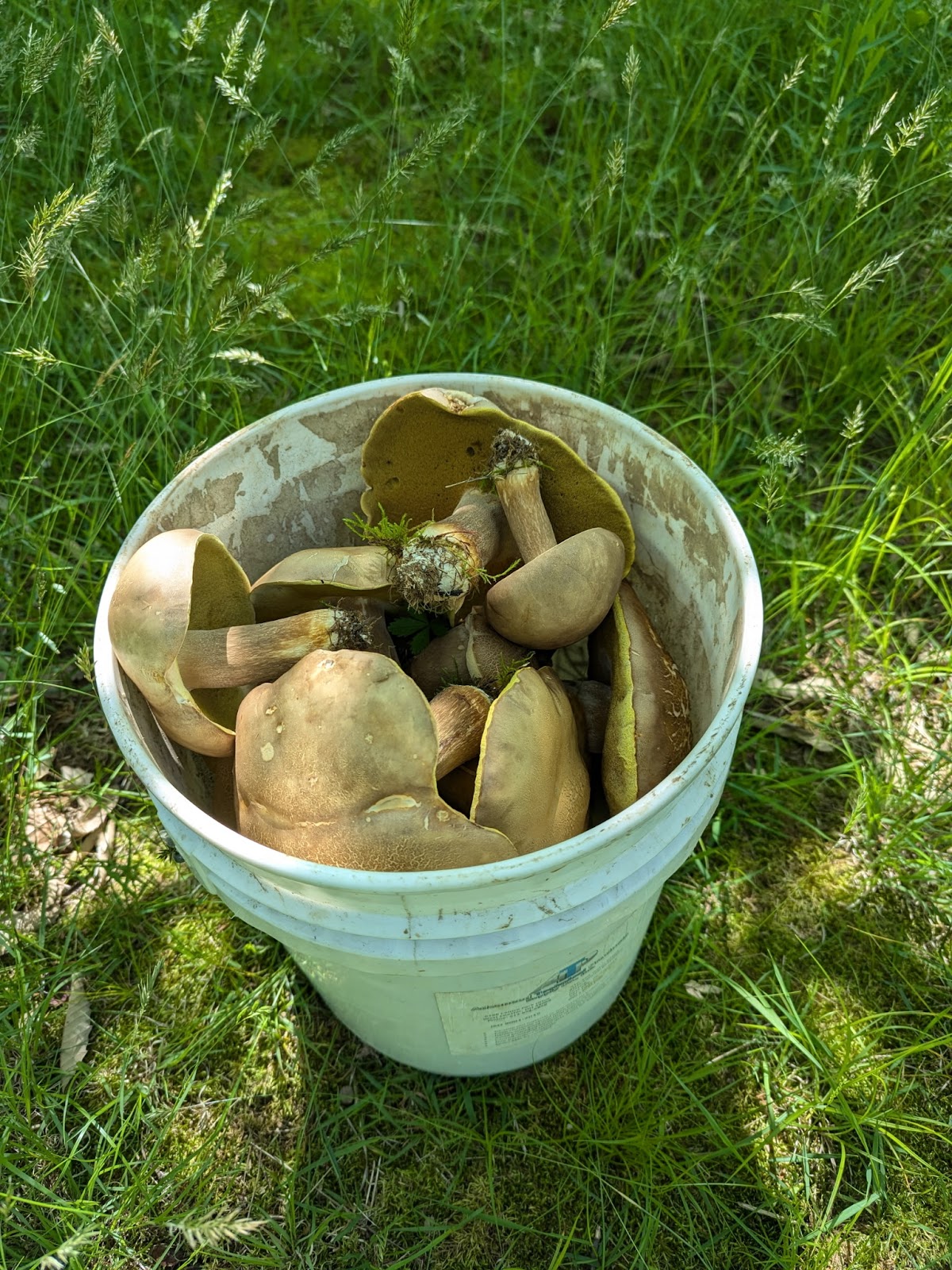
In late May & early June, Tom Patterson and Amy Miller shipped freshly foraged King Bolete mushrooms overnight to Thomas Lodge’s lab. Our specific mushrooms came from over-mature Christmas tree plantations in PA and a unique Chinese chestnut orchard that sits on a former oak woodland in OH. We have tentatively identified Boletus variipes from the OH site. Genotyping with bioinformatics analysis will be necessary to confirm this identification.
Thomas says that our King Boletes are successfully growing on the Petri dishes, see his video explanation here. Chris Smyth at Deer Orchard Nursery in Cincinnati has been watching the late-planted chestnuts begin to germinate. He tried a delayed germination technique to make the trees to order, such that the seedlings would not have been growing for very long before we could expect to see King Boletes in spring 2025. Chestnut seedlings started germinating but the germination rate to date has been much lower than when germinating chestnuts early in spring.
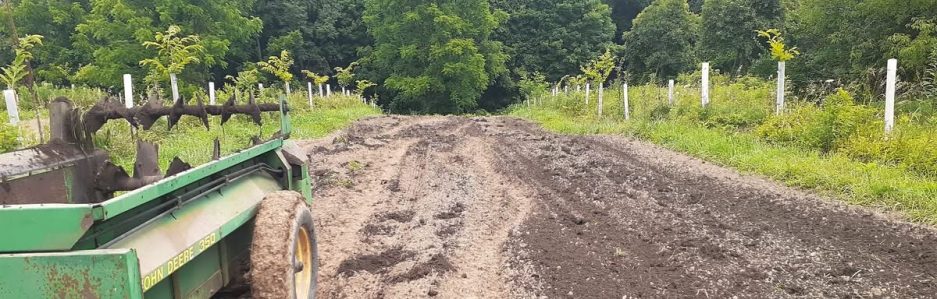
Chris built air-pruning beds and filled each with an autoclaved potting mix, and observed weed seeds germinate later. The pasteurization was not completely effective, as Dave Moore predicted. Soil is notoriously difficult to sterilize. Thomas says we could try a soil pasteurization wagon. Here are pictures of the potting mix, transported from by pickup truck in sealable, stackable plastic crates. You can see the freshly planted chestnuts in air-pruning beds, following methods from Perfect Circle Farm and Yellowbud Farms.


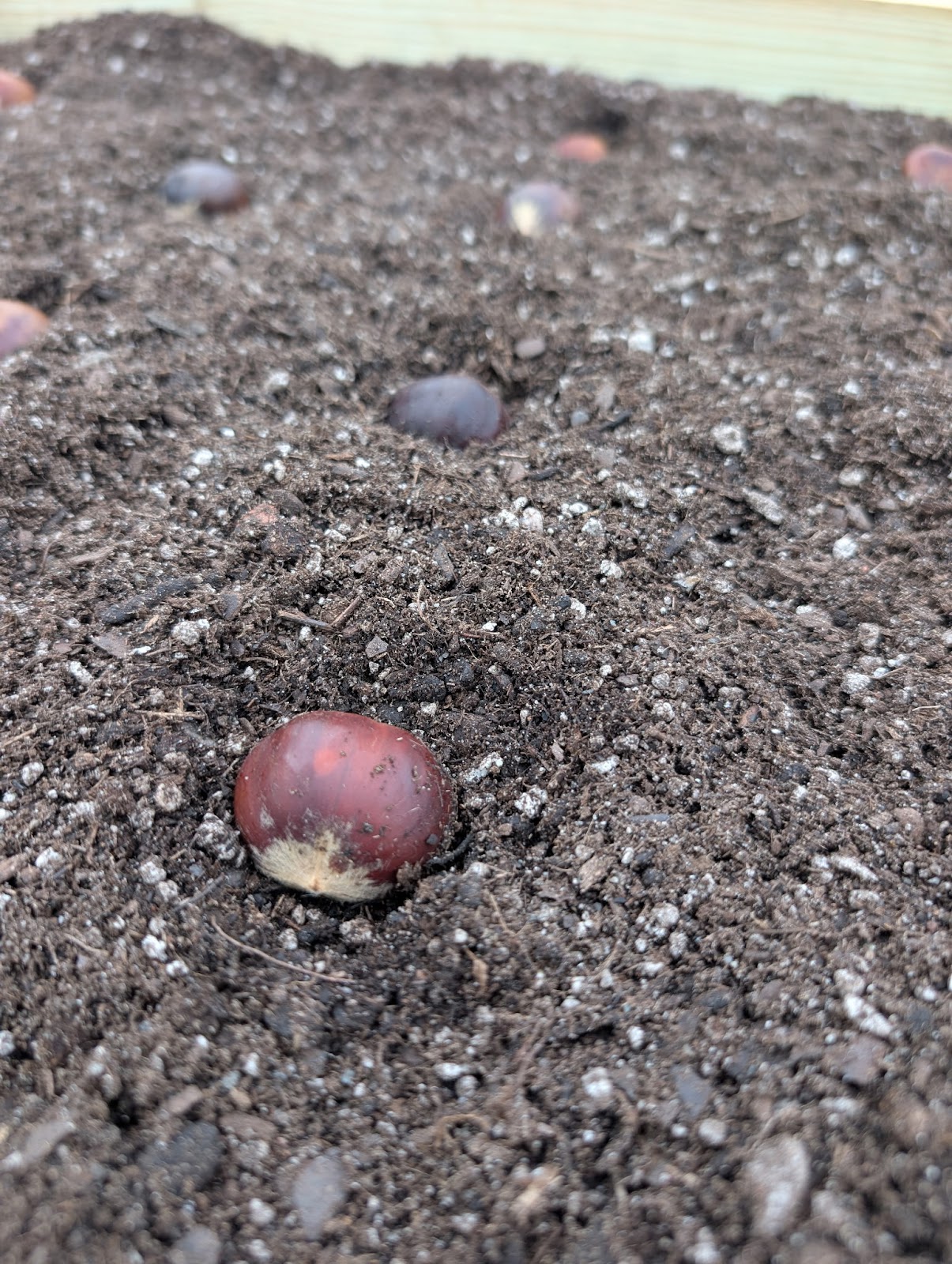

The potting mix was sourced from Nathan Rutz of Tilth Organic Living Soil. He designed this mix for us based on lengthy conversations about the need for some nitrogen in the form of dead organic matter, good water-handling capabilities, an acidic pH of less than 6.5, and reviewing the literature for what others had used. Others may raise their eyebrows at the addition of compost, but given the hard to predict nature about when our King Bolete inoculants would be ready, we decided that some rich compost could be an important source of nitrogen for ectomycorrhizal fungi to enzymatically break apart and disperse to chestnut seedlings.
Sand: 5%
Compost: 15%
Perlite: 20%
Pine Bark: 20%
Peat: 40%
Lesson Learned
With a goal of inoculating new chestnut seedlings, we should have developed the inoculant in sufficient quantity, and then autoclave the soil, and then germinate the chestnut seedlings at the first good opportunity. This order of operations would reduce the opportunity for other soil microorganisms to accidentally be introduced through the air into the autoclaved potting medium, and allow enough chestnut seedlings to be available simultaneously. Thus, we may delay inoculating chestnut seedlings until spring 2026, with a goal of germinating chestnut seedlings earlier in the spring.
A Mother Tree Site
Members of the team visited a Norway Spruce where Boletus edulis fruiting bodies have come up the last few autumns to assess where chestnut seedlings could be planted for the “mother tree method” of inoculation. The type species of the King Bolete genus- B. edulis– is said to almost exclusively fruit under Norway Spruce in North America, but fruits in association with virtually every deciduous and coniferous tree species in Europe except European larch. Why it would be host-specific on one continent and generalist in the US is an area of research for the Dentinger Lab.Interestingly enough, B. chippewaensis, which is found under some hardwoods, turns out to be genetically identical to B. edulis despite appearing phenologically distinct!

Dr. Dietrich Epp Schmidt shared a summary of where the project is at, more broadly.
“Scientifically, we’re still a long ways away from being able to say anything definitive about inoculating chestnuts with King Bolete based on our own experiment. But, there’s a lot of learning that has already shaped the project. There are a few key insights that surfaced during our proposal writing, and which I found to be exciting. First, our back of the envelope calculation suggests that during good years the market value of the King Bolete yield could easily eclipse the market value of the chestnut crop. This is a huge benefit to the farmer! Our proposal is focused on providing an incremental improvement to farm financial viability by increasing the growth rate and resilience of seedlings, thereby (hopefully) decreasing the time to market by a few years for newly planted orchards. However, the economic value of the mushrooms themselves offers a long-term vision of multiple revenue streams for the farmer from one cropping system. We love to see it!
Along the same lines, our proposal was focused on producing mycorrhized seedlings. However, we found evidence that suggests that it is likely that mature trees can successfully be inoculated, and that the development time for the mushrooms on mature trees is significantly shorter. If true, this is a huge development! It means that from the mushroom’s perspective, the main limitation for fruiting is having a tree partner that is able to supply sufficient carbon. From a production system perspective, it also means that mature chestnut orchards could also cash in on the King Bolete inoculants we develop, and start producing their own King Bolete. It further opens the possibility that we can develop the methods to inoculate mature hazelnut and pecan orchards with culinary mushrooms as well.”
Thank you to our sponsors, collaborators and fellow travelers. Please get in touch if you’d like to discuss this with us.



 Paradise Ecological Services