Echinacea simulata

Echinacea simulata
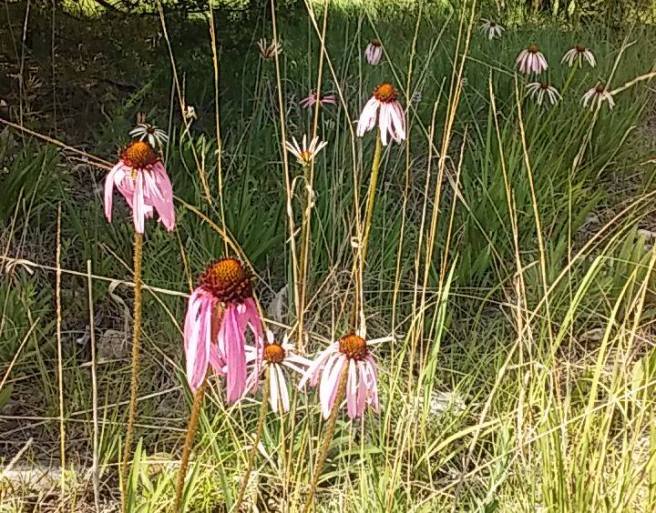
Echinacea simulata, “Glade Coneflower” or “Wavy-leaf Purple Coneflower”
Asteraceae
Picture taken along the driveway at Echo State Park in Missouri, formerly Camp Zoey.
 
Not ordinarily one used for medicine (others in genus used for acute challenges to immune system, during those hours when you realize you need to immediately take rest if you’re gonna make it out of a stressful week without getting sick), but I imagine it could work similarly. Many commercial root diggers have assumed this too, and sold this species as E. purpurea. 
 
Perennial. Stems (40)60-120 cm tall, sparsely to mod pubescent with  stiff, minutely pustular-based hairs.
Alternate leaves, margins entire and usually pubescent with loosely appressed hairs. Leaf surfaces mod to densely pubescent with stiff, mostly spreading, minutely pustular-based hairs. Mod to strongly roughened, 3(5) main veins. Basal leaves 8-35 cm long; stem lvs 4-25 cm long.
 
Yellow pollen. Pale pink to purplish pink ray flowers
 
Found on dolomite glades, tops of bluffs, savannas, woodlands.
 
Compare to Rudbeckia missouriensis (petioles are very fuzzy rather than having a few scattered hairs) and Coreopsis lanceolate (one main vein, leaf edge slightly translucent)
 
Very similar species to Echinacea pallida (pale purple coneflower), CC=7, which in Missouri is found mostly in prairies in southwest part of the state; pollen white, ray flowers paler.
 
(Hybrid MOFEP/Park Service Fire Ecology Manual)

Echinacea tennesseensis

Echinacea tennesseensis

Echinacea tennesseensis, “Tennessee purple coneflower”
Asteraceae

Snapped this picture at Missouri Botanical Garden in summer 2018 with Madeline Wright and Derick Asahl.

Edemic to the cedar glades of the central portion of Tennessee. It has been hypothesized that an ancestral Echinacea species spread into middle Tennessee during the hypsothermal period following the last ice age, when conditions were drier and prairies extended into much of the central eastern U.S. that is now forested. As conditions became wetter, the Echinacea populations became isolated on the prairie-like habitat of the cedar glades which were eventually surrounded by forest. This isolation resulted in divergence and speciation of E. tennesseensis.

A noticeable characteristic is its generally erect ray flowers, in contrast to the more drooping rays of its most similar congener, E. angustifolia (widespread throughout the prairie of the central U.S.) and other common Echinacea species such as E. purpurea.

The Tennessee coneflower was once a federally listed endangered plant species and its recovery has been aided by the purchase of habitat by TNC and the State of Tennessee. The Fish and Wildlife Service proposed that this plant be removed from the endangered species list because all the former threats to the species are eliminated or reduced. The Tennessee coneflower was delisted in 2011.

(Wikipedia)

Echinacea purpurea

Echinacea purpurea

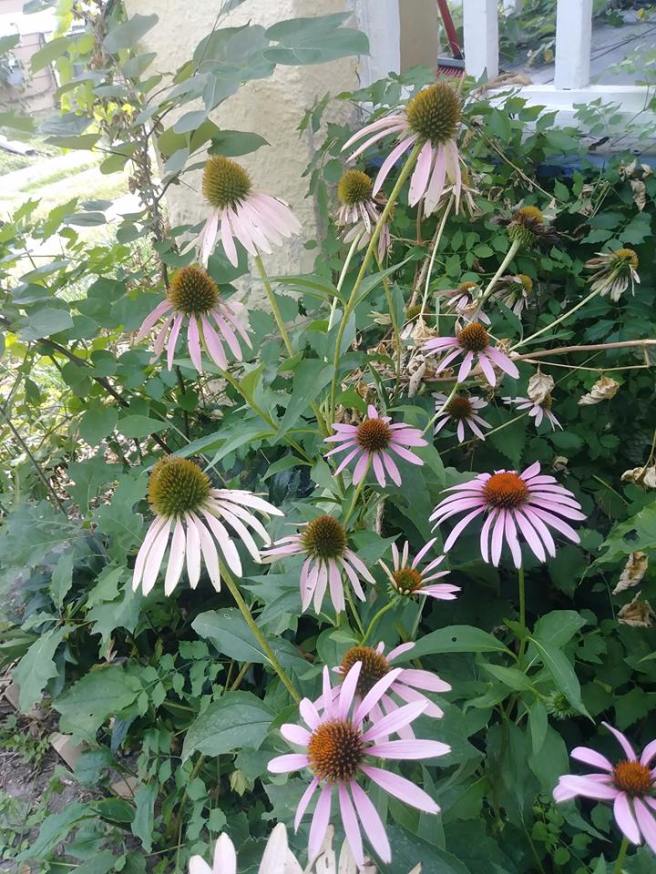
Echinacea purpurea, “eastern purple coneflower”
Asteraceae

That purple coneflower that’s growing in so many front yards (including Dan Bugnitz’s Columbia, MO yard in this picture) turns out to be one of the most popular herbal remedies in the US. It’s commonly used for Rhinovirus and influenza. It’s not at all hard to grow or maintain. It goes great in a rain garden or pollinator garden and propagates easily through root division. You can dig it up, tincture it in Everclear in the dark for 30 days and take a shot every few hours as soon as you notice your body just about to get sick (that takes some bodily self-awareness). Don’t forget to get a bunch of sleep, as well as and stopping activities that would otherwise compromise your body’s immune system!

Echinaceas are heavy phosphorous feeders and will bloom prolifically after a dormant season prescribed fire.

“While there is some controversy about which of the constituents of Echinacea contribute to the immunostimulatory activity, there is a consensus that the lipophilic alkylamides, as well as the polar caffeic acid derivative, probably make the primary contribution to the activity of alkoholic extracts by stimulating phagocytosis of polymorphonuclear neutrophyl granulocytes. In addition to these constituents, polysaccharides are implicated in the activity of the expressed juice and aquaeous extracts, and in the response to the powdered whole drug.” (VAVERKOVÁ and VAVERKOVÁ 2006)

“If the E. purpurea seeds are from a wild source (not cultivated material), a period of cold, moist stratification at 43 degrees for thirty days is recommended…. If grown from seeds, expect flowers in the second or third year. When other plants succumb to droughty conditions, echinaceas will withstand the dry weather with little attention. They do well in any average, well-drained garden soil and prefer a lightly alkaline to neutral pH. Good drainage is essential. Echinaceas do not favor highly enriched, wet soils. Full sun is preferable, though E. purpurea does well under dappled shade. Yield of up to a ton of dried root and tops per acre can be expected.” (United Plant Savers, 2013)

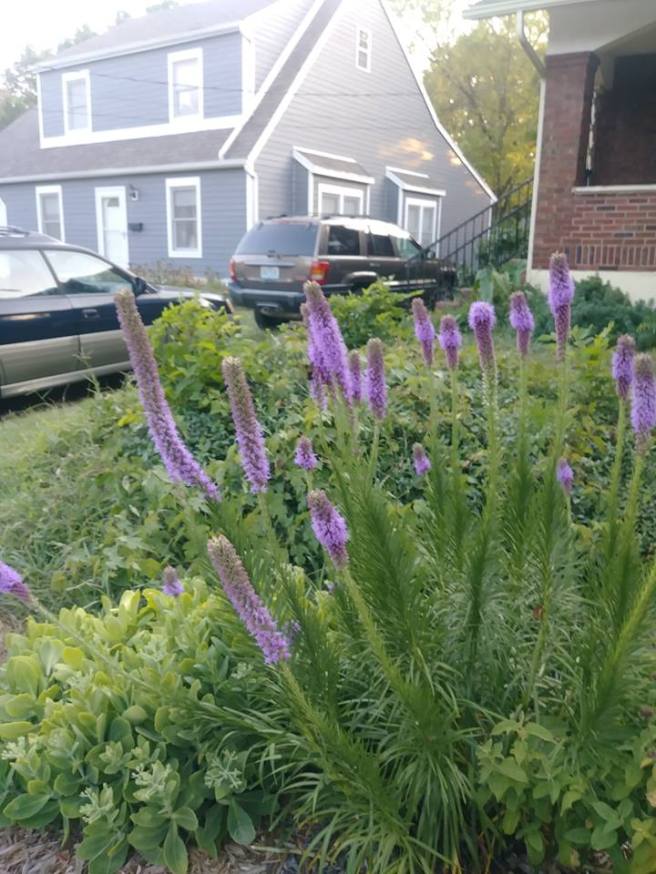
Liatris pycnostachya

Liatris pycnostachya

Liatris pycnostachya “gayfeather”, “prairie blazing star”
Asteraceae

One of the iconic wildflowers in Missouri, seen here being pollinated by a Hemaris hummingbird moth.

CC value=6. Perennial, stems 50-150 cm, mod to densely pubescent with short, curled hairs, may be glabrous toward base.

Basal and low stem leaves are mostly short-petiolate, 8-40 cm x 3-13 mm, linear or narrowly oblanceolate, glabrous to densely short-hairy, green, 3-5 main veins; stem leaves mostly sessile, 1.5-15 cm, linear.

Flower heads are densely spaced (axis mostly not visible), sessile or with stalks 1 mm long, and 1 basal bract.

Involucral bracts are broadly lanceolate to oblong-lanceolate, tapered to long. Bract tips are sharply pointed spreading or recurved.

Found on prairies, fens, glade seeps and roadsides.

(Hybrid MOFEP/Park Service Fire Ecology Manual 2018)

Castanea sativa

Thanks Chris Chmiel for these pics from the Cevennes region of France. I wish we had a bigger chestnut industry in the US. May have to start one? 🤔 I remember being enthralled in 2007 at Mountain Gardens when I read about the massive chestnut orchard/forests on Corsica (see J. Russell Smith’s “Tree Crops), and have wanted to be part of a chestnut growers’ cooperative ever since. The Savanna Institute (of which I am a supporter) is really pushing for chestnut orchards in the Midwest as a land-regenerating staple crop that can make farmers a good living on small acreage. Empire Chestnut in Carrollton, OH is a good example of this, and has inspired some of their neighbors to grow chestnuts as well and work as a grower cooperative. Chestnut weevils and gall wasps present barriers to organic producers. (Personal Communications)

This tree attains a height of 20–35 m (66–115 ft) with a trunk often 2 m (7 ft) in diameter. The bark often has a net-shaped (retiform) pattern with deep furrows or fissures running spirally in both directions up the trunk. The oblong-lanceolate, boldly toothed leaves are 16–28 cm (6–11 in) long and 5–9 cm (2–4 in) broad.

The flowers of both sexes are borne in 10–20 cm (4–8 in) long, upright catkins, the male flowers in the upper part and female flowers in the lower part. In the northern hemisphere, they appear in late June to July, and by autumn, the female flowers develop into spiny cupules containing 3-7 brownish nuts that are shed during October. The female flowers eventually form a spiky sheath that deters predators from the seed. Some cultivars (‘Marron de Lyon’, ‘Paragon’ and some hybrids) produce only one large nut per cupule, rather than the usual two to four nuts of edible, though smaller, size.

The tree requires a mild climate and adequate moisture for good growth and a good nut harvest. Its year-growth (but not the rest of the tree) is sensitive to late spring and early autumn frosts, and is intolerant of lime. Under forest conditions, it will tolerate moderate shade well. It can live to more than 2,000 years of age in natural conditions, see the poetically-named “hundred-horse chestnut” in eastern Sicily for example.

The leaves provide food for some animals, including Lepidoptera such as the case-bearermoth Coleophora anatipennella and rose chafer Macrodactylus subspinosus.

C. Sativa is found across the Mediterranean region, from the Caspian Sea to the Atlantic Ocean. It is thought to have survived in several refuges during the last ice age in southern Europe, Northeast Turkey and the Caucasus. It then spread North and West throughout mainland Europe, and is thought to have arrived in Italy from Asia Minor with the Greeks.

The species is widely cultivated for its edible seeds (also called nuts) and for its wood.

They are used for flour, bread making, a cereal substitute, coffee substitute, a thickener in soups and other cookery uses, as well as for fattening stock. A sugar can be extracted from them.[5] The Corsican variety of polenta (called pulenta) is made with sweet chestnut flour. A local variety of Corsican beer also uses chestnuts.

As early as Roman times, it was introduced into more northerly regions, and later was also cultivated in monastery gardens by monks. Today, centuries-old specimens may be found in Great Britain and the whole of central, western and southern Europe. Roman soldiers were given chestnut porridge before going into battle.

Leaf infusions are used in respiratory diseases and are a popular remedy for whooping cough. A hair shampoo can be made from infusing leaves and fruit husks.

The tree was a popular choice for landscaping in England, particularly in the 18th and 19th centuries. C. sativa was probably introduced to the region during the Roman occupation, and many ancient examples are recorded. More recently, the tree has occasionally been planted as a street tree in England, and examples can be seen particularly in the London Boroughs of Islington and Camden.

A tree grown from seed may take 20 years or more before it bears fruits, but a grafted cultivar such as ‘Marron de Lyon’ or ‘Paragon’ may start production within five years of being planted. Both cultivars bear fruits with a single large kernel, rather than the usual two to four smaller kernels.

The ornamental cultivar C. sativa ‘Albomarginata’ has gained the Royal Horticultural Society’s Award of Garden Merit.

Sweet chestnut has been listed as one of the 38 substances used to prepare Bach flower remedies.

(Wikipedia)