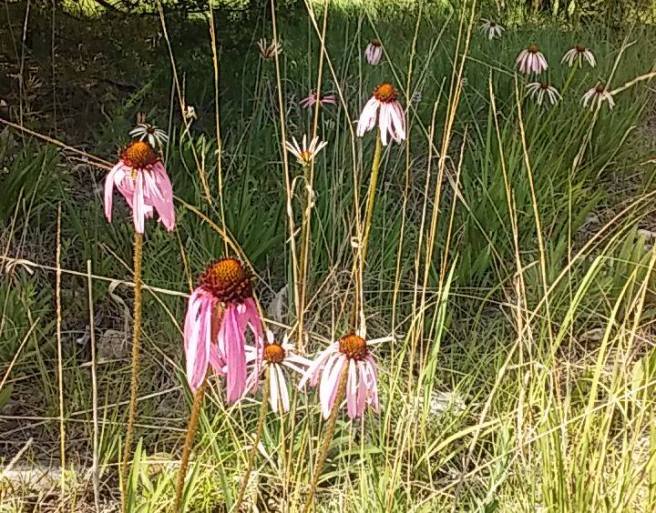
Echinacea simulata


Echinacea tennesseensis, “Tennessee purple coneflower”
Asteraceae
Snapped this picture at Missouri Botanical Garden in summer 2018 with Madeline Wright and Derick Asahl.
Edemic to the cedar glades of the central portion of Tennessee. It has been hypothesized that an ancestral Echinacea species spread into middle Tennessee during the hypsothermal period following the last ice age, when conditions were drier and prairies extended into much of the central eastern U.S. that is now forested. As conditions became wetter, the Echinacea populations became isolated on the prairie-like habitat of the cedar glades which were eventually surrounded by forest. This isolation resulted in divergence and speciation of E. tennesseensis.
A noticeable characteristic is its generally erect ray flowers, in contrast to the more drooping rays of its most similar congener, E. angustifolia (widespread throughout the prairie of the central U.S.) and other common Echinacea species such as E. purpurea.
The Tennessee coneflower was once a federally listed endangered plant species and its recovery has been aided by the purchase of habitat by TNC and the State of Tennessee. The Fish and Wildlife Service proposed that this plant be removed from the endangered species list because all the former threats to the species are eliminated or reduced. The Tennessee coneflower was delisted in 2011.

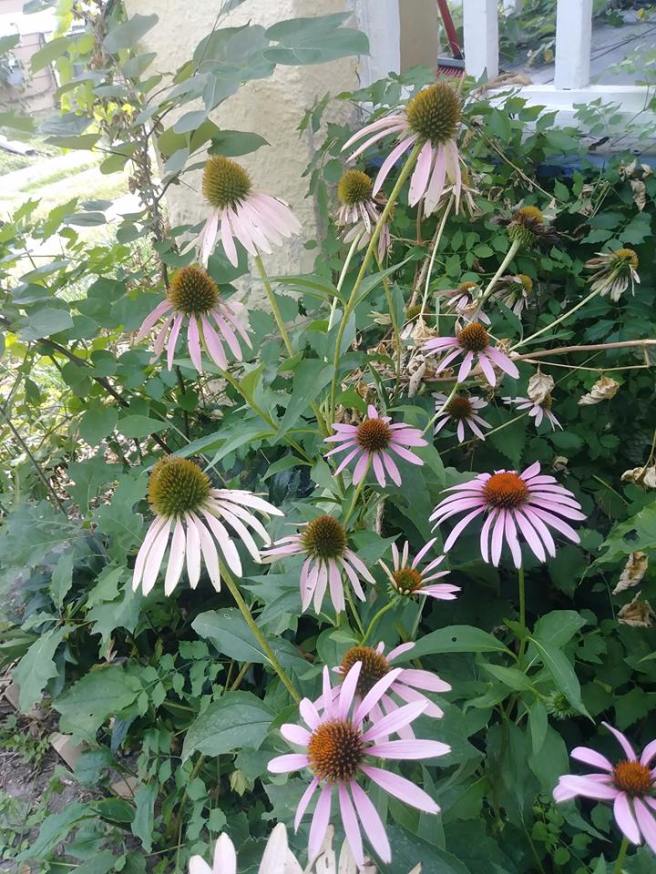
Echinacea purpurea, “eastern purple coneflower”
Asteraceae
That purple coneflower that’s growing in so many front yards (including Dan Bugnitz’s Columbia, MO yard in this picture) turns out to be one of the most popular herbal remedies in the US. It’s commonly used for Rhinovirus and influenza. It’s not at all hard to grow or maintain. It goes great in a rain garden or pollinator garden and propagates easily through root division. You can dig it up, tincture it in Everclear in the dark for 30 days and take a shot every few hours as soon as you notice your body just about to get sick (that takes some bodily self-awareness). Don’t forget to get a bunch of sleep, as well as and stopping activities that would otherwise compromise your body’s immune system!
Echinaceas are heavy phosphorous feeders and will bloom prolifically after a dormant season prescribed fire.
“While there is some controversy about which of the constituents of Echinacea contribute to the immunostimulatory activity, there is a consensus that the lipophilic alkylamides, as well as the polar caffeic acid derivative, probably make the primary contribution to the activity of alkoholic extracts by stimulating phagocytosis of polymorphonuclear neutrophyl granulocytes. In addition to these constituents, polysaccharides are implicated in the activity of the expressed juice and aquaeous extracts, and in the response to the powdered whole drug.” (VAVERKOVÁ and VAVERKOVÁ 2006)
“If the E. purpurea seeds are from a wild source (not cultivated material), a period of cold, moist stratification at 43 degrees for thirty days is recommended…. If grown from seeds, expect flowers in the second or third year. When other plants succumb to droughty conditions, echinaceas will withstand the dry weather with little attention. They do well in any average, well-drained garden soil and prefer a lightly alkaline to neutral pH. Good drainage is essential. Echinaceas do not favor highly enriched, wet soils. Full sun is preferable, though E. purpurea does well under dappled shade. Yield of up to a ton of dried root and tops per acre can be expected.” (United Plant Savers, 2013)

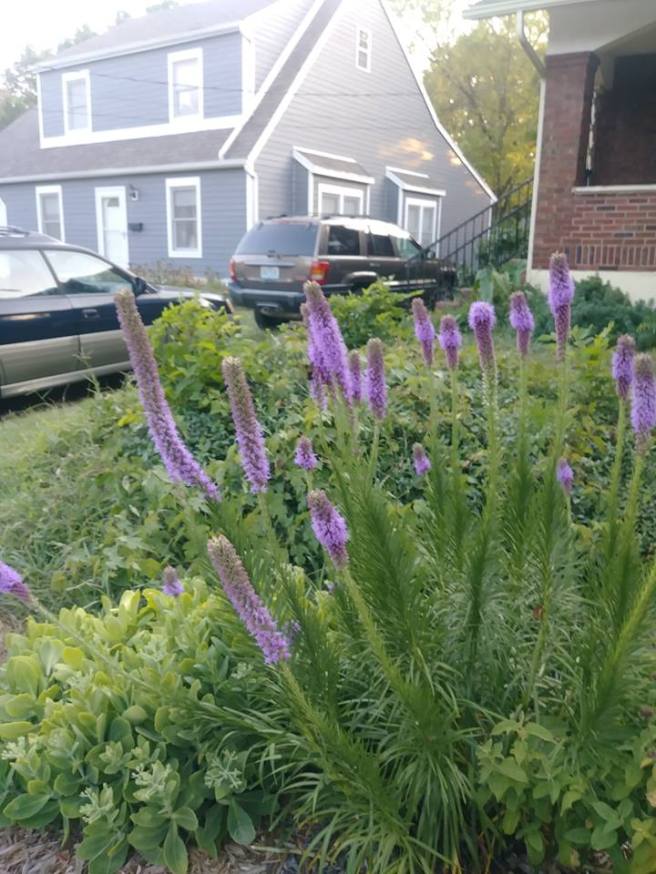
Liatris pycnostachya “gayfeather”, “prairie blazing star”
Asteraceae
One of the iconic wildflowers in Missouri, seen here being pollinated by a Hemaris hummingbird moth.
CC value=6. Perennial, stems 50-150 cm, mod to densely pubescent with short, curled hairs, may be glabrous toward base.
Basal and low stem leaves are mostly short-petiolate, 8-40 cm x 3-13 mm, linear or narrowly oblanceolate, glabrous to densely short-hairy, green, 3-5 main veins; stem leaves mostly sessile, 1.5-15 cm, linear.
Flower heads are densely spaced (axis mostly not visible), sessile or with stalks 1 mm long, and 1 basal bract.
Involucral bracts are broadly lanceolate to oblong-lanceolate, tapered to long. Bract tips are sharply pointed spreading or recurved.
Found on prairies, fens, glade seeps and roadsides.
(Hybrid MOFEP/Park Service Fire Ecology Manual 2018)