Cultural and technical features of chestnut production in Türkiye

Introduction

Our reason for crossing the Bosphorous was to see how the Turkish people grow tree crops, particularly chestnuts. The trip was partially inspired by this article. People in Anatolia have been tending chestnuts far longer time than the current iteration of chestnut farming in the US. Similar to our trips to Italy, Kazakhstan and Kyrgyzstan, we planned our itinerary based on a few hunches, and a lot of curiosity. The trip happened against a cultural background that included Danilo Coretllino’s  Chestnut, Porcini and Rosemary Risotto recipe, Jonathan Katz’s version of Lamb and Chestnut stew, targeted ads from our friends at the amazing Perennial Crops Nursery, amusing headlines around the 2024 Conkers Controversy, and competing ideas of the best ways to cure chestnuts for flavor and nutrition. We flew into and out of Istanbul from Cincinnati.

Because some of my readers are permaculture people, I must make a comment about Turkish home gardens. We saw these in villages and cities that we passed through, including between new high rise apartment buildings, tiny cottages, and every scale in between. In full sun, people grew pole bean, hot peppers, and huge green pumpkin-esque squash with deep orange flesh. Those winter squash were thick-walled monsters. I think you can buy these under the name Adapazari a type of blue pumpkin, species Cuburbita maxima. In larger home gardens and small alley cropping settings, we saw at least several kind of collard or tree kale (Brassica oleracea var. acephala) being grown, sometimes several acres at a time, usually under and between walnuts. In most villages each yard has at least three fruit trees. Short fruit or hazel trees in these home gardens would usually get pruned so that the first branches would be over my head, high enough to allow more light down to the annual crops. In the yard of the Plane Tree Mosque, there were many hot peppers being grown. They had left a spruce tree growing amidst the peppers, and it too was pruned up quite high so as to successfully reduce light competition.

Specifically for my Turkish friends, I want to prelude the rest of the story with a horticultural reflection on an agricultural struggle that they’re figuring out.  Türkiye’s gall wasp woes are new, and well documented. Introducing a parasitoid wasp with high host fidelity to control gall wasp impact has been proposed. Fighting monsters with monsters makes a lot of people nervous, so I suggest reading the article linked above before you make up your mind. Grafting newly developed cultivars into an existing orchard is another way to support yields despite pest pressure.. Our fruit and nut aficionado friend in Trabzon, Omer Selim, suggested the cultivar “Ertan”. I think he described Ertan as a 3:1 Sativa:Mollisima with good size, flavor, production as well as strong blight and gall wasp resistance. Here is a paper documenting the gall wasp resistance of Ertan and other promising cultivars. These are two tactics that I imagine could form the basis of an integrated pest management (IPM) strategy. Getting permission to release this second wasp, and getting access to the gall wasp resistant scionwood, are solvable problems I think. Whether or not these are desirable tactics to be deployed in Türkiye is a decision for Turkish farmers, not American farmers.

With those findings stated and cited, let’s get into the stories. The first is what I’ll call the Chestnut UBI in Bursa. Chestnut honey was a major headline. There is also the current center of Turkish chestnut production in Aydin, where we saw 30,000 acres of contiguous chestnut orchard being harvested. A lot could be said about our observations of Turkish hazelnuts, which seem to be analogous to how corn is treated by US agribusiness, but that is for another time. I will treat each topic here as separate, even though these topics are connected in many ways.

Chestnut UBI in Bursa

Everyone in-country, when hearing that we wanted to experience chestnut culture, said “Go to Bursa!” Street vendors would say this in Istanbul, as they served us charcoal-roasted chestnuts in front of every major mosque and tourist attraction. Chestnut translates to “kestane” in Turkish. There are normally annual chestnut festivals in Beydağ, Sinop and Bursa. Ultimately most of these events did not occur in 2024, though we missed one in Sinop. Bursa used to be the top-producing chestnut producing region, and is still arguably the cultural capital of chestnuts. However, we were told that a combined assault of chestnut gall wasp and blight had killed a whopping 80% of the trees in Bursa, including the famous “1000 Year Old Chestnut Tree” nearby.

Why is Bursa the chestnut cultural capital of the country? That is a *very* interesting tale involving chestnuts, religion and politics. Once upon a time, one of the Ottoman Sultans had a mosque built in the Tophane district of Bursa. It is the one now known as Kavakli Cami. An old man came and, without asking permission or receiving command, and planted a plane tree in front of the mosque. The Sultan was surprised and very pleased when he saw the plane tree growing. So, the Sultan asked his staff to find the person who planted the plane tree, and bring him in for a royal audience. The staffers dutifully found the old man who had planted the plane tree, and invited him to the palace. The old man hobbled in, leaning on his stick. The Sultan said “Grandfather, throw your stick in the air. Say aloud what your heart desires, before the stick falls to the ground. Whatever you wish, I will grant it- what do I care? I love that tree!” The old man bowed. Then, with surprising force, he threw the stick in the air and shouted “May Bursa chestnuts be a foundation!” The stick clattered to the ground. “In other words sire, I wish for everyone to eat Bursa chestnuts for free.” The Sultan agreed that from this day forth, the Ottomans would uphold this: Bursa chestnuts were free for the common folk. A foundation for the people. From that day forth, some people say Bursa’s chestnuts might be best. And the great plane tree is growing there still.

I don’t speak Turkish and the word foundation was unclear to me. I put on my “Nietzschian etymology detective hat”. Foundation is translated from the modern Turkish word “vakif”, from the Ottoman Turkish وقف (vakıf, vakf), from Arabic وَقْف (waqf). And waqf has a *very specific* meaning. Arabic-speaking and Muslim friends, chime in here. In Islam, a waqf is an endowment of land given for religious or charitable purposes. In this case the waqf is the north-facing slope of Uludağ, the ancient Mysian or Bithynian Olympus. Uludağ is the highest mountain in Türkiye, and overlooks the former Ottoman Empire capitol where we were staying. Before the yields were negatively impacted by blight and gall wasp, chestnuts were harvested for free by peasants. Some they undoubtedly ate themselves. These nuts had also been the origin of the chestnuts for Istanbul’s food cart operators. That’s an interesting food system, is it not? I have been thinking of the chestnut waqf as a “Chestnut UBI” for Bursa residents, once upon a time. So we went to Bursa to learn what more we could about this.

After buying chestnut candies in Bursa, and then later more chestnut chocolate confections in a shopping area on the way to Şirince from Bursa, we sought out the Kavaklı Cami- the Plane Tree Mosque. The plane tree that the old man planted is still alive, but it has been struck by lightning, and just a shard of the original tree was left. There were a plethora of root sprouts.

We went inside the Plane Tree Mosque, but the imam was out. By finding the Plane Tree Mosque, we confirmed that its tree was different than the Inkaya Plane Tree in the next valley over. That one is 600+ years old and supposedly the largest tree in the country. We considered visiting it, but decided instead to climb Mount Uludağ.

We went to Uludağ Milli Parkı, the national park, poking around looking for chestnuts. We found ourselves surrounded by permaculture homesteads. More of the home garden pattern was observed. This looked like people tilling the ground under orchards with walk behind tractors, which we observed directly. In an area with limited rainfall, slow weed growth and high wildfire danger, this makes more sense than in Ohio, for letting precious rain soak into the ground. We saw a fair amount of intensive vegetable and melon production with bees, chickens, goats and ducks. This was reminiscent for us of the datchas above Almaty, Kazakhstan, except unlike that place, this homestead area was obviously being expanded into, and the newer houses generally followed suit with the area’s traditional homesteading. There are many pre-fab cabin kits that are replacing the tumbled-down rock wall houses in this district… Our rental sedan could not reach the upper slopes. The gondola to the top, that skiers and hikers typically take, was down for maintenance. There were multiple roadside stands selling chestnut honey on the lower slopes, and it tasted good but obviously had wildflowers in the flavor profile as well as kestane.

Chestnut Honey

There were beekeepers with roadside stands on Uludağ. We sampled some and it was great. Because everyone always asks, chestnut honey is not honey with chestnuts floating in it! It is like clover or orange blossom honey- a single origin nectar source was used by the honeybees in the production of the honey. Bee keepers move the hives to where the flowers are blooming, for chestnut honey you move the hives into the forest or orchard while the chestnut trees are blooming. Yes, chestnuts can completely pollinate via wind, without insect pollinators. But if you get honeybees involved, you can produce honey with a distinct aroma and taste profile that has specific health benefits. You can speed-read this very interesting paper to understand why chestnut honey’s health benefits excite me. Maybe chestnut honey is better for wound healing than Manuka honey!

Şile is a town on the coast of the Black Sea, and the chestnut honey produced there is renowned. Allegedly there is also special chestnut honey vinegar produced there. We found the chestnut honey, but no chestnut honey vinegar, though we tasted generic honey vinegar. That damn magical acetic acid completely eluded us, but I assume you’d be able to taste the kestane in it. We did not get to visit Bartin, but Bartin chestnut honey is also supposed to be quite good.

Aydin

Beydağ and the surrounding area grows 76% of Türkiye’s chestnuts now, at an altitude of 600 to 1000 meters. We visited our good friends Çetin and Hüseyin Camurcu at HC Spice in Beydağ. We hope to work with them more in the future. They gave us a grand tour! They sell 4,400,000 lb of chestnuts per year out of quite a large processing facility and a contiguous mountainside chestnut growing district. Bursa used to be the chestnut capital, but no longer. It’s here.

The HC Spice facility processes bay laurel, sweet chestnut, figs and oregano. It is a humongous place. They harvest and burn the invasive English ivy from their orchard to dry their bay laurel on the branch, which we found particularly noteworthy. For many people, including myself, the notion of “invasive plant medicine” is a little bit woowoo and impractical, but viewed through an asset-based lens these folks have found an agriculture outlet for one invasive species, and this use seemed to be keeping the population in check. It sounds like most of the ivy is harvested off the trunks of the trees and the ground, on an annual basis. Is that alley cropping or forest farming?! The USDA’s schema did not prepare me for this.

We drove the valley and up into the mountains where the chestnuts grow. Some people in Türkiye referred to chestnuts as “the bread of the mountains”. In the valley we observed mostly cotton, greenhouses, landscaping horticulture, olive, pomegranate and fig. We saw cotton alley cropping between new olive orchards, multi-species orchards of walnut/olive and olive/fig. As we snaked up the steep mountainside, we entered an anthropogenic forest. It seemed like a primeval yet intensively managed orchard. I think any student of sustainable agriculture would find meditating in this type of setting to be extremely edifying, as we did. The higher we went, everything shaded into chestnut, cherry, fig and oak- majority chestnut. Up the mountain we climbed, past work gangs of people climbing the trees and beating the branches. Their counterparts on the ground were picking the ground clean, so the team could pass through the orchard in one wave and be finished with it. Other workers carried bags of chestnuts and burs away. Consistently they’d pile up the chestnuts on tarps 4 or 5 feet high, and cover in fern leaves that were harvested from the orchard floor to keep the nuts from desiccating. The piles were left for 20-25 days, we were told. Our Turkish hosts surprised us to no end with their methods. They said this in-field storage results in bigger, sweeter, uniformly ripened nuts. The bad ones mold out and are easy to discard… they put mini sprinklers on top of these piles. To compare to how we do it in Ohio, this is sort of like the step that Route 9 takes with their high humidity lettuce cooler.

We learned that they use prescribed fire in the chestnut understory. They burn the grass off in February or March. Burning off the thatch makes their Herculean task of weed whipping the orchard much easier.

The view from the mid-slope was beautiful. The town and its reservoir spread out below us. The reservoir was scarily near empty, compared to 5 years ago. Just not enough rain. I asked about mushrooms under the trees and they said yes but not many on dry years. We did see what I think were Slippery Jacks 🤤 Far above were a series of bald nobs, which they tell me paraglider pilots launch from. Guess I’m coming back! ⛰️🌰🌳🌬🪂 Hopefully I can bring back a bunch of chestnut flour, made to our specifications by HC Spice.

Chris noted some details in here that are worth sharing. The worker who uses a stick they pay 4000 Lira per day because it’s dangerous, you have to get up in the tree. The workers who pick on the ground get 2,000 Mira per day 8-hour days. Our hosts said maybe 500 farmers sell to the co-op. They hire many workers to bring in the harvest. I don’t yet have a clear picture about how many trees or acres each farmer manages. What’s the average farm size? I don’t know.

Conclusion

We did many things and visited many places not reported in this summary. Hopefully our permaculture friends, our friends in Türkiye, our consulting forestry clients, and our allies in the US chestnut industry will find these remarks useful. Would you like to know more? Feel free to reach out to Southern Ohio Chestnut Company or Paradise Ecological Services to discuss further.

QGIS and Avenza: a how-to guide for making maps

tl;dr: if you find yourself in the position of wanting to teach yourself to make and use maps, I invite you to check out my DIY guide: “QGIS and Avenza: using free mapping software for land management planning“. If you want to contribute to the document’s further development, I am happy to include you as a commenter.


With the help of some friends, I taught myself to digitally create maps to the standard that is accepted by the forestry profession. I like use free, open-source software, in this case QGIS. This avoid the $500 annual commercial licensing fee of ArcGIS, and also lets me participate in an idealistic software movement that strives to make information technology a purely liberatory factor in human existence.

I still have a lot to learn. For instance, I don’t know any of the Python programming language. Knowing Python would greatly expand the range of my possible uses for QGIS. However! If you need to make maps to help plan the sustainable management of farmland or forestland, it has been my experience thus far that you don’t need to know Python. You just need to read my guide and go mess around with it. I offer this to you as a free resource. If you find the guide useful, you could practice reciprocity by directing potential clients, patrons, or students my way. You could also just pay the blessing forward to other worthy recipients.

In closing, I want to offer a quote from Ivan Illich, in his 1971 book “Deschooling Society”: “Most learning is not the result of instruction. It is rather the result of unhampered participation in a meaningful setting. Most people learn best by being “with it,” yet school makes them identify their personal, cognitive growth with elaborate planning and manipulation.” Go out on the land and try this stuff out with other stakeholders!

So you want to get your Red Card

Working at Woodcock Nature Preserve, I have been teaching about prescribed fire since 2019. One question comes up every year: “How can I get my Red Card?” I have my Red Card and can answer from my experience. But what is a Red Card, and what’s it have to do with Rx fire in Ohio? “Red Card” is the colloquial term for the Incident Qualification Card. It qualifies you to work in FEMA’s Incident Management System (ICS), making it legal for agencies to employ you in response to national emergencies- including wildfires on public land, but also floods and similar situations. Even though prescribed fire and wildland firefighting are different, both are connected. You can learn a lot about fire behavior on a wildfire, and that learning can be applied to conducting prescribed fire. You can learn about protecting human life and property, as well as natural and cultural resources, through wildfire work. Also, if you want to do Rx fire in Ohio for other land owners, you will need to get licensed. Having some wildland experience under your belt supports your application to take the Ohio Certified Prescribed Fire Manager class, which ODNR puts on every two years. I did all of this, and can tell you how you might do it too. I took some free online classes, printed my certificates of completion, enrolled in the Ohio Fire Academy’s class for $95 in late February/early March. In 2017 I had a seasonal job for the National Park Service in Missouri, they red carded me, and I went on a fire that summer. When I moved back to Ohio, I applied to be an AD (administratively determined employee) through the Wayne National Forest- they issue Red Cards for their ADs. I have been on three fire assignments through them since. If you’re reading this, your route might look similar but a little different. Here is more information, to help you along your way.

Online and In-Person Classes

National Wildfire Coordinating Group requires the following classes, most of which (but not all) are available to take for free online, to become a Firefighter Type 2:

ICS-100, Introduction to ICS (online)

S-110, Basic Wildland Fire Orientation (online)

L-180, Human Factors in the Wildland Fire Service (online or in person)

S-130, Firefighter Training (in person)

S-190, Introduction to Wildland Fire Behavior (online or in person)

IS-700, NIMS: An Introduction (online)

Work Capacity Test (in person): walk 3 miles w/ a 45 lb weight vest in 45 minutes or less

You need to save a digital copy, and a couple of physical copies, of the completion certificate for each class. After your first year, you have to take the annual refresher:

RT-130, Wildland Fire Safety Training Annual Refresher (WFSTAR) *

To fulfill all of the above class requirements, one way is to take the all-inclusive class at Hocking College in Nelsonville, OH. Their forest management program offers a class (for college credit) that fulfills all of those NWCG requirements: FOR-2221 Wildland & Prescribed Fire (3 Credits). Mike Broecker is a good teacher and a good guy. This class goes for 8 weeks, in 2023 went from the second week of October through the first week of December. At time of writing I checked in with Hocking College admissions about the cost to take just this class (it’s cheaper per credit hour, the more credit hours you take). As a stand-alone class it was $1,117 in 2023. The benefits of this course include not just meeting your Red Card requirements, but also getting additional learning opportunities with prescribed burning in the college’s forest and prairie, lectures from an expert, and a foot in the door with prescribed fire work. 

If you are in Ohio but Hocking College isn’t an option for you, there is a second in-person pathway- through the Ohio Fire Academy. You would sign up to take their class called “Interagency Wildfire (S-190/S-130/L-180)”. Interagency Wildfire has historically been offered in two formats: a week-long class held Monday-Friday (was Oct. 2 – 6 in 2023), OR a weekend class held over three weekends (was Feb. 25 – March 11 in 2023). The fee for that has been $95 historically. You can do the free online courses and print the certificates of completion and bring those in, before the class.

Another resource for taking the classes, for people living in Ohio, is the Mid-Atlantic Wildland Firefighting Academy. This is a one week event, usually in the second week of June, in western Maryland. There are a ton of different classes offered, including what you need to get your FFT2. This one-week event is also an opportunity for people who have already gotten their Red Card, with many classes useful for people who already have their FFT2. For instance, I took S-211 Portable Pumps and Water Use after I already had my Red Card. For beginners, if you take ICS-100, L-180, S-190, IS-700 online, you can take S-130 and the WCT in-person at the Mid-Atlantic Wildland Firefighting Academy. 2023 prices were $320, or $580 with food and housing.

Applying for Red Card

After you take the classes, you can apply to be an administratively determined (AD) employee of a firefighting agency. The Wayne National Forest and ODNR Division of Forestry both have AD programs and deploy hand crews and engines. You could apply to either. If you are accepted they will issue you a Red Card. If they issue you a Red Card, you agree to be on call for them, and to have your bags packed and be available with less than 1 day notice to be gone for 18 days at least. I would suggest making time to go out as an AD during peak wildfire season, which historically has been July, August and/or September. AD’s tend to get called out frequently when the national Preparedness Level (PL) is at 5. You can learn about and monitor the PL here. To view the website where you can request a change in your availability status, visit our region’s dispatch website, the Mid-Atlantic Fire Compact.

Agroforester’s Tree and Log Measuring Stick with Cruising Prism

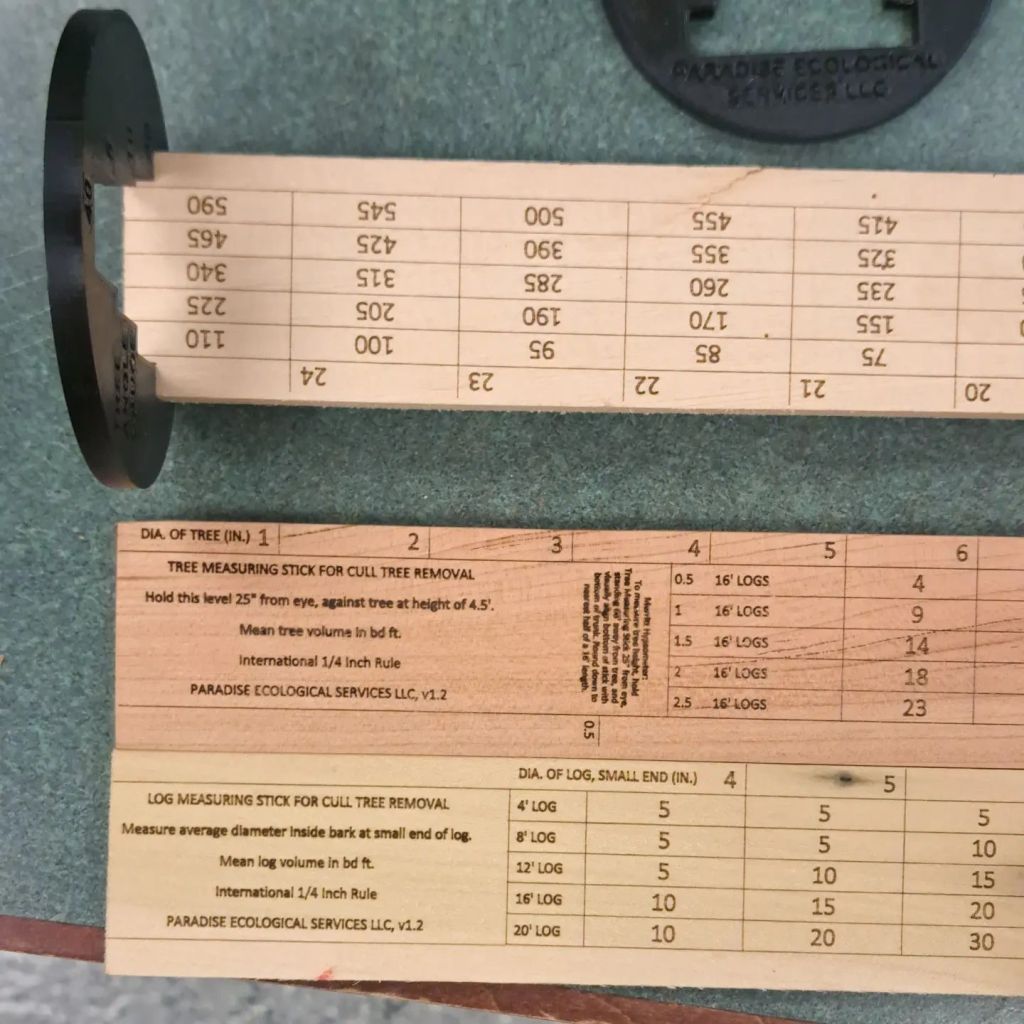
I have a tool to share. It is used in a similar way as the classic forestry tools known as the Biltmore stick and the cruising prism. But it is used for different purposes. My adaptations are designed with other agroforesters in mind, as well as consulting forestry clients managing their private non-industrial forest.


These tools are for people who do forest stand improvement, & for whatever reason want to measure “waste wood” from these treatments. For agroforesters pursuing forest farming, this tool is handy. You might find yourself thinning overstocked oak woodlands in order to better cultivate sun-adapted NTFP herbs, such as black cohosh. Cutting trees out without selling to a logger means cutting small diameter trees to make growing space for healthy larger trees. These cull trees may be suppressed, they may be of a species that isn’t part of the plan, or maybe there are just too many trees and competition between them has grown fierce. Either way, logs from this light-on-the-land management have many uses. Timber-framing elements are useful in green building, with the smaller logs useful for mushroom bolts, and the even smaller poles useful for various crafts and as fuelwood.


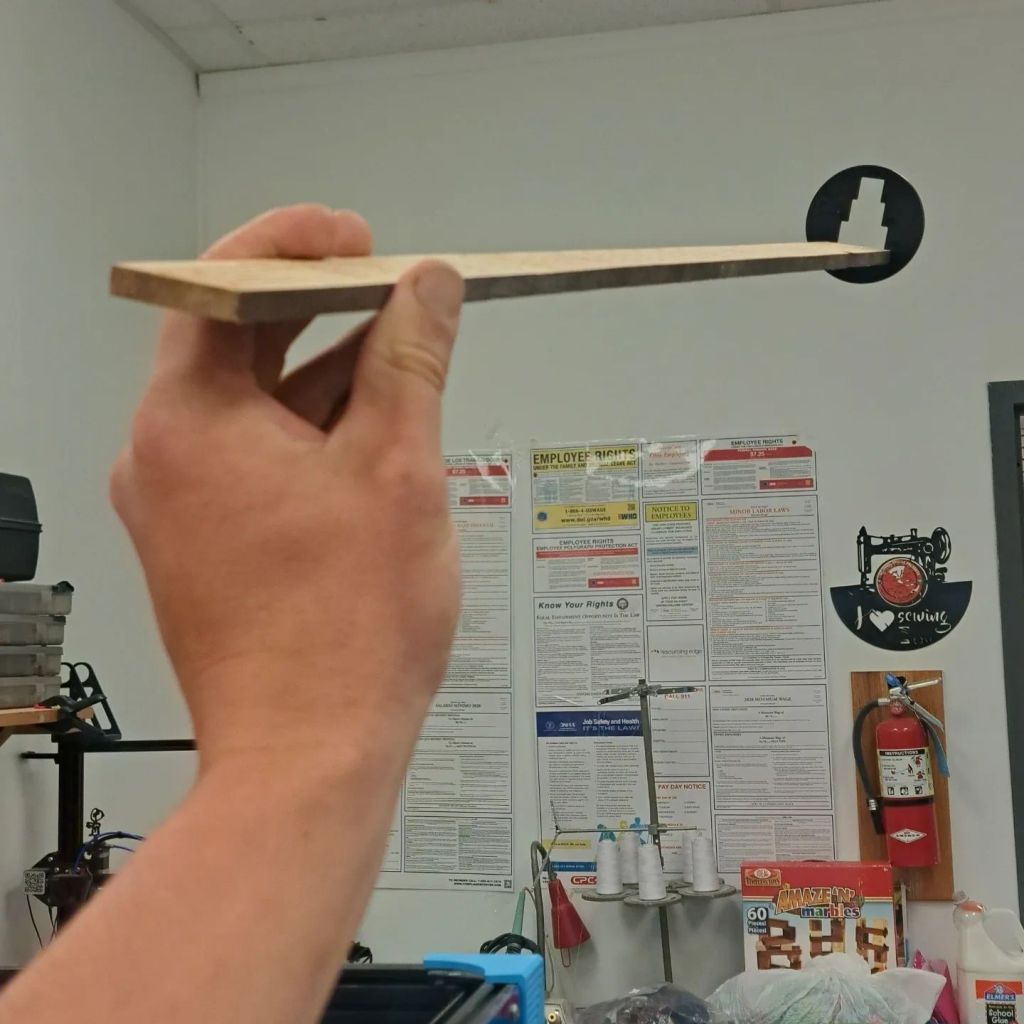
This was manufactured by me and friends working together at the Athens Makerspace, with design sessions happening in our homes. Special thanks to Asa Peller (A-STUDIO) and Henry Hellbusch, as well as Pauline Phillips (our Makerspace guardian angel). It is because of these specialized uses for small roundwood that we started this project, because now the board foot scale on both sides of the measuring stick goes down to half a 16′ sawlog, and uses the International 1/4 Rule- rather than Doyle Rule. Thus we avoid underestimating timber volume from the narrower & shorter logs, which is a classic problem with tree measuring sticks. Because we didn’t need our stick to be 36″ long to measure the diameter of small roundwood, we made it 25″ long. This allows us to attach a 3-D printed angle gauge (a type of crusing prism), for variable radius plot cruising.

The 25″ length of the stick is the same distance that the angle gauge must be held from one’s eye. Thus you can hold the stick up to your face and look through the angle gauge, at the precisely correct distance from your face for conducting forest inventory.

I hope users will find adapting and combining these inventory tools to be very useful. If you would like to purchase one of these, please reach out to me through this website.


Badger Johnson for Paradise Ecological Services LLC

Defending (some of) Ohio’s Beech Trees

Author Note: this article will be updated with new information as it comes in.


My mom sent me this cool article about pollarded beech trees in Romania. Romanian beech is Fagus sylvatica, rather than the Fagus grandifolia that grows around Athens County. People in Romania use pollarded beech roundwood as a building material. Ohio settlers were accustomed to using beech roundwood to timber-frame large barns. Today, those beech barn timbers get re-used for building modern houses. Romanians use the tiny but nutritious and abundant beech nuts for fattening up pigs. Farms in Appalachian Ohio often have beech as an increasingly dominant component of their woodlot. Maybe farms around here can learn from Romania, and make efficient commercial use of beech trees?

Building houses and barns with beech roundwood may take special consideration. A friend who builds timber framed houses around here had this to say about American beech wood: “Strength-wise it comes close to hickory but apparently beech is very hard to dry properly. It checks and twists and shrinks a ton. Folks recommend using it higher up in the frame, typically only in unfinished spaces like barns. So, cutting in winter when it’s already at its dries would make sense and then letting it air dry for awhile before use, probably stickered and strapped. Because it also reabsorbs moisture more than most woods, it’s critical to seal the end grain when drying.” As this friend points out, not all woods are equally useful in all parts of a timber-framed house. But since most private forestland is lease hunted, retaining beech to fatten up wildlife could be viewed as an additional economic benefit of choosing to protect beech from BLD. For the moment,, American beech seedlings and saplings come up thickly under overstory oaks and hickories. Later I’ll describe how that can sometimes be a problem. Pollarding small sawtimber sized beech stems for later commercial harvest of building materials may result in smaller, more vigorously growing stems. Given the limitations on its use, it would take a particular kind of highly motivated landowner and homebuilder to realize commercial value from beech roundwood. If you’re that person, I want to tell you about a new challenge to consider in 2024. A disease is spreading across Ohio that is severely damaging this species, and it’s almost at our doorstep. Treatment options are available, fortunately.

Beech Leaf Disease  (BLF) is a potentially fatal tree disease caused by nematodes from Eurasia. Last year, BLF made it as far south as Muskingum County. That means only Morgan County stands between Solid Ground Farm and these nasty little worms. It may be here within this calendar year. If we think beech can be valuable, and I say that rhetorically because it’s obviously valuable, what should we do to manage it when confronted with high disease pressure?

An ounce of prevention is worth a pound of cure. Our hypothetical land owner could establish a stand where there’s a focus on beech trees, and work with them long term. In 2022, Ohio researchers shared encouraging results from a five-year research project. Using an off the shelf type of fertilizer, applied twice as a soil drench or soil injection to soil beneath small diameter American beech stems, the beech tree’s immune system was bolstered enough so that the tree was able to fight off the BLF. Soil injection is regularly conducted by certified arborists. If you are stewarding a forest with beech trees and you have an end use in mind for the nuts and wood, we might need to engage in a little “target hardening” if we’re going to partake of the beech’s gifts into the future. I like this fertilizer option, because we’re not injecting a tree with pesticide, we’re simply nourishing it and letting it do its thing.

The product that was used in the study was PolyPhosphite 30, which bills itself as “The Only True Long Lasting Potassium PolyPhosphite Fertilizer”.

Here are two written resources furthering detailing this Integrated Pest Management option:

Beech Leaf Disease Management Options

Beech leaf disease treatment

Additional options for spot treatment of BLD exist. Bio-SAR Fungicide/Nematicide is a certified organic bio-stimulant product made of Chitosan that has been successful. A synthetic alternative that has also shown effective nematode and symptom reduction is fluopyram, a FRAC Group 7 fungicide. Broadform, a fluopyram plus trifloxystrobin product labeled for ornamental and shade trees, is typically the synthetic product used and has shown good efficacy. It’s good to have different options.

How is American beech doing in southeast Ohio, immediately prior to BLD’s arrival in Athens County? A useful website for looking at that question, which uses Forest Inventory and Analysis data, is maintained by the American Hardwood Export Council. “Forest Inventory Analysis (FIA) data shows U.S. beech growing stock is 348 million m3, 2.6% of total U.S. hardwood growing stock. U.S. beech is growing 4.5 million m3 per year while the harvest is 3.8 million m3 per year. The net volume (after harvest) is increasing 0.7 million m3 each year.” As of 1/31/24, their website was showing that in a region encompassing Athens, Hocking, Meigs, Morgan, Perry, Vinton and Washington Counties, there is 78,000 m3 of American beech that grows every year, and 71,000 m3 of American beech that is harvested each year, for a net increase of 7,000 m3 increase across these 7 counties each year. I’m guessing that number will go down and be reversed after BLD arrives.

According to recent historic trends in American beech growth, how do foresters around here tend to view this species? Beech trees are slowly accumulating in the midstory of many oak and hickory stands, and it looks like beech would replace a greater share of the current overstory, via ecological succession, in the absence of prescribed fire, thinning, or BLD. But that outcome seems in question, now. For people tending the woods, furnishing an increasing amount of oak-hickory timber and nuts is perhaps the most common goal on high, dry sites. In pursuit of that goal, beech dominance of the midstory is widely regarded as problematic. Maybe with the advent of BLD, concerns of beech dominance in oak hickory stands will diminish without any effort at mid-story removal. Maybe some forest managers will consider setting a goal of retaining some healthy beech trees, instead of ignoring or discouraging these from growing. Hopefully this happens on at least a small subsection of site types, where this species naturally grows productively.

Carving out a stand here and there for beech to become co-dominant might be easy, even with the advent of BLD. Maybe this goal doesn’t have to conflict with oak-hickory management, at least in southeast Ohio- even though the oak wants fire, and the beech does not want fire, these mutually contradictory management strategies could be spatially segregated. Our location in Athens is almost exactly in the center of beech’s current natural range. To quote Silvics of North America Volume 2: “At latitudes in the middle of its range… beech is more abundant on the cooler and moister northern slopes than on the southern slopes.” In contrast, oaks and hickories thrive on a bit of deprivation, having a competitive edge on drier sites. I have seen service foresters set aside the driest 1/3 of a landscape to manage oak and hickory, variously calling these sites “oaky dokey”, generally with an Acid Mixed Sedimentary Upland ecological site description. One could manage those sites with fire, while excluding fire and fertilizing beeches on some portion of the shaded side of the hill, thereby supporting habitat diversity and beta-level species diversity.

To dig deeper into this topic, of dry sites with shallow soil being conducive to commercial management of white oaks, check out Trystan Harpold’s 2022 master’s thesis: “Uneven-Aged Management in the Missouri Ozarks: Effects of Site Conditions, Stand Density, and Prior Populations on Oak Regeneration“. Soils are overall more mesic in southeast Ohio than in the Missouri Ozarks, so attempting the same management strategy as Harpold wrote about without the addition of prescribed fire may get different results.

I am not arguing that this fire-excluded, phosphite fertilization of beech is commercially viable across entire stands. But some healthy beech stems could probably be retained for wildlife value, and builders who like using beech lumber in their projects may be motivated to try this. If I dare to speculate, maybe after two treatments with phosphite fertilizer have been applied as a prophylactic against BLD, pollarding some beech stems (as is done in Romania) may be something worth pursuing for such builders.