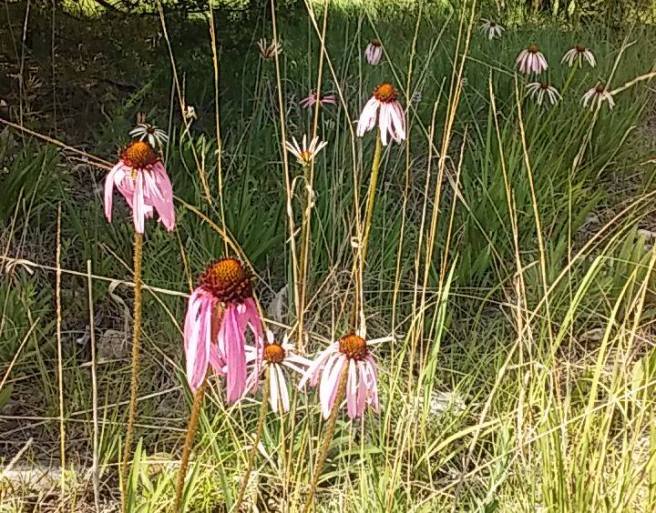
Echinacea simulata

Echinacea simulata
Echinacea simulata, “Glade Coneflower” or “Wavy-leaf Purple Coneflower”
Asteraceae
Picture taken along the driveway at Echo State Park in Missouri, formerly Camp Zoey.
 
Not ordinarily one used for medicine (others in genus used for acute challenges to immune system, during those hours when you realize you need to immediately take rest if you’re gonna make it out of a stressful week without getting sick), but I imagine it could work similarly. Many commercial root diggers have assumed this too, and sold this species as E. purpurea. 
 
Perennial. Stems (40)60-120 cm tall, sparsely to mod pubescent with  stiff, minutely pustular-based hairs.
Alternate leaves, margins entire and usually pubescent with loosely appressed hairs. Leaf surfaces mod to densely pubescent with stiff, mostly spreading, minutely pustular-based hairs. Mod to strongly roughened, 3(5) main veins. Basal leaves 8-35 cm long; stem lvs 4-25 cm long.
 
Yellow pollen. Pale pink to purplish pink ray flowers
 
Found on dolomite glades, tops of bluffs, savannas, woodlands.
 
Compare to Rudbeckia missouriensis (petioles are very fuzzy rather than having a few scattered hairs) and Coreopsis lanceolate (one main vein, leaf edge slightly translucent)
 
Very similar species to Echinacea pallida (pale purple coneflower), CC=7, which in Missouri is found mostly in prairies in southwest part of the state; pollen white, ray flowers paler.
 
(Hybrid MOFEP/Park Service Fire Ecology Manual)

Desmanthus illinoiensis

Desmanthus illinoiensis, “Illinois bundleflower”
Fabaceae

Over the past few years I’ve picked up quite a bit of lore about this plant, and I was happy to finally notice it on the roadside yesterday!

A common plant in many areas of the south central and Midwestern US. It can often be found growing on the sides of roads, needing full sun and ample moisture during its short growing season. USDA Zones 5-8 are recommended for outside cultivation (Wikipedia).

People have had good luck interesting it into existing warm season pastures (Dovel, Hussey, Holt 1990). Bundleflower can contribute protein in summer pastures in the Midwest (Fischbach et al. 2005). In a study comparing the possibility of native prairie legumes, sheep found Illinois bundleflower extremely palatable (Sheaffer, Wyse, Ehlke 2009). Illinois bundleflower also appears to have the greatest potential as a forage species among 15 species of native legumes evaluated for forage yield, quality, and seed production (McGraw et al. 2004).

Root bark of D. illinoensis has been found to contain N,N-DMT, NMT, N-hydroxy-N-methyltryptamine, 2-hydroxy-N-methyltryptamine, and gramine (toxic). The root bark is mixed with a native source of beta-Carbolines (e.g., passion flower in North America) to produce a hallucinogenic drink called prairiehuasca, which is an analog of the shamanic brew ayahuasca.

At one time the Land Institute in Salina, Kansas looked into using its seed as breeding stock for a novel, perennial, temperate, leguminous human food but have dropped it and are evaluating other leads.

(Wikipedia)