Our goals for the trip were simple. We wanted to do some Samhain-esque stuff, a chestnut party and see social movements in Barcelona, we wanted to go hiking and see cooperatives in the Basque Country, and we wanted to experience the Cork and Pork silvopastures East of Lisbon- particularly one that produces a lot of acorn-derived bread flour. We are always looking for ways to improve our chestnut-based agroforestry- the honey and the porcini were both ideas that came from traveling to chestnut growers and festivals in Italy and Turkey. For Rising Appalachia, they wanted to meet people who cared for oak trees as we do. The forest products facility Rising Appalachia is standing up will be able to process so many acorns that seeing an acorn culture was top of their list.
Day 1, Spain and Portugal
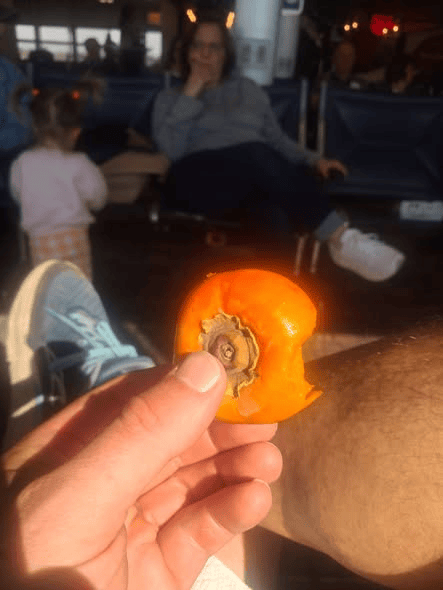
A Christian Science nurse is sitting across from me at the gate. Her name is Carol. She is talking about this and that to a rapt (if captive) audience. She claims that she and her husband have worked at their marriage over the years, and are in a very happy place with it right now. She has dressed in a hand stitched outfit with a vibrant, colorful palette. Because she’s a missionary, it’s unclear to her listeners whether her tailors are from Columbus, or Zimbabwe. The yap session is interrupted when the man next to me begins coughing violently. Carol sympathetically informs him that he must eat a persimmon, and that really we all had better have one! “You know I keep that thing on me” as she pulls out a bag of fruit. Carol promises that the persimmon will clear up this man’s cough… Sure, I say, I’ll take one. After all, my NAFEX friends in West Virginia are just crazy about persimmons. She nods knowingly, handing me a small, ripe Diospyros kaki. This is how I came to have juice dripping from my lips, as I write our introduction.
For vacation this year, some friends and I are going to Iberia. As is our way, we’re checking out tree crops and food culture. This trip is Chris and I’s third investigation into Sweet Chestnut, Castanea sativa, with trips to Italy and Turkey in 2023 & 2024. This time, we’re traveling with Weston and Molly Jo. They are reeeeeally into acorn flour and acorn bread.
Molly Jo and Weston’s passion for acorns is so intense that they’re building a dedicated acorn processing facility. Acorns usually have bitter tannins in them, so they are often soaked in water to reduce the bitterness. Equipment for shelling and soaking Ohio acorns has been acquired. They’ll also be pressing hickory nuts for cooking oil. The equipment is large, robust, and it cost a pretty penny. Foraging nuts from the forest for fun, food and profit will be much, much easier now. If you live in Appalachian Ohio, plan a day next fall to gather nuts to take to their processing facility- and community space!- once their place is up and running.
Chris and I tripping with those acorn enthusiasts means we are expanding our investigations beyond chestnuts, to include oak trees in Iberia- and the people who tend oak trees. We’ll be getting acquainted with Cork Oak/Quercus suber. Cork Oak are tended as part of pig, acorn, grass and treebark silvopasture systems- called the Dehesa in Spain, or Montado in Portugal. The bark of this tree is where much of Europe’s wine corks come from. There will be more on that later… The Dehesa is also known around the world for producing jamón ibérico. The pigs frolick in the winter and get fat on acorns. Their meat is used to make this special salt-cured pork product. People say you can taste the acorns in the jamón ibérico. High-grade Jamón Ibérico is cured from 3 to 5 years. Chris and I hail from Cincinnati, which once had a huge pork processing industry. Allegedly the beginning of that industry was settlers raising pigs on acorns and hickory nuts, and shipping the extra pigs out of town. Before that, the forest was tended my indigenous people who used fire to help the oak and hickory trees proliferate, which in turn fed abundant game. Today game hunters like our friend Tyler Wortman tend the forest with similar goals.
Another oak species is grown in the Dehesa, the Holm Oak/Quercus ilex. The acorns on this one are sweet enough that people like to make flour from them. Additionally, Holm Oak roots form mycorrhizal relationships with black truffles (Tuber melanosporum). Lots of black truffles get harvested in the Dehesa. Because of our mycoforestry work growing King Bolete on the roots of Chinese Chestnut, this oak mycoforestry thing with truffles is pretty interesting to us.
I’m flying from Columbus to Dallas to Barcelona, and boy howdy that’s a long travel day. Columbus will soon have a whole new international terminal. Maybe someday soon this flight could have been a bit more direct. The airport lounge this morning was nice. The lounge in Dallas was even nicer, with a yoga room and Peloton and showers. Boarding the plane to Barcelona now- catch you tomorrow!
Day 2, Spain & Portugal
After a sleepless Red Eye from Dallas to Barcelona, I escape the airport and begin exploring on foot. I walk past the housing and anti-gentrification protesters. They are many. They have set up a tent encampment in Plaça de Catalunya in central Barcelona. Their demands revolve around affordable housing, lower rents, and an end to mass evictions. They will probably get energized by the festive atmosphere on October 31st. The encampment is mostly highschool and college age people, acting purely in solidarity with the successful student movements in France and Serbia, happening right now.
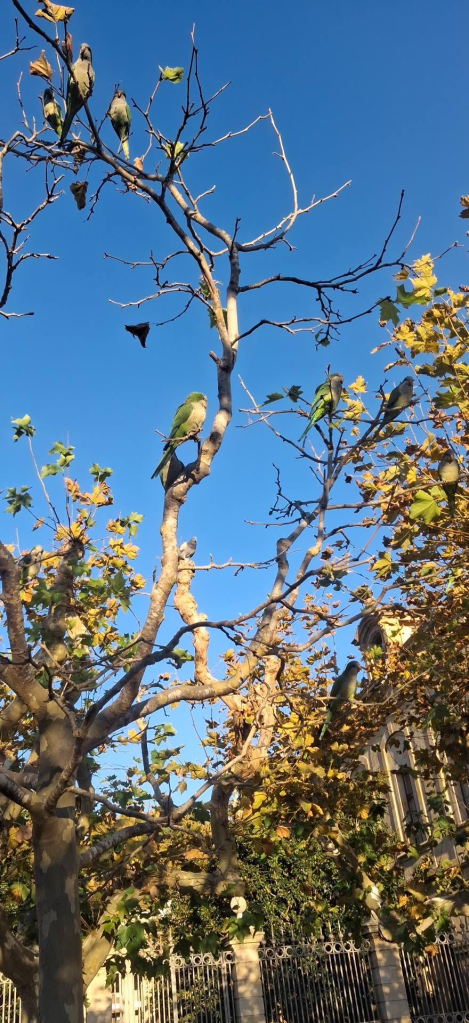
Overhead, there are bright green flocks of the small-statured Quaker Parrots. A few of these little South American newcomers got out of a pet store in 1975, and now there are 7,000 of them! They’re pretty unique among parrot species in that they build large, communal nests made of sticks, which helps them survive the winter. You can find similar communities of Quaker Parrots in Chicago, San Francisco and NYC as well. You can hear them up in the date palms, in the plane trees, having a great time and living large.
Chris, MaryKate, Saoirse, Ashley and Naomi went walking all over the city (after I napped). We saw many historical points of interest. Some monumental architecture was put in place for the World Fair, back in 1885, with a lot of Classical Pagan iconography. The Chariot of the Aurora/ Quàdriga de l’Aurora – is part of this monumental fountain/waterfall complex that is the cast iron sculpture that is at the highest point of the waterfall. Four golden-coloured horses pull a two-wheeled wagon with a Goddess at the reins. Additionally there is Cupid, Venus, Neptune, and a few other gods in attendance. It was the work of sculptor Rossend Nobas i Ballbé (1841-1891). Because I’m commenting on this kind of thing, I want to mention one of my favorite conspiracy theories. It is so colorful and stupid as to be entertaining, and it relates to some of these World’s Fair installations. It’s basically the normal Aliens built the Egyptian pyramids Serpent Mound/etc BS, except it’s turned against European architecture from the last few hundred years. There’s a feeling that since we often don’t build as much beautiful, monumental public architecture anymore, that any good looking stuff from 100 to 300 years ago must have built by a lost civilization  it’s a stupid rabbit hole but you can look up Mud Floods or the Tartarian Empire if you want to have a good laugh and lose a few brain cells. The point of pointing out that bizarre bit of historical revisionism is to plants seeds. We could build more cool stuff like The Chariot of the Aurora, and functional mass transit like they have here, but Americans would really need to believe in ourselves and organize to that end, for it to happen.
Aaaanyway, that whole Parc de la Ciutadella was enchanting, with Wild Dagga planted everywhere and tangerine trees loaded with fruit being prominent in the landscaping.
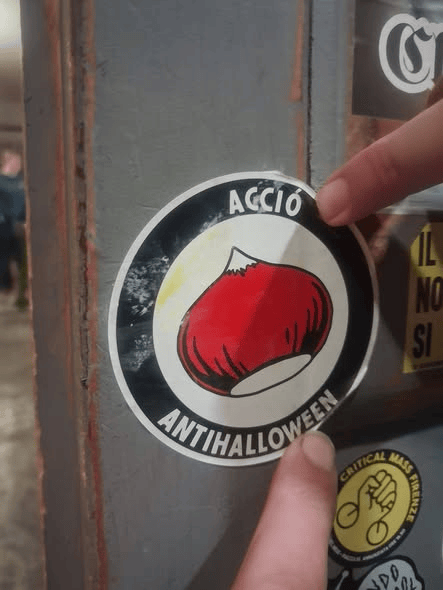
We ran into one of many “funny” Catalonia vs. Spain culture war issues, specifically as it relates to the Castanyada Festival. It involves the “Halloweenification” of this festival. Depending on who I talk to, there’s talking to your ancestors in the graveyard happening as part of Castanyada. But the Halloweenification of it is the introduction of horror elements and costumes. There’s a chain bakery/coffeeshop called 365 which promotes entirely hybridizing the festivals, calling it “Castaween”. There are supposedly grafitti stickers up around town that bare an image of a chestnut, with various slogans promoting a return to Catalonian Castanyada tradition and abondoning the Halloween bits. This has to be read in the context of the relatively recent Catalonian independence referendum, which the Spanish government cracked down on and blocked despite success at the polls. Some Catalonian political leaders fled, others were imprisoned.
We stopped at a few bakeries, and a chill Catalonian restaurant. The paella was good, but my favorite dish was the stewed snails and rabbit. Too tired to think and write more now.
Day 3, Spain & Portugal
Here we are, at the Western end of the Mediterranean. It was a good day. Caught up on sleep and then meandered about the town.
We schemed and made plans for the next few days-will save discussion of plans for day-of. We went on a bus tour of the whole city. The Hop-On Hop-Off Bus. https://barcelona.city-tour.com/en/
It has headphones and a 2-hour or so loop where the landmarks you pass are narrated into your ear. Some things I learned- did not realize that the Spanish Fascists started the Spanish Civil War in response to the Catalonians protesting Berlin’s 1936 Olympics. It would have happened sometime I’m sure, but interesting timing. Barcelona was organizing a People’s Olympics because they didn’t want to send their athletes to Hitler’s Germany, and Franco just couldn’t sit back and watch that happen I guess. Speaking of the Olympics, after Franco died in 1975, Barcelona hosted The 1992 Summer Olympics. Their city planners and architects made sure that all of the beautiful, expensive new construction that was necessary for the event, they built it to be durable and useful to the citizenry afterwards. It’s just another thing the city got right.
We visited a social center (La Base: Ateneu Cooperatiu) and a makerspace that services the squats (Ateneu D’Oficis). My sister-in-law’s sister’s sister-in-law works with a tenant union here that operates out of La Base. Interestingly, their group was not participating in the occupation of the square I mentioned yesterday. Sort of a generational divide between Millenial and Gen Z housing organizers, as much as anything. And between the Boomers and Millenials, same story… at La Base, we finally sighted that famous Anti-Halloween Action chestnut sticker that I mentioned yesterday. Without reading yesterday’s post, it would make zero sense to see a chestnut juxtaposed with the white circle inside a black ring. In the US, the analogous sticker would show somebody punching Pepe the Frog. I know this is niche and maybe less interesting to some readers, but it got a good laugh from me. Also, saw pro-Ukraine, pro-Rojava, pro-Palestine propaganda side by side? I haven’t ever witnessed this before, though it makes sense in my head.
We had a lot of tapas! My favorite was the Razor Clam.
I learned to make a dip that goes with everything, including roasted onions and seafood- ROMESCO sauce. Like Pesto, Romesco has many variations. Here’s a simple one:
https://cookieandkate.com/easy-romesco-sauce-recipe/#tasty-recipes-33438-jump-target
More variations on ingredients:
Base & Veggies: Roasted tomatoes, garlic, and roasted red peppers or rehydrated ñora peppers (small, round, sun-dried red peppers).
Nuts & Thickeners: Toasted almonds, hazelnuts, or pine nuts, often combined with toasted bread or breadcrumbs for texture.
Aromatics & Liquids: Extra-virgin olive oil, sherry vinegar or red wine vinegar, smoked paprika, and sea salt.
…
Kevin wrote me to share an acorn recipe from Yanbian (the Chinese side of the border with North Korea). It revolves around acorn starch, no shelling required, goes well with chili crisp and that Chinese fermented black soybean called douchi.
Will be curious to compare this with Iberian chestnut foods.
Day 4, Spain & Portugal
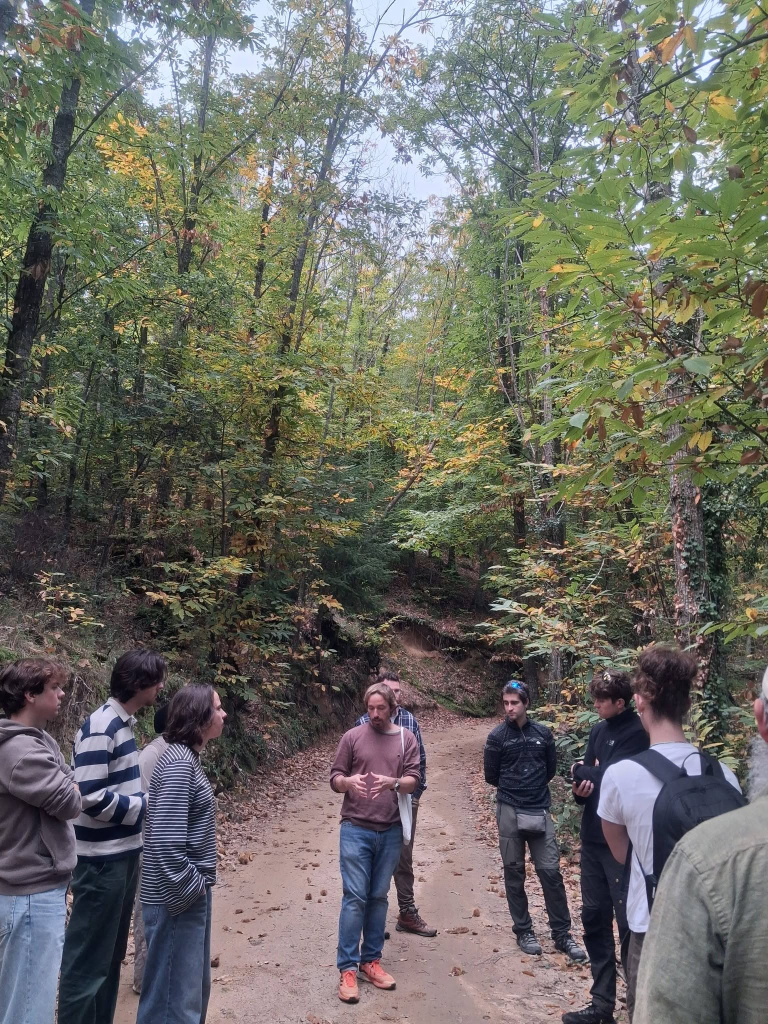
Rented a car, attended some lectures by esteemed forest pathologist Dr. Jonas Oliva. We met this class on a granite mountain with acidic soil south of Les Guilleries. On the lower southern slope we looked at Bot canker and Charcoal disease in Cork Oak. On the upper northern slope we examined Swiss needle cast in Douglas Fir plantations, & Chestnut Blight in Castanea sativa. We stopped at Castanyer de les Nou Branques on the way back to the city and paid homage to this giant, mostly dead tree.
Then we went to Universitat Autònoma de Barcelona and met with esteemed environmental geography professor Dr. Albert Pelachs Mañosa, to discuss the 20,000+ year history of prescribed fire, here.
We got back into town and had tapas, then retreated to a friend’s apartment to roast chestnuts and sip Moscatel.
Some things we learned along the way:
-The chestnuts here were planted and coppiced for wood, which once was used for furniture. Temu and IKEA killed the market for that wood.
-These trees would be coppiced. The most vigorous stem would be selected, the others pruned.
-Wait to harvest the cork an extra year, if it means skipping a wet year. The trees won’t get Bot Canker if you wait until a dry summer to harvest.
-The shepherds are the ones with the Traditional Ecological Knowledge of prescribed fire. Fire suppression changed the environment, now fire effects are different than 200 years ago. Shepherds have a tough time getting permits to burn. They burned to manage woody emcroachment into pasture. It was argued the Dehesa was a fire-adapted system.
-Panellets, the traditional marzipan sweets eaten during La Castanyada, are a cultural legacy of the Moors.
-The college students are pretty fired up, and are going to be striking next month.
-Spanish omelette, known traditionally as tortilla de patatas or tortilla española, are good any time of day.
Day 5: Spain and Portugal
We slept in and went to the beach. The street trees here are amazing. We saw an Ombu, which is in the Phytolacca genus (like Pokeweed). Always weird to see the tree version of an herb you’re already familiar with!
Molly Jo, Weston and I walked around town for awhile while Saoise and her parents napped. We stopped at a few different chestnut and sweet potato stands. Unlike other places we’ve been, they were cooking the chestnuts over wood fire rather than charcoal or gas. The chestnuts were delicious. We’d buy 12 or 15 from each cart, and just go from cart to cart looking for subtle differences in preparation and provenance. All of the nuts here were cooking over wood fire, in a welded metal box with a metal lattice lid.
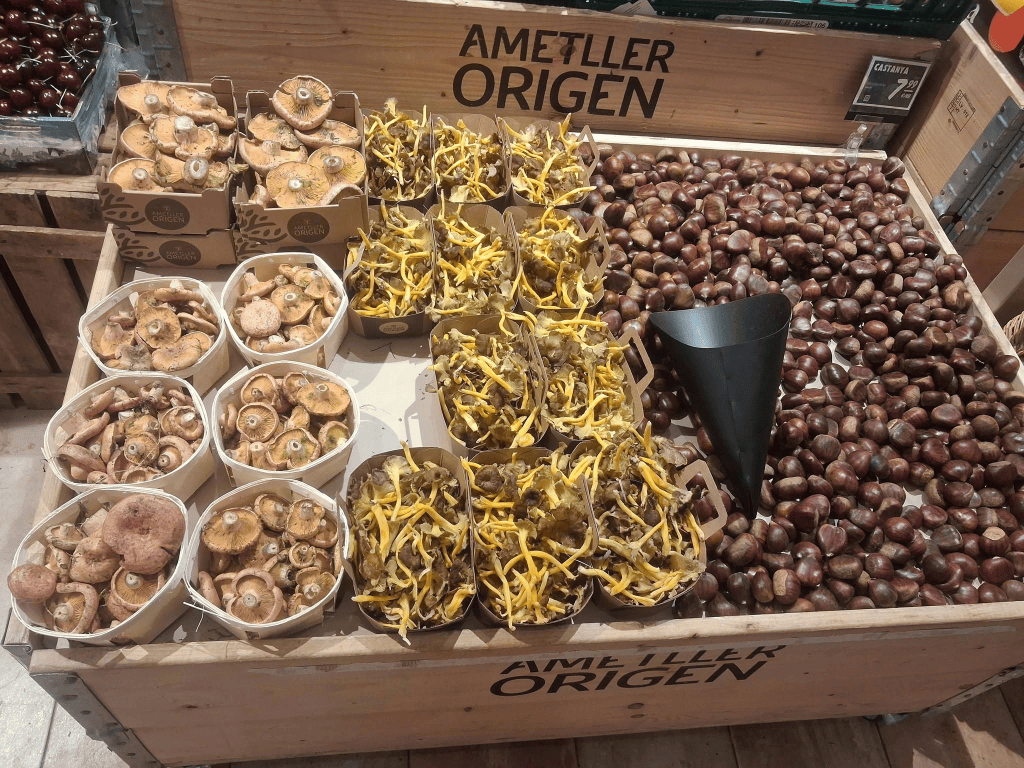
We stopped for tapas and eventually after that the rest of the gang joined us, in a health food store. We noticed a chestnut and mushroom display at the front of the store. The mushrooms were Saffron Milkcap (Lactarius deliciosus) and Yellowfoot (Craterellus lutescens). Mycoforestry researchers are working with Monterey pine plantation managers in New Zealand to commercially produce Saffron Milkcap for sale. I had never seen these before. I had also never seen Yellowfoot mushroom, a relative of the Horn of Plenty. Wikipedia says these The species can commonly be found in large colonies in some coniferous forests, under spruce, mountain fir trees, or pinewoods near the seashore. It also says they’re “usually found in wetlands”. If you’re familiar with foraging this species, I’d love to learn more. There was also Chufa Milk for sale. Chufa is what Americans call Yellow Nutsedge when it’s a weed in your garden, or Tiger Nuts if you’re getting these at the health food store. Not quite a sedge, but same family- Cyperus esculentus.
Anyway, we kept walking to a few different Castanyada parties. The first we came to was an old mutual aid society for seniors, and it turned out it was a private event. They were all dressed to the nines and shewed us away. We went on to a second party, a Castaween party- the bastard child of Castanyada and Halloween- and was all people in their mid-twenties, in Halloween costumes. The venue looked like a mosque, so we looked it up and it was actually an Art Deco bullfighting venue originally! We decided we were too old to be there, so we just slid on down the road to a third party. This one was run by a group of women workers and had loud music and bingo. We decided this was the Goldilocks Zone version of Castanyada, and hung out for awhile dancing. Very few visible cell phones were present, and it just seems that everyone was very engaged with the people next to them.
After our chosen Castanyada, we had more tapas. The waiter came up with a large syringe full of arugula pesto and injected it into our ball of burrata. Gelato afterwards from a really charming gelataio.
Molly Jo and Weston will be visiting Bolano Trees starting tomorrow. BalanoTrees is a tree nursery specialised on sweet acorn oaks. Our goal is to bring back the acorn as tree crop for human consumption. Their grafted Holm oak trees bear acorns that taste great with no trace of bitterness. These are what we call true sweet acorns- “and yes, they are the real deal in terms of flavour and texture. They can be eaten as nuts, raw or cooked, and also transformed into many products: bread, pasta, cakes, oil, pickles, drinks, etc.” Then they are headed to Natural Park of the Sierra de Montsant, a popular rock climbing destination.
Tomorrow, Chris and MaryKate and baby Saoise will be headed to a puppet festival North of Town.
I’ll be going to an All Saints Day event at Poblenou Cemetery tomorrow. Starting at 10:00, the organization MEXCAT will present a Mexican-style altar in memory of Antoni Gaudí. You might know about him already, he was the founder of Catalan Modernisme Architecture, and started building La Sagrada Familia back in the day. There will be a mass in memory of the deceased at 10:30am. At 1pm, the cemetery will host its traditional concert in honor of Josep Anselm Clavé. Clavé was a Catalan politician, composer and writer, founder of the choral movement in Catalonia and a promoter of the associative movement.
While going to see the acorns or the puppets tomorrow seemed like great options, I’m more curious about the ancestor remembrance going on at the cemetery.
Day 6, Spain and Portugal
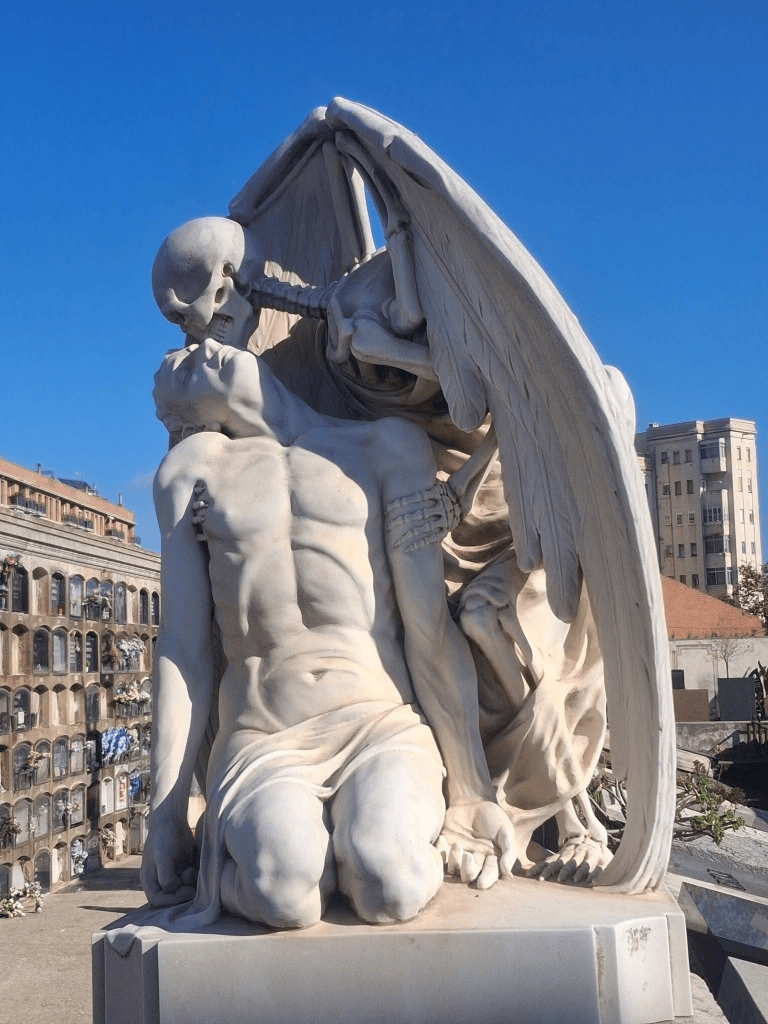
“Defunctorum quieti et solatio sacrum” translates to:
“Sacred to the rest and consolation of the deceased” (or “Consecrated to the peace and comfort of the dead”).
^this was inscribed over the entrance to the chapel at the center of the cemetery.
I had an interesting time into the cemetery today, but didn’t have time to write much about it. The place was packed! On All Saints Day, everyone goes to their family plot. They tidy up, offer flowers, talk to the dead, cry and grieve, laugh, and hang out with living relatives at the grave site. I like making space for this on the Wheel of the Year, and it just makes sense to do so as it starts to get cold. I was in a contemplative mood, and cried some about my dead relatives. And kind of zoned out just vibing with Gothic masoleums. Because of that choice, I completely missed the choral concert and Dios de Los Muertos altar! Ah well.
Despite me going alone it was a communal, collective experience for me. Idk if I think this is like the ultimate form of this tradition, but there’s a lot to like here.
Poppy symbolism on some graves here… something something about peaceful transition to death, death as relief from pain. I have heard that Greeks and Romans connected the poppy to Hypnos (god of sleep) and Morpheus (god of dreams), and used poppies in funerary rites.
Day 7, Spain and Portugal
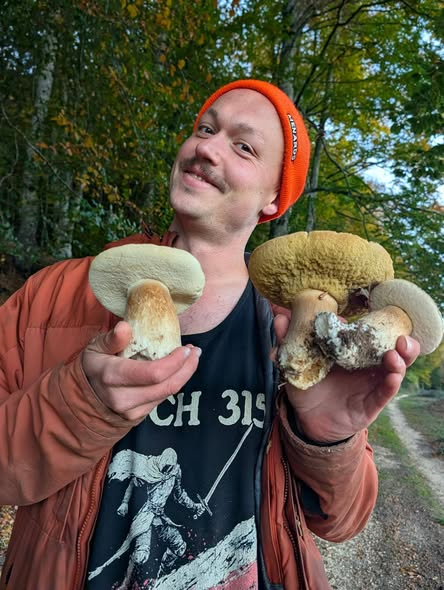
Our main stop on this 3 day excursion was the Chestnut grove of Apellániz. You can look up this place- Arraya-Maestu, Álava. It’s a Basque village that has a community chestnut grove going back at least 4 or 5 hundred years. Many of the trees were ENORMOUS. Each family has a few trees and is responsible for tending to them. After October 31st, picking is fair game and lemme tell ya, the place was picked clean. These trees looked very healthy compared to the plantation we saw northeast of Barcelona. There were ancient trees, trees from 50 years ago, newly planted and caged seedlings. It was quite heartening to see the robust care this Basque village takes of its communally managed orchard. Supposedly they have a research plot nearby. Above the orchard, which extended above the village for a ways at a narrow elevation band, the topo got steep. There were Sweet Chestnuts and Pyrenean Oak at this forest edge, deeper in it was all European Beech. I stepped into the forest for three minutes and immediately found three large Porcini, and some Blushers (one of the few Amanitas that a few wild, risk-tolerant foragers will eat). Horses with bells on their necks wandered the orchard, helping keep vegetation down. Def woth exploring, would be cool to catch their mid-October chestnut festival. Everyone should be so lucky as to have recent ancestors who planted and tended some breadtrees for you. https://www.xn--arbolybosquedelao-uxb.es/castanar-de…/
On the way to the chestnuts we passed through an arid landscape. Massive windmills towered above olives, vineyards, corn, collard greens, almonds, herds of sheep and alfalfa. Solar farms accompany most small towns. We passed through this arid landscape on our way through the Navarra region. We stopped briefly in Tudela for lunch. When these people refer to a tortilla, they mean a tall potato omelette. Making a sandwich out of this with thinly sliced ham, shisito-esque Pimientos de Padrón and mayo was the local bar food, not bad for €5.
We are staying in Vitoria-Gasteiz next two nights. There was a tech boom in the 90’s here and the government required the builders to do 400 housing units per hectare, and subsidized it to make it nice. So tons of new affordable housing here and bike lanes, underground utilities, light rail, bikes. Surprisingly still relatively easy to find on-street parking. The skyline is crazy, freshly plowed earth and then BOOM, highrises and city parks. Trying to find just the right restaurant now… update: Slow Food restaurant called Sukalki had Porcini on the menu and it was great! 
Day 8, Spain and Portugal
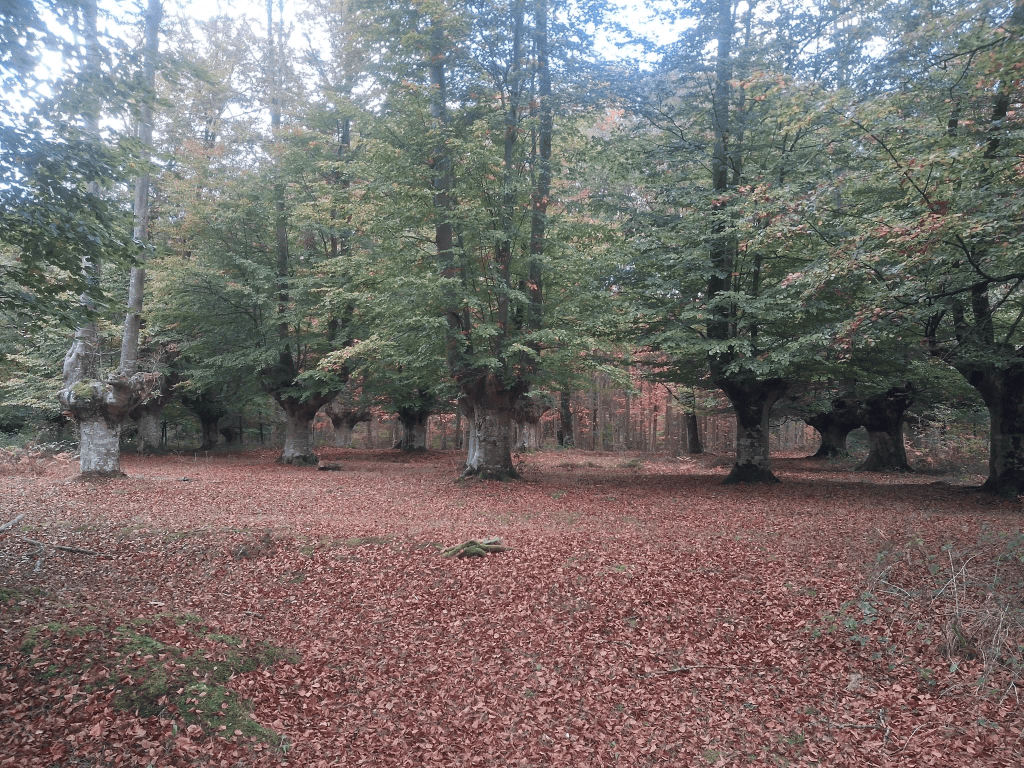
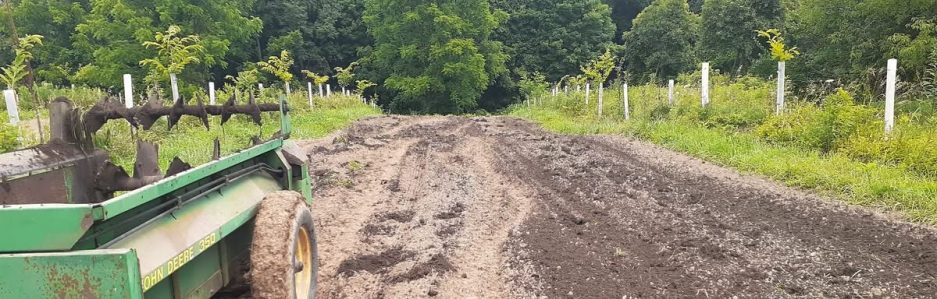
In the morning, we drove to Behi-Alde to check out the largest dairy operation in the Basque Country. It is a subsidiary of a subsidiary of the Mondragon Corporation. Cue the drum roll! We discussed what this meant as we looked at their fields, which were freshly spread with manure and seed-drilled with grain.
Mondragon is an unusual company in that it’s built on principles of worker-ownership, democratic management (“one person, one vote”), wage solidarity, and intercooperation. They have tens of thousands of worker-owners. This goes way beyond having a stock option. My dad loves this place and has led a few study tours here. We didn’t get a tour, which they only offer once a month, but we did drop into their Eroski supermarket- a continent spanning chain of worker owned grocery stores. We bought some supplies and had breakfast. It was good , cheap and fast.
We stopped at an ancient pollarded beech copse. Coppicing is a method of getting a sustained yield of straight woody stems on a short rotation, basically chopping the tree down over and over again at head height. This keeps livestock from eating or destroying the tender new growth, and basically keeps trees alive forever.
We also walked the Camino de Santiago (north coast route) between Lezana and Bilbao. We passed loquat orchards, eucalyptus plantations, northern red oak plantings, chestnuts growing up in clearcuts. All very actively managed stands, Chris was amazed… the Camino goes back to the Druids, then the Roman god Janus, and then to Jesus’ brother James (or maybe a different James from the Bible, unclear), and a certain path across Iberia that has been sacred to people for a long time. There were some great views.
Day 9, Spain and Portugal
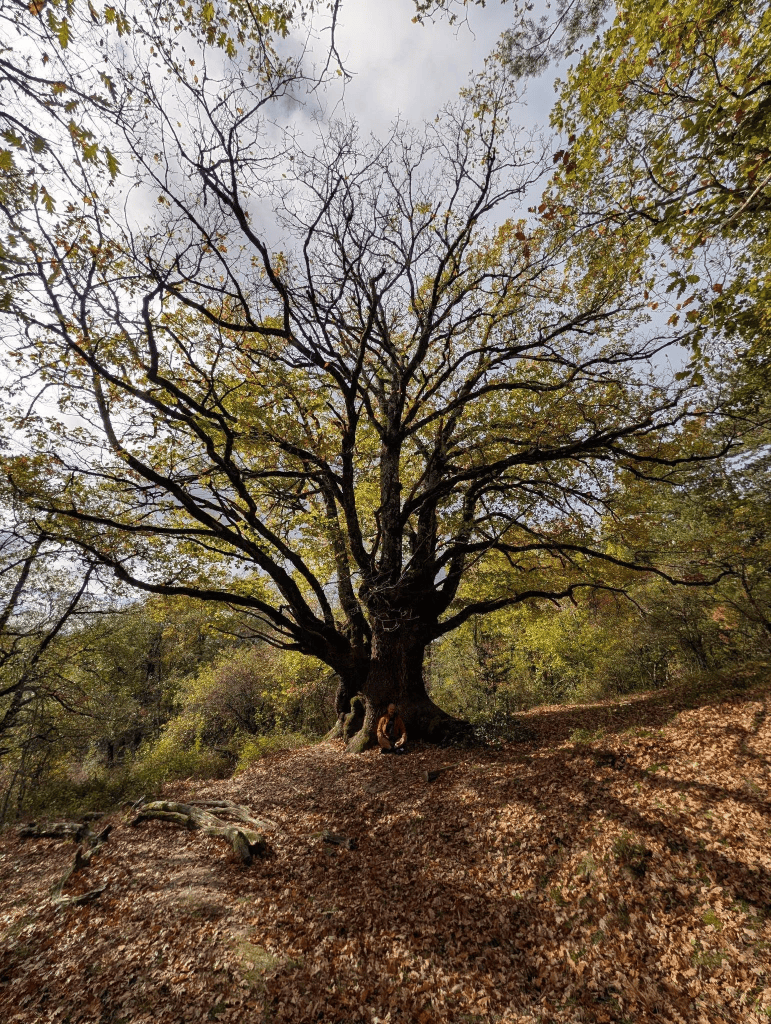
We woke up in Vitoria and drove to visit the oldest oak in the Basque country. Like a lot of these ancient trees, it has been continuously pollarded for building materials since before the Reconquista, and only abandoned since industrialization. Coppicing like that is super popular here. The “stool” that coppicing creates has tremendously enhanced longevity. This one is a Pyrenean Oak named El Abuelo de Galarreta, Roble Centenario. Sitting beneath it, imagining its own experience over the course of its long life, what a trip. Wish I’d had time for a nap at that spot.
We went on to Donostia to visit our buddy Esteful. She works as an ecological technician for the Basque state and taught us a lot about what’s going on. Interesting to my family, many of whom grew up in Baltimore, the Atlantic Blue Crab is a major invasive crab species, causing major ecological and economic disruption in Spain. Complete eradication is considered impossible. Instead, authorities and local fishers (such as in the Ebro Delta and Albufera) manage populations through intensive cage and fyke-net fishing. While destructive, the catch is increasingly sold in local fish markets and featured in regional cuisine. I told them that if they like eating invasives, the shoots of Golden Bamboo she’s in charge of purging grom riparian areas are quite tasty. Another intetesting story was told, related to escaped American bison, seemingly unrelated to the rewilding efforts with European bison in Spain… The Iberian Lynx restoration has been hugely successful. The wolves in Galicia are contentious with vaqueros, a familiar story.
We had a fixed menu, traditional style, at a famous Petritegi Sagardotegia. The cider is flat and there are unlimited refills out of 20 3000 gallon barrels. It is poured out in a thin jet and aerated by this splashing into the cup. The cod omlette, fresh sheep yogurt and everything else was just top notch. Highly recommend the Basque Country for food, we’re certainly not the first Americans to say this.
Esteful learned mycology from professional chefs, and showed us her textbooks. I am inspired by the rigorous and delicious depth these folks take their ecologically oriented gastronomy when it comes to mushrooms. Way way way beyond just the top five easiest choice edibles to identify, and Boletus is their favorite. They have good taste!
Day 10, Spain and Portugal
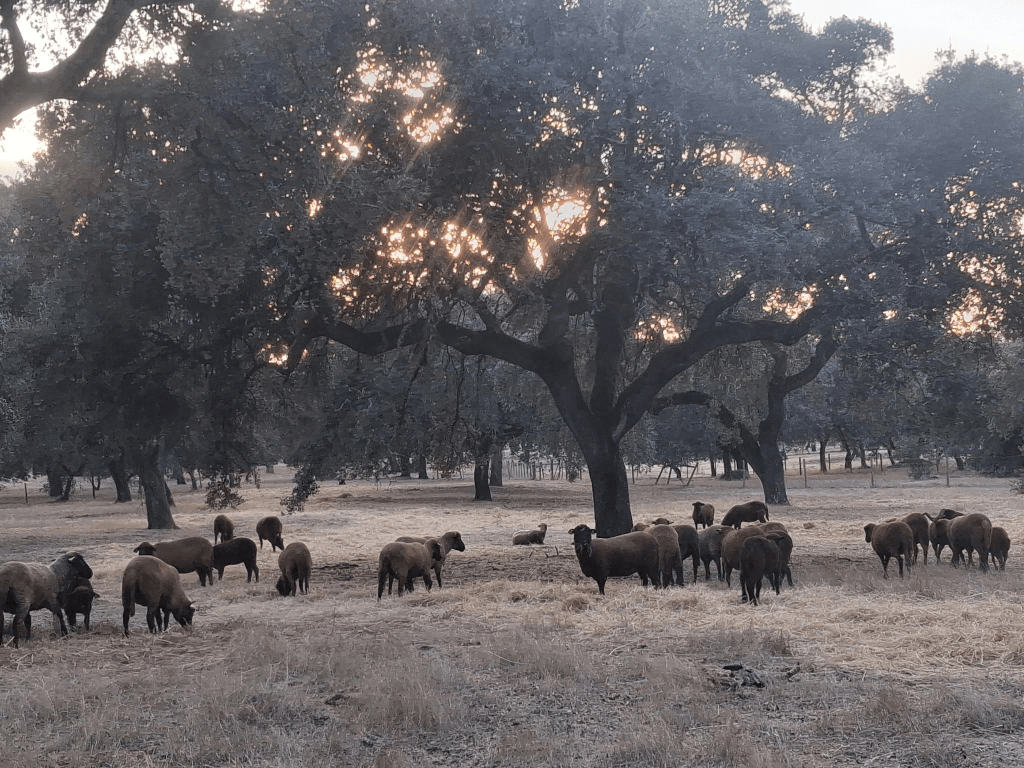
“90% of tannins leave acorns when we dry them”. “All (white) acorns are sweet acorns.” Alfredo is sort of the Paul Straus of the Montados, if you know that charismatic genius who co-founded United Plant Savers… Alfredo is one of those very rare permaculture grandfathers who has tried and succeeded at many things, and as a result he’s attracted others to do related projects, on the same land project with him. We flew from Barcelona to Lisbon then drove in to get a tour. In reporting out about this project, known as Montado/Herdade Freixo do Meio, I can’t do it total justice. It is worth coming here to learn from these projects directly. Jo found this place because we had heard of an “Acorn Cooperative” in Portugal, and our web crawl led us here. Their website was impressive- they seemed to be doing really cool things (agroforestry/commons/shared processing facility/etc.) on our wavelength, with an emphasis on Acorns/Oaks. But we couldn’t find any information about the processing equipment they use. So before we build the forest product processing facility in Athens, we figured we’d come establish a relationship with these folks and see what we could learn from their 35 years of experience.
These Quercus rotundifolia acorns they harvest don’t really need leaching. The crew here sells 100 acorn products to visitors, but they export only three: acorn flour, acorn coffee, acorns halves. We’re bringing some back for Michelle and Amy. But lactofermented acorns to be like olives, oak honey, acorn burgers- it’s really something!
The folks here have a Savory-style holistic grazing management system with four different livestock- cows, sheep, pigs, donkeys. These are heritage breeds that are closer to the wild-type of these species. All the Montados around here are silvopastures, but, this oak savanna agroecosystem is a little more complex and well put-together. Supplemental feeding of hay is sometimes necessary during drought. But the grazing helps keep grass down, making acorn harvest easy. They have tree and branch shakers, and tarp catcher implements. They loooove hacking different farm equipment together to do their idiosyncratic agroforestry practices.
There is a Syntropic research project here that is quite interesting, on a small part of the land. It’s beyond me to really explain this very well. But it’s mainly about building soil, for these people, and it makes their oak seedlings much grow faster. It almost looks like alley cropping, but they just cut hay from the alleys and pile it up at base of the trees. They have eight or more trees of different heights (and different ecological seral stages!) in the same tree row. “Brambles are the mother of oaks”. They do a lot of pruning, and they mulch the pruned bits and apply this meristem-rich material back to the tree row. I don’t think it’s humid enough to work here in the way that it does in Brazil, but I think I see where they’re going with it, and it’s a line of questioning that I think is worth exploring for sure.
We had dinner with a French agroforestry intern named Bertrand, and the four Americans- Jo, Weston, Badger, Chris- are settling into a small team that will be traveling together for a few days. Bertrand is funny, and says he’ll help Weston with some mulberry questions.
Under the oaks, the main shrub I see are various Cistus species, or Rock-Rose. This made me ask about truffles, because truffles fucking love Rock-Rose. “We know there are Tuber here, but we don’t have a dog. But we harvest lots of Terfezia, the Desert Truffle. They come up in loose soil after rain in the spring.”
Day 11, Spain and Portugal
“Mr. Hobbes was right, but only about part of the story.” He gave us a David Graeber-esque speedrun of cultural and ecological history of this place, from human’s first arrival to today. Our guide is definitely more of an indigenous enlightenment guy, philosophically.
They have a fenced-in deer silvopasture area, under olive trees. Funny. European Fallow Deer are making a comeback in the region. “Big animals are the soul of the landscape.”
The shocking thing to me was his narrow Japanese combine, $10K, he uses it to harvest fava beans and wheat in 10′ Syntropic alleys. I complain about alley cropping in 40′ alleys. Yeesh! His crop rotation is sunflower, chickpea, fava and wheat. Tiny fucking alleys, as I said it’s much smaller than in my chestnut orchard. Wow. I wouldn’t have believed he could do it, but he showed me the beans.
Okay, so the big reveal on acorn processing was first that they use a chestnut harvester, a chestnut dryer, an almond desheller, an olive chaff separator, and then they mill, roast then mill.
Acorn Coffee: take the halves. Break in small pieces, homogeneous pieces- size of coffee beans. Heat oven, put acorns in trays (maybe better with auger in tube- coffee roaster would work, small Indonesian machine is what ), similar to coffee roasting- 300° C, it cools off to 220 to 250°, 15 minutes. Then mill after it cools. If you have a coffee roaster
Cacao + Acorn is a great combo. They sell a lot of brownies.
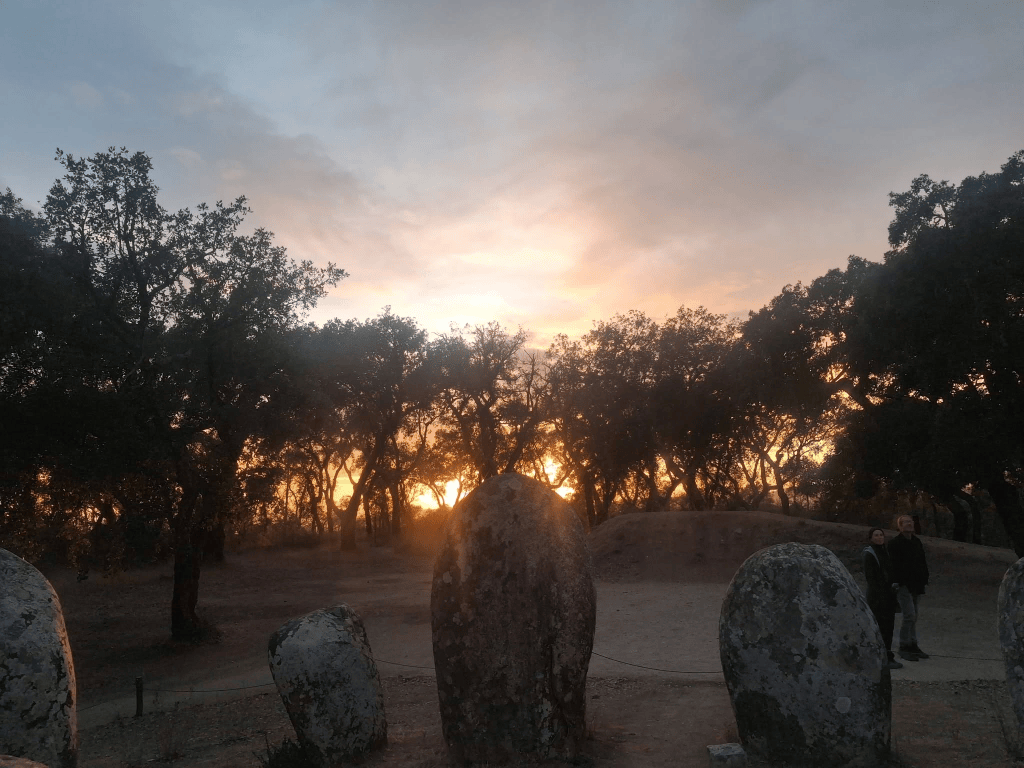
The next stop was Almendres Cromlech! This circle of 95 granite monoliths are aligned with the sun, solstices, and equinoxes, suggesting the site functioned as a ceremonial center, gathering place, or calendar linked to seasonal cycles and agricultural rhythms. Construction happened 6000 years ago in the early Neolithic, at the transition from hunter-gatherer to pastoralist-farmer. In the Montado, that distinction makes a little less sense to me than most places, because it’s a savanna with megafauna that were domesticated and retained, and breadtrees as an almost monoculture that were also retained. After this was built, the same Celtic culture came from here, colonized the British Isles, and built Stone Henge.
I didn’t want to leave. The folklore says this place is home to thr Mouras Encantadas. They are described as beautiful, seductive, immortal women trapped in a parallel spirit realm, bound to guard ancient stones, rivers, and treasures. Who were credited with carrying the stones to the site on their heads, while simultaneously spinning flax or sun rays into gold threads. These ladies sound a bit like the Tuatha. Local folklore states that the barrier between our world and theirs becomes thin at dawn on the Summer Solstice (June 21st) or during St. John’s Eve (Noite de São João). To catch a glimpse of the Moura or the portal beneath the stones, you must be at the cromlech exactly as the morning’s first sun rays strike the aligned menhirs. At that point, you can see a Moura. At first, the Moura will appear to the traveler as a giant, terrifying snake or a black bull slithering or charging from beneath the stones. To recruit their help and win their friendship, you must stand your ground without showing fear. If you run, the portal closes to you forever. The Moura comes at you, and you must bravely kiss the serpent on the mouth. This transforms her back into her beautiful human form, and breaks her from her aggro spell Then you’re supposed to give her an offering of bread or milk- then she opens a portal to a place beneath the megaliths with treasure for you.
It’s not the solstice, so I didn’t bother with any of that. I took a nap. When I woke up, the sun was setting on the site, and there was a double rainbow overhead! We were excited as this felt like a good omen.
Day 12, Spain and Portugal
Short one today.
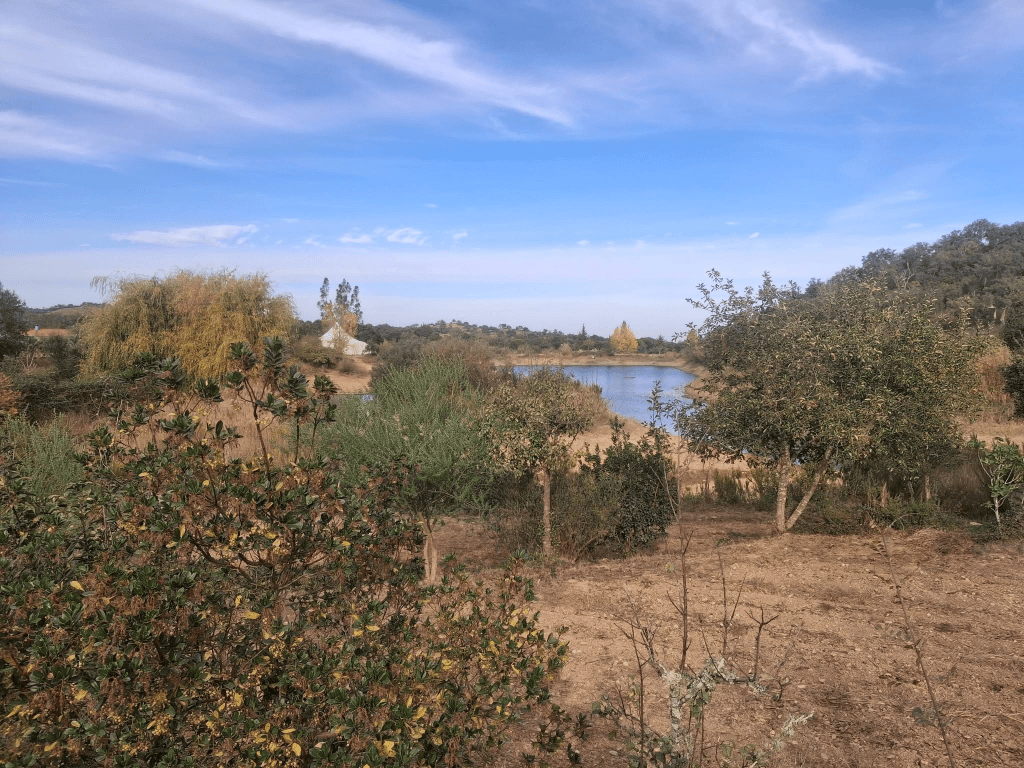
We tooked a guided tour of Tamera. An intentionally community of sorts, right now about 140 people. Sepp Holzer did a design here with a bulldozer and a bunch of swales and ponds and one big lake, now this collection of caravans and group meeting halls, is offgrid for water. Their neighbors were afraid that their water was being stolen, but they actually recharged the aquifer and neighbors springs started flowing again.
All those swales are planted with fruit and nut trees… Their favorites are figs and loquats. Nationally the Portugese mainly grow Eucalyptus, Cork Oak and Olives. The Tamerians are not a fan of the the “Denteza” method of clearcutting Eucalyptus, and eliminating all brush and other tree species, saying it’s bad for soil health and water infiltration.
Much else could share. If you’ve been there, & want to discuss, hit me up.
Day 13, Spain and Portugal
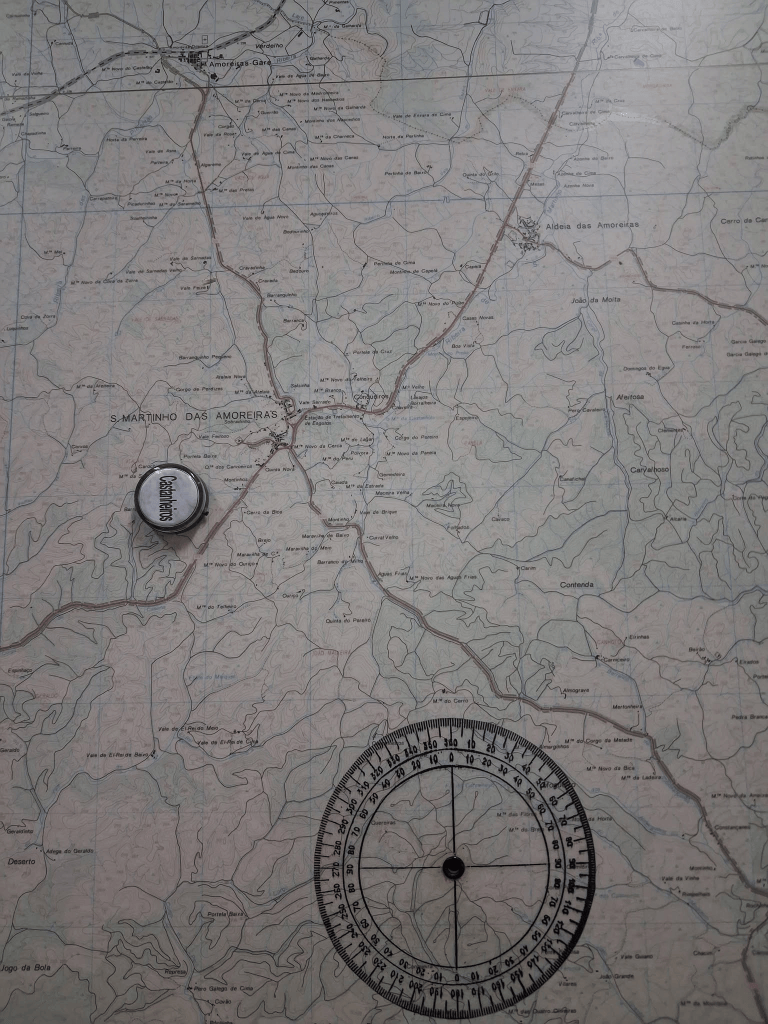
Mostly just tourist stuff today. I would not go to Portugal just to be a tourist, but since we’re over here, it’s nice to take a few days off of any serious inquiry. This gets at the difference of leisure vs. recreation. Recreation has a goal- you go somewhere to SCUBA, or to do a multi-day through hike, or sit out in your deer stand until you get that big buck. Recreation is this kind of fun, with a specific goal that you orient to. Leisure on the other hand is more open-ended fun, aimless and spontaneous. There’s nothing spontaneous about being absorbed by your phone, so I’d argue leisure requires a kind of mindfullness in this regard.
The enjoyment of leisure used to be a hallmark of success in life, and I think we still need it. Leisure means having enough free time to employ your perceptive faculties, wander, and not be overly distracted by what is happening at home or work. Leisure can actually be quite a challenge for people who already do what they love and love what they do, but it’s good for helping you not only identify as a worker. We do accept that our minds will stray to back home from time to time. But since our time in Europe has been a combination of recreation and study tour up until now, we need to shift into flâneur mode. I am not sure this part is something that stirs me to write publicly, at least, for the most part?
I met some EMS & firefighters, and they invited me on a tour of their facilities. Some things that were interesting and different from the US:
-free ambulance and emergency medical care is guaranteed to all citizens in Portugal’s constitution. They will charge you if you abuse the system, which is uncommon.
-they have a youth scouting program that acts as a funnel to get people into their VFD system.
-they are inter-operable with the US and EU emergency management systems, since 2017, which is unique. Thus they invited me to firefight with them next summer.
-the hardest part of wildland firefighting here is saving the Van Life people, because it’s not immediately apparent where people are when you arrive on scene. Lots of hidden Van Life people are all about the landscape. Housing is also guaranteed in the constitution, so if you see a drone from your fire-scouting UAV, you know there’s more people to find, but there aren’t American-style homeless encampments. In this sense, the job is easier than what Cal Fire has to deal with in Southern California, despite a similarly Mediterranean climate.
Day 14, Spain and Portugal
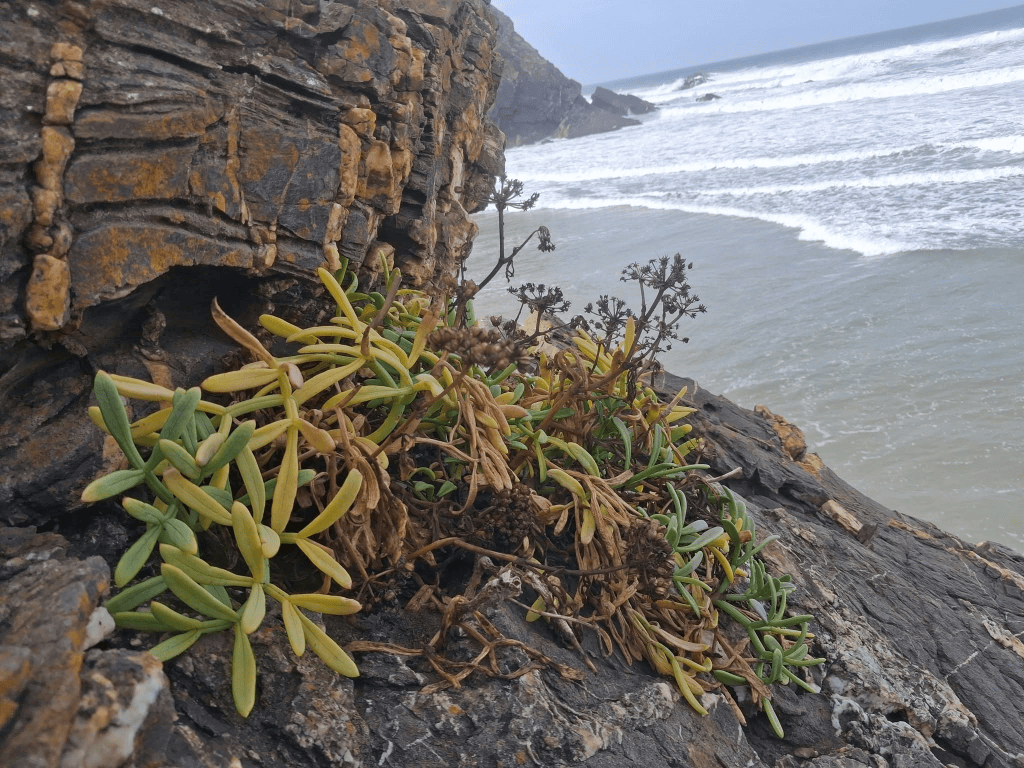
Crithmum maritimum, “Rock Samphire” is a delicious Apiaceae/carrot family wild food that grows on beaches and cliffsides. It is salty, juicy and succulent, pleasantly crunchy but non-fibrous and has an intensely aromatic flavor. The taste is somewhere between a carrot and that American lovage that I’m always going on about. The roots go very deep. It is almost cactus-like in appearance but with no sharp bits. It is not to be confused with the unrelated marsh samphire!
Quote from GALLOWAY WILD FOODS, pictures from me:
“It is interesting that unrelated marsh samphire (a curiousity of the goosefoot family of plants), is now a fashionable wild vegetable while rock samphire can’t be bought for love or money. This wasn’t always the case, rock samphire being so popular up until the early 20th Century that it was regularly cut with less tasty and easier to harvest marsh samphire. I love it pickled and served with smoked eggs and winkles and, most importantly, beer!”
We did a lot of scrabbling on the seaside cliffs of Odeceixe, to eat our fill of rock samphire today. We harvested extra for dinner. I put mine on a veggie burger made out of acorns tonight, with acorn pate. The others had spelt-acornbread as the bun, and washed it down with 96 proof Medronho. This is liquor made of the Ericaceous fruits of the “Strawberry Tree”, Arbutus unedo. It takes people 15-30 minutes to harvest enough fruit- 2 kg of fruit- to make a 200 mL bottle of the spirit. That’s the only ingredient in the mash bill and it will knock your socks off. No thanks.
Day 15, Spain and Portugal
This morning we got out the door at 5:30am, and hauled ass to get Chris to the Lisbon airport. We made a brief stop to see the the Sobreiro Monumental (Monumental Cork Oak), also known as The Whistler Tree. It’s a 236 year old cork oak from Águas de Moura, Palmela, Portugal and was voted European Tree of the Year in 2018. In an arid land of small trees, this felt like meeting the Great White Oak of Logan. I can’t imagine many Portuguese people seek that tree out when they visit Ohio, but they’re missing out.
After Chris got to his flight, which was a dicey proposition because of flooding and traffic slowdowns, we hiked up to a Moorish castle that had been taken over by the Knights Templar. There were some mammoth-sized chestnut trees up there, also rather inexplicably a couple of quite large Sequoia sempervirens which must have been planted very early during the Portuguese period of conquest by sea.
Other fun things- I had a moment with a cockatoo, we got sauna time in, and then somehow we decided to find Portuguese chestnut beer. Interestingly, drinking on the street is somewhat regulated by various neighborhoods, but across all of recreational drugs besides alcohol are all decriminalized for personal consumption. This policy was established under Law 30/2000 and treats illicit drug use as a public health issue rather than a criminal offense. Heroin, MDMA, etc.- and if you get addicted, there’s help as part of the national health system. Imagine how much smaller our prison population would be in the US if our policy looked like that!
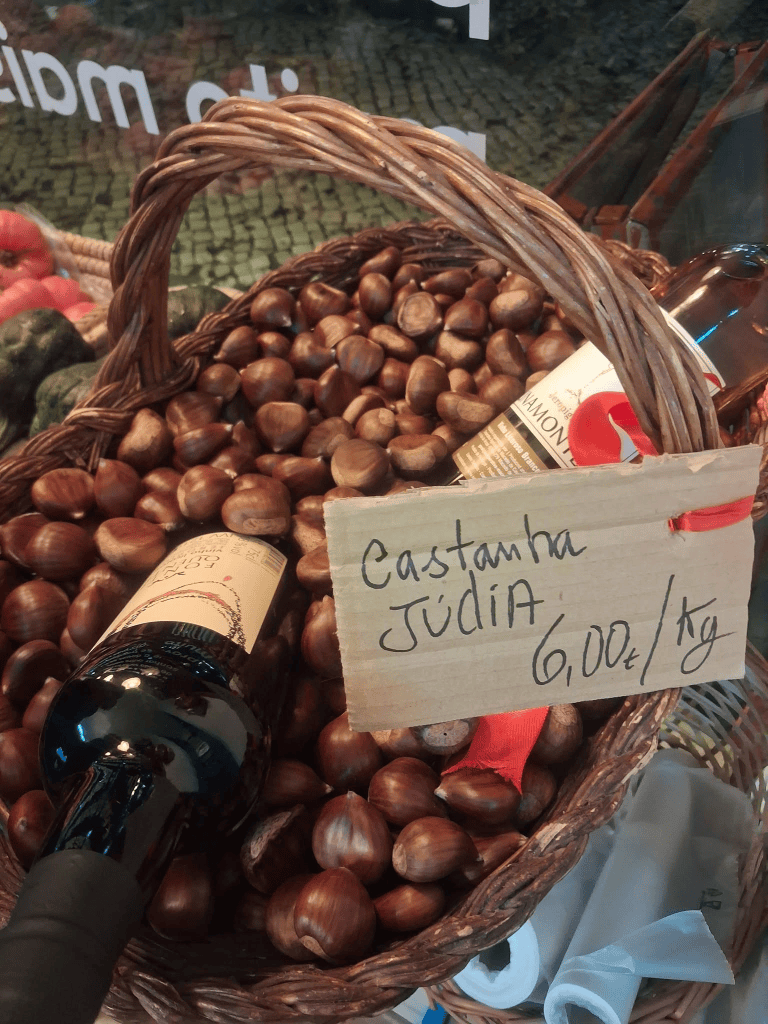
Okay, on to the surprising main event of the day. Chestnut beer quest led us to a north-Portuguese specialty food store. But what really got me was the basket of chestnuts labeled “Castanha Judia” (Jewish Chestnut) in the window. And that was on two of the beers, and on a bottle of chestnut gin. Now what on earth could this Jewish chestnut phenomenon be about? I tried one, raw. It was buttery and had that almost maple sweet flavor, like it was already halfway caramelized from roasting. That’s a good chestnut!
We went inside and poked around. The proprietor was very knowledgeable and helpful. When I asked him about the Jewish chestnuts, he said that following the Spanish Inquisition and the Alhambra Decree in the late 15th century, many Sephardic Jews fled from Spain across the border into the isolated, rugged valleys and villages of the Trás-os-Montes. These Jews were forced to convert to Christianity by King Manuel I in 1497. But many families continued practiced Judaism in secret, and are usually referred to here as New Christians or Marranos. They’d outwardly adopt Catholicism to get by, but communities in places like Bragança, Chaves, and surrounding rural outposts, they maintained hidden Jewish traditions for centuries. The Jews who fled to Trás-os-Montes were in an area that was hard to get to and not so densely inhabited, and it became associated with a rural Jewish community that got more deeply involved in cultivating native crops than Jews in Europe typically have done. Because Portuguese agricultural varieties are traditionally named after the specific location or the person who perfected them (like the Pêra Rocha or Maçã Bravo de Esmolfe), these high-quality chestnuts are thought to come out of this crypto-Jewish regional community. That’s all he could tell me.
The chestnut beer(s) were all excellent. They make a jam out of chestnut puree cooked in wine that is interesting, olive oil infused with roasted chestnut, they had chestnut honey… it was great. If I come back to Spain/Portugal, I want to go to Galicia in Spain and Trás-os-Montes in Portugal- so much good chestnut culture up there, it seems.
Day 16, Spain and Portugal
Today was anti-climactic in that the rain we were promised this trip all came on the last day, and canceled the Magusto celebration we’d planned on attending. If you were hoping for something particularly poignant and unexpected, I suggest going back and reading yesterday’s post about Crypto-Judaic chestnuts!
Josh Dunbar asked me what the top 3 things I learned have been. This is a very fine question. In Catalonia, going to the cafe/social center/maker space that services a bunch of, um, let’s say affordable housing residents, taught me what a grown-up mutual aid housing cooperative can look like. The traditional Basque ciderhouse meal we had in Donostia taught me how delicious, beloved and idiosyncratic a tree crop-based cuisine can be- one that attracts gastronauts from around the globe, and has staying power since before 1492! When we’re developing tree crop cuisine, let’s aspire to get to this level, yes? Finally, the almost 2000 acre oak silvopasture at Montado Freixo de Meio in Portugal taught me way more than I captured in those days’ journal entries, but by eating many different acorn flour products as well as beef, mutton and pork from beneath the trees, I was taught that the forest products facility we’re developing is far from a pipe dream. As one bit of street art in Lisbon quipped “Utopia is, by definition, always under construction”. I’m looking forward to going home and doing more thinning and burning in our oak woodlands!
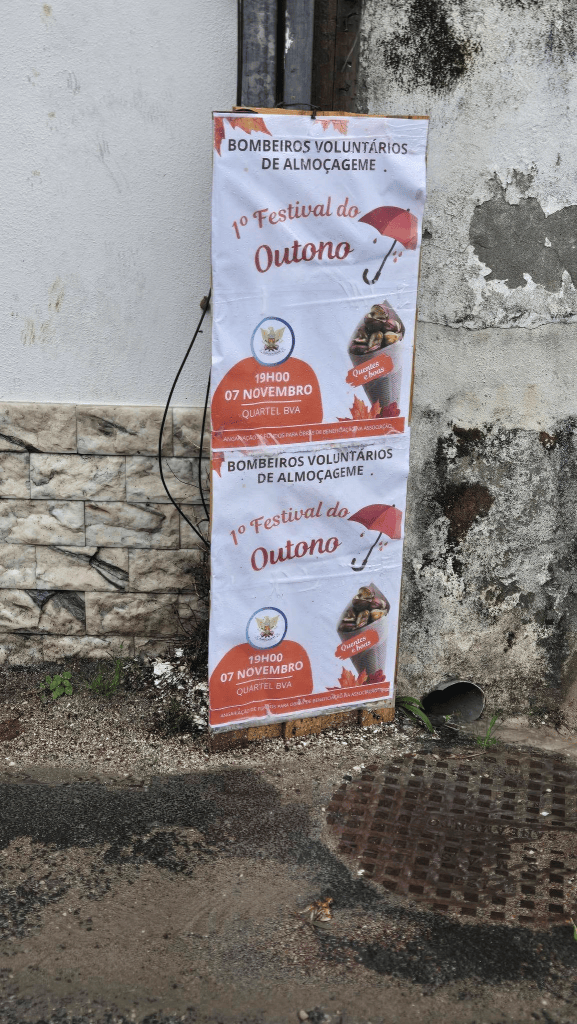
By way of a final closing thought. Here’s a picture I forgot to include from yesterday: advertising for a Voluntary Fire Department fundraiser, that happened to be a chestnut roast. These are a few of my favorite things ˖ ݁♬⋆ this is what it looks like when chestnuts are normalized and celebrated.

