Some of the ingredients for a Prescribed Burn Association in Appalachian Ohio?

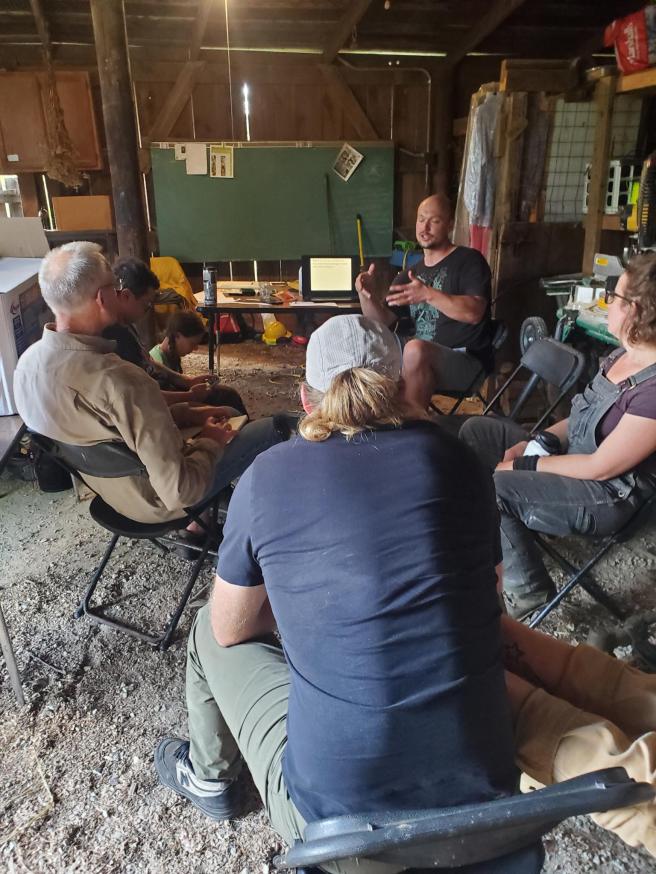
For the last few years, I have volunteered to teach people about prescribed fire. I am an Ohio Certified Prescribed Fire Manager, so part of my motivation is develop a client base, as well as a pool of gig workers to staff my fires. The teaching is pretty straightforward. We spend a few hours in the classroom looking at maps, plans and slides, and then I host several “learn and burn” events to get peoples feet wet. I am happy to say that as of yesterday, there are (144) people who have participated and are on the Google Group. My hope is that one day, people from this mailing list will coalesce and help found a Prescribed Burn Association (PBA) in Appalachian Ohio.
What is a A Prescribed Burn Association (PBA)? It’s a group of landowners and other proactive, ordinary people that form a partnership to conduct prescribed burns. Association members pool their knowledge, labor and equipment to help other people in their association conduct prescribed burns. I think at some point, the people in Appalachian Ohio should start a PBA. Why? There is safety in numbers when it comes to staffing a fire. Mutual Aid between land owners/managers/stewards is a powerful force. The more resources on a fire, the less likely something will go wrong. If people are willing to play tit for tat, it can keep the labor costs down.

Where are PBA’s a thing? At the time of writing, states that have at least one regional PBA are Virginia, North Carolina, South Carolina, Georgia, Florida, Alabama, Louisiana, Arkansas, Texas, Illinois, Missouri, Kansas, Oklahoma, Nebraska, South Dakota, North Dakota, Washington, Oregon, California. None of these states have complete coverage. PBA’s are usually at the county or multi-county level, sort of sub bio-regional.

One of the slides for the classroom portion of my intro workshop includes a national map of Prescribed Burn Associations (PBA’s). I make it a point to check the Great Plains Fire Science Exchange website annually, to see what has changed for PBA’s nationally. Here are the changes I saw this year:

-Between this time last year and now, Washington and North Dakota both picked up a PBA, whereas these states had zero before!

-But in that same period, Colorado and Mississippi went from having one PBA to zero, not sure why.

-Illinois picked up one PBA, but lost another.

-Coverage of Missouri and Texas improved.

Notably, there are currently no PBA’s in Minnesota, Wisconsin, Indiana, Kentucky, Michigan, Ohio, Tennessee, West Virginia, Pennsylvania or New York. I will tell you this. The oak, hickory, yellow pine and chestnut (such as it is) in these states misses the fire that a PBA could offer. The nut trees will continue to fade away without prescribed fire, replaced by other species. As a habitat manager, the slow decline of trees that produce hard mast for wildlife is a huge concern. This is part of my motivation for helping people learn prescribed fire. If you’d like to connect to the people who have taken my class and learn and burns, and now help each other burn on each others properties, I’d like to introduce you. Please contact me.
So you want to get your Red Card

Working at Woodcock Nature Preserve, I have been teaching about prescribed fire since 2019. One question comes up every year: “How can I get my Red Card?” I have my Red Card and can answer from my experience. But what is a Red Card, and what’s it have to do with Rx fire in Ohio? “Red Card” is the colloquial term for the Incident Qualification Card. It qualifies you to work in FEMA’s Incident Management System (ICS), making it legal for agencies to employ you in response to national emergencies- including wildfires on public land, but also floods and similar situations. Even though prescribed fire and wildland firefighting are different, both are connected. You can learn a lot about fire behavior on a wildfire, and that learning can be applied to conducting prescribed fire. You can learn about protecting human life and property, as well as natural and cultural resources, through wildfire work. Also, if you want to do Rx fire in Ohio for other land owners, you will need to get licensed. Having some wildland experience under your belt supports your application to take the Ohio Certified Prescribed Fire Manager class, which ODNR puts on every two years. I did all of this, and can tell you how you might do it too. I took some free online classes, printed my certificates of completion, enrolled in the Ohio Fire Academy’s class for $95 in late February/early March. In 2017 I had a seasonal job for the National Park Service in Missouri, they red carded me, and I went on a fire that summer. When I moved back to Ohio, I applied to be an AD (administratively determined employee) through the Wayne National Forest- they issue Red Cards for their ADs. I have been on three fire assignments through them since. If you’re reading this, your route might look similar but a little different. Here is more information, to help you along your way.

Online and In-Person Classes

National Wildfire Coordinating Group requires the following classes, most of which (but not all) are available to take for free online, to become a Firefighter Type 2:

ICS-100, Introduction to ICS (online)

S-110, Basic Wildland Fire Orientation (online)

L-180, Human Factors in the Wildland Fire Service (online or in person)

S-130, Firefighter Training (in person)

S-190, Introduction to Wildland Fire Behavior (online or in person)

IS-700, NIMS: An Introduction (online)

Work Capacity Test (in person): walk 3 miles w/ a 45 lb weight vest in 45 minutes or less

You need to save a digital copy, and a couple of physical copies, of the completion certificate for each class. After your first year, you have to take the annual refresher:

RT-130, Wildland Fire Safety Training Annual Refresher (WFSTAR) *

To fulfill all of the above class requirements, one way is to take the all-inclusive class at Hocking College in Nelsonville, OH. Their forest management program offers a class (for college credit) that fulfills all of those NWCG requirements: FOR-2221 Wildland & Prescribed Fire (3 Credits). Mike Broecker is a good teacher and a good guy. This class goes for 8 weeks, in 2023 went from the second week of October through the first week of December. At time of writing I checked in with Hocking College admissions about the cost to take just this class (it’s cheaper per credit hour, the more credit hours you take). As a stand-alone class it was $1,117 in 2023. The benefits of this course include not just meeting your Red Card requirements, but also getting additional learning opportunities with prescribed burning in the college’s forest and prairie, lectures from an expert, and a foot in the door with prescribed fire work. 

If you are in Ohio but Hocking College isn’t an option for you, there is a second in-person pathway- through the Ohio Fire Academy. You would sign up to take their class called “Interagency Wildfire (S-190/S-130/L-180)”. Interagency Wildfire has historically been offered in two formats: a week-long class held Monday-Friday (was Oct. 2 – 6 in 2023), OR a weekend class held over three weekends (was Feb. 25 – March 11 in 2023). The fee for that has been $95 historically. You can do the free online courses and print the certificates of completion and bring those in, before the class.

Another resource for taking the classes, for people living in Ohio, is the Mid-Atlantic Wildland Firefighting Academy. This is a one week event, usually in the second week of June, in western Maryland. There are a ton of different classes offered, including what you need to get your FFT2. This one-week event is also an opportunity for people who have already gotten their Red Card, with many classes useful for people who already have their FFT2. For instance, I took S-211 Portable Pumps and Water Use after I already had my Red Card. For beginners, if you take ICS-100, L-180, S-190, IS-700 online, you can take S-130 and the WCT in-person at the Mid-Atlantic Wildland Firefighting Academy. 2023 prices were $320, or $580 with food and housing.

Applying for Red Card

After you take the classes, you can apply to be an administratively determined (AD) employee of a firefighting agency. The Wayne National Forest and ODNR Division of Forestry both have AD programs and deploy hand crews and engines. You could apply to either. If you are accepted they will issue you a Red Card. If they issue you a Red Card, you agree to be on call for them, and to have your bags packed and be available with less than 1 day notice to be gone for 18 days at least. I would suggest making time to go out as an AD during peak wildfire season, which historically has been July, August and/or September. AD’s tend to get called out frequently when the national Preparedness Level (PL) is at 5. You can learn about and monitor the PL here. To view the website where you can request a change in your availability status, visit our region’s dispatch website, the Mid-Atlantic Fire Compact.

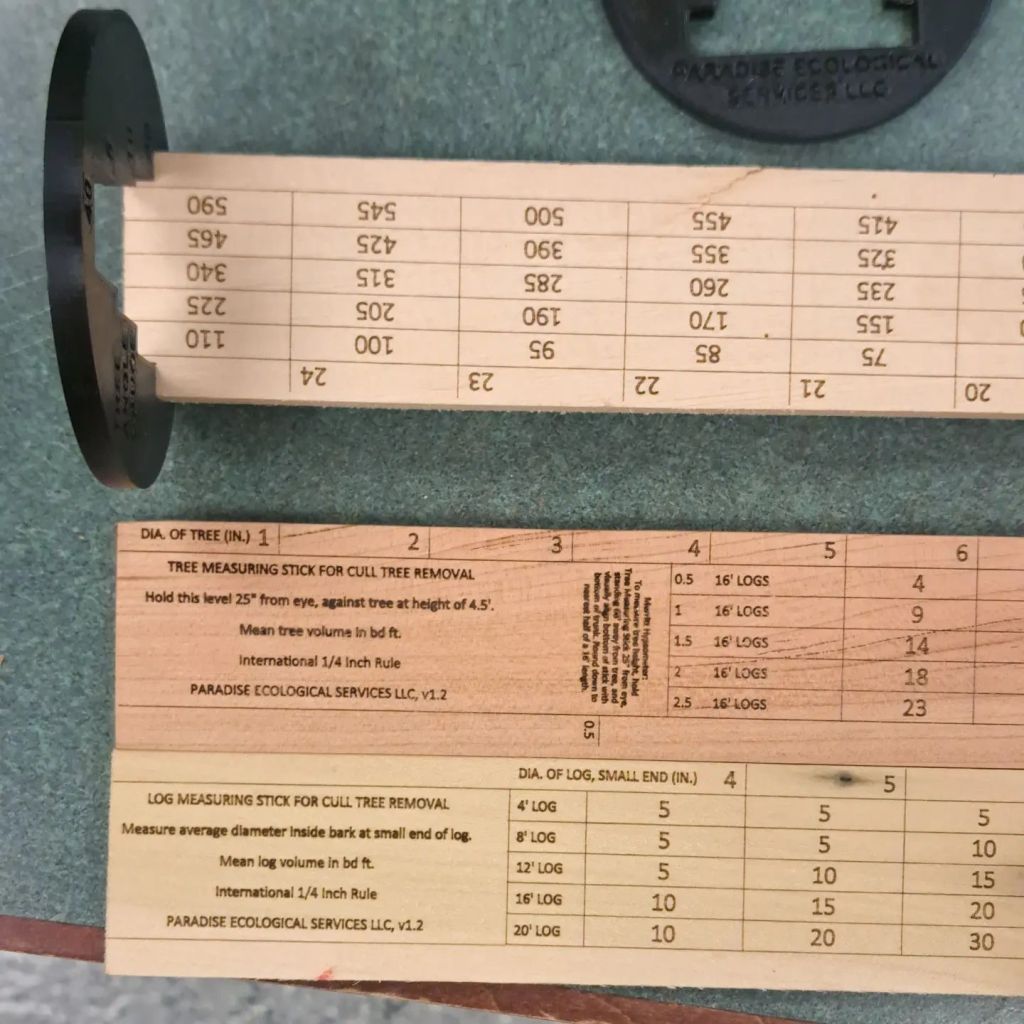
Agroforester’s Tree and Log Measuring Stick with Cruising Prism

I have a tool to share. It is used in a similar way as the classic forestry tools known as the Biltmore stick and the cruising prism. But it is used for different purposes. My adaptations are designed with other agroforesters in mind, as well as consulting forestry clients managing their private non-industrial forest.


These tools are for people who do forest stand improvement, & for whatever reason want to measure “waste wood” from these treatments. For agroforesters pursuing forest farming, this tool is handy. You might find yourself thinning overstocked oak woodlands in order to better cultivate sun-adapted NTFP herbs, such as black cohosh. Cutting trees out without selling to a logger means cutting small diameter trees to make growing space for healthy larger trees. These cull trees may be suppressed, they may be of a species that isn’t part of the plan, or maybe there are just too many trees and competition between them has grown fierce. Either way, logs from this light-on-the-land management have many uses. Timber-framing elements are useful in green building, with the smaller logs useful for mushroom bolts, and the even smaller poles useful for various crafts and as fuelwood.


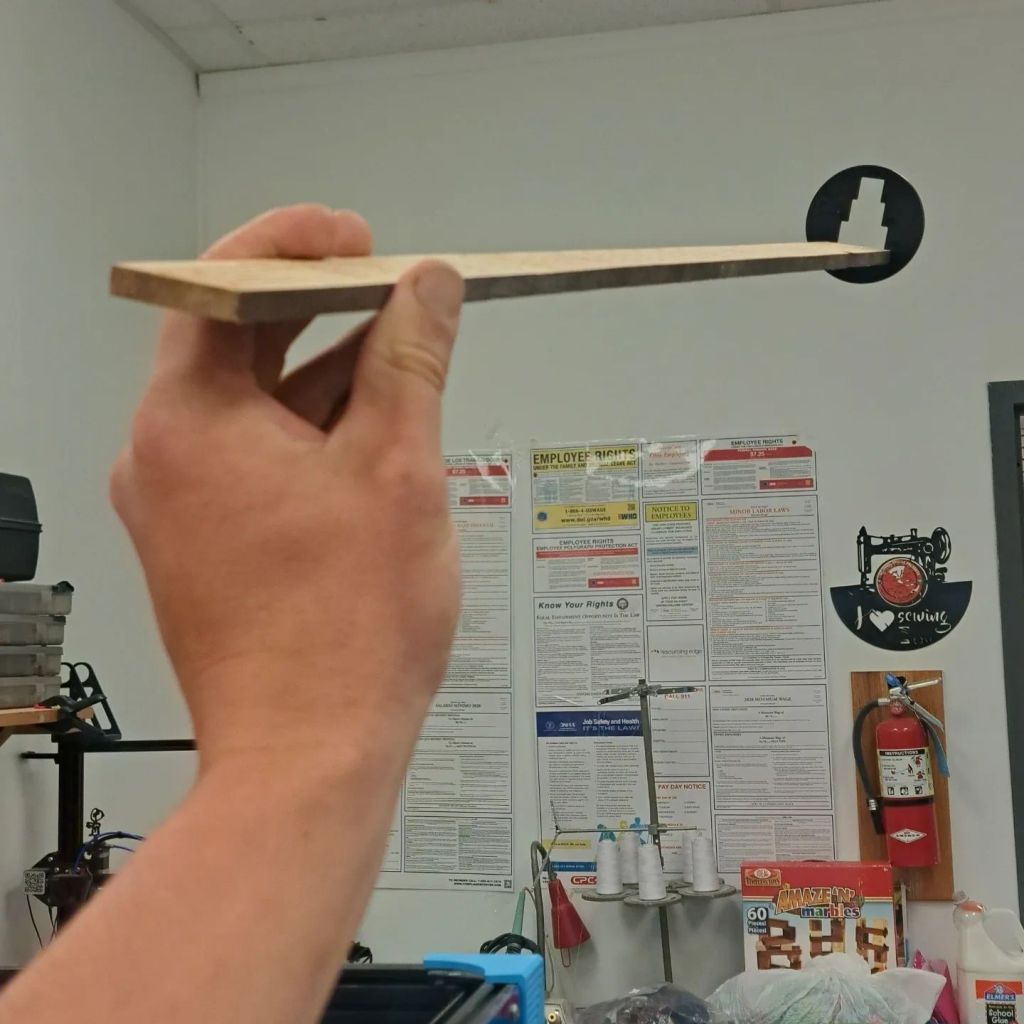
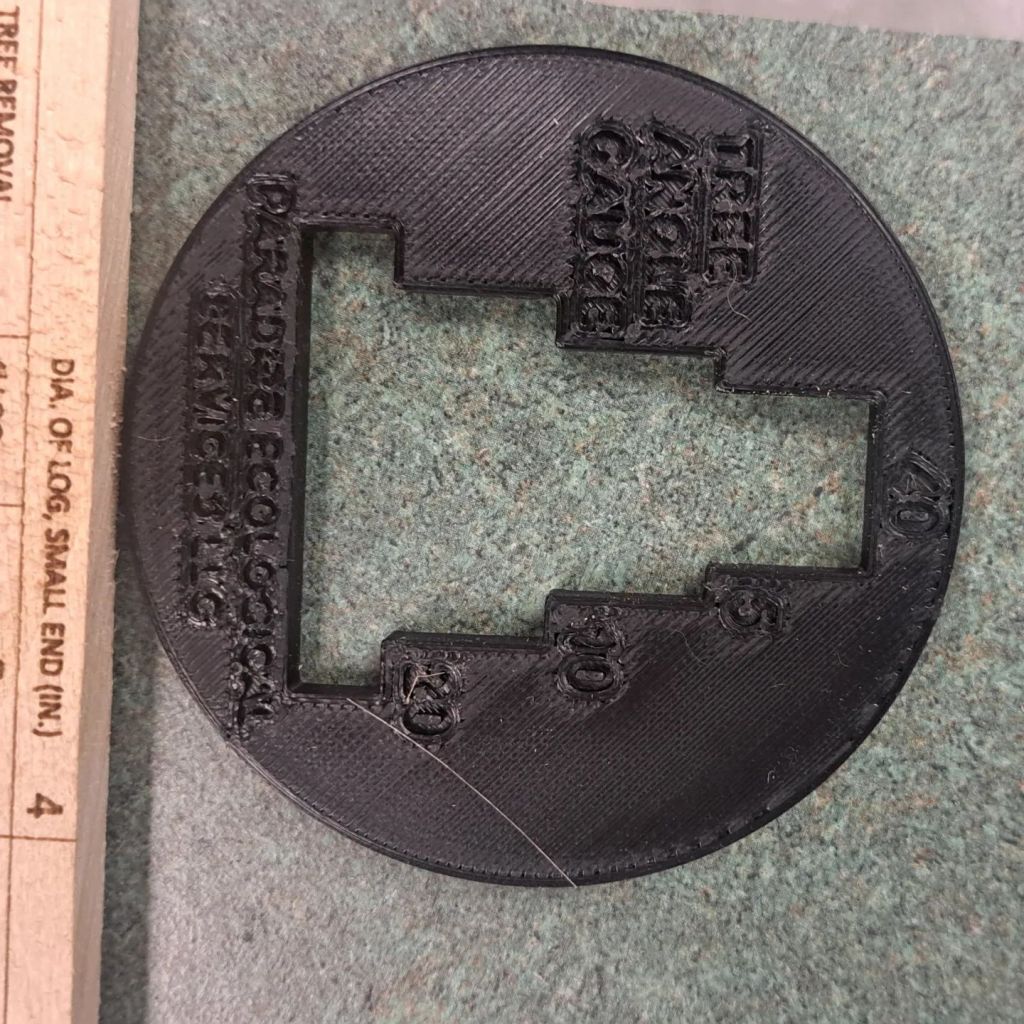
This was manufactured by me and friends working together at the Athens Makerspace, with design sessions happening in our homes. Special thanks to Asa Peller (A-STUDIO) and Henry Hellbusch, as well as Pauline Phillips (our Makerspace guardian angel). It is because of these specialized uses for small roundwood that we started this project, because now the board foot scale on both sides of the measuring stick goes down to half a 16′ sawlog, and uses the International 1/4 Rule- rather than Doyle Rule. Thus we avoid underestimating timber volume from the narrower & shorter logs, which is a classic problem with tree measuring sticks. Because we didn’t need our stick to be 36″ long to measure the diameter of small roundwood, we made it 25″ long. This allows us to attach a 3-D printed angle gauge (a type of crusing prism), for variable radius plot cruising.

The 25″ length of the stick is the same distance that the angle gauge must be held from one’s eye. Thus you can hold the stick up to your face and look through the angle gauge, at the precisely correct distance from your face for conducting forest inventory.

I hope users will find adapting and combining these inventory tools to be very useful. If you would like to purchase one of these, please reach out to me through this website.


Badger Johnson for Paradise Ecological Services LLC