2026.01.31 #2 research update on “Chinese chestnut seedling mycorrhization with porcini”

Introduction

Supported by SARE, the Southern Ohio Chestnut Company is mid-way through our farmer-led research project. “Chinese chestnut seedling mycorrhization with porcini”. This is the second research update to the public. We had intended for this to be a quarterly research update. Our progress, dependent on fluctuating weather and mushroom fruiting cycles, has not been the quickest version imaginable. However, we have still made significant research progress. Here is a summary of what we have accomplished, and what is coming up.

For starters, our prediction that novel species pairings between Boletus and Castanea would be feasible, vis a vis what we call the Compatible Genera Generalization, appears to have been correct. That is, if one species in an EMF genus is known to pair with one species in a tree genus, then pairings of other species from those two genii will probably work, especially if the EMF species is a generalist. In Asia, the King Bolete species Boletus bainiugan associates with the Chinese chestnut species Castanea mollissima. This fact supports our hypothesis that a North American King Bolete species can also pair with C. mollissima. Dr. Dietrich shared the Compatible Genera Generalization as a postulate from the broader mycosilviculture research community.

Mother Tree Treatment

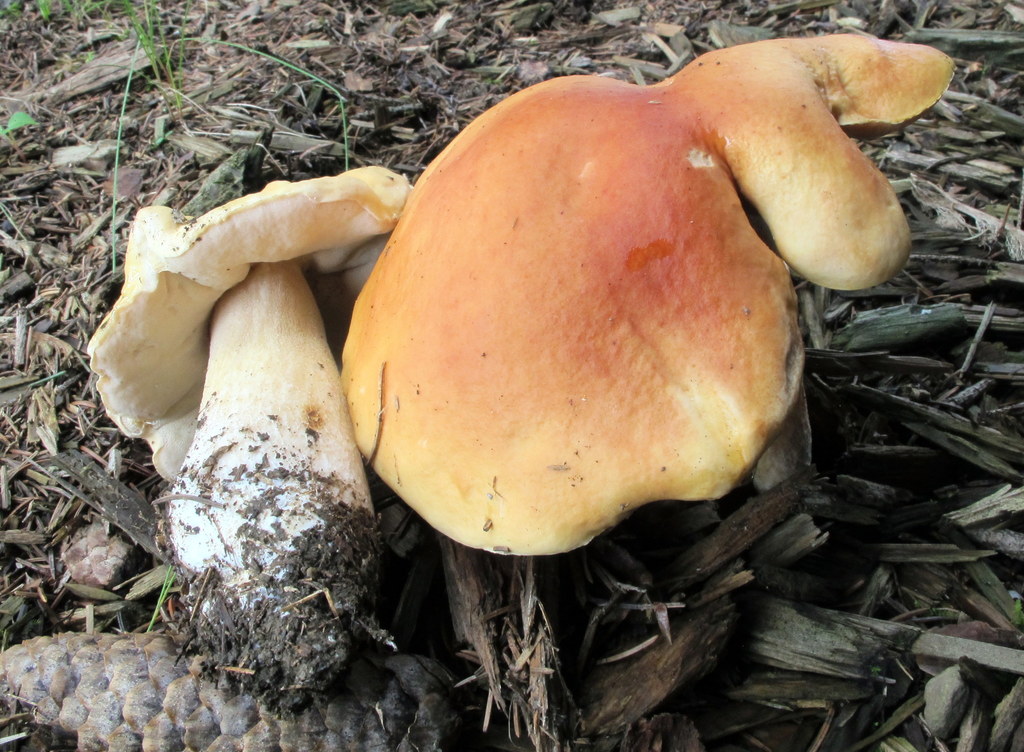
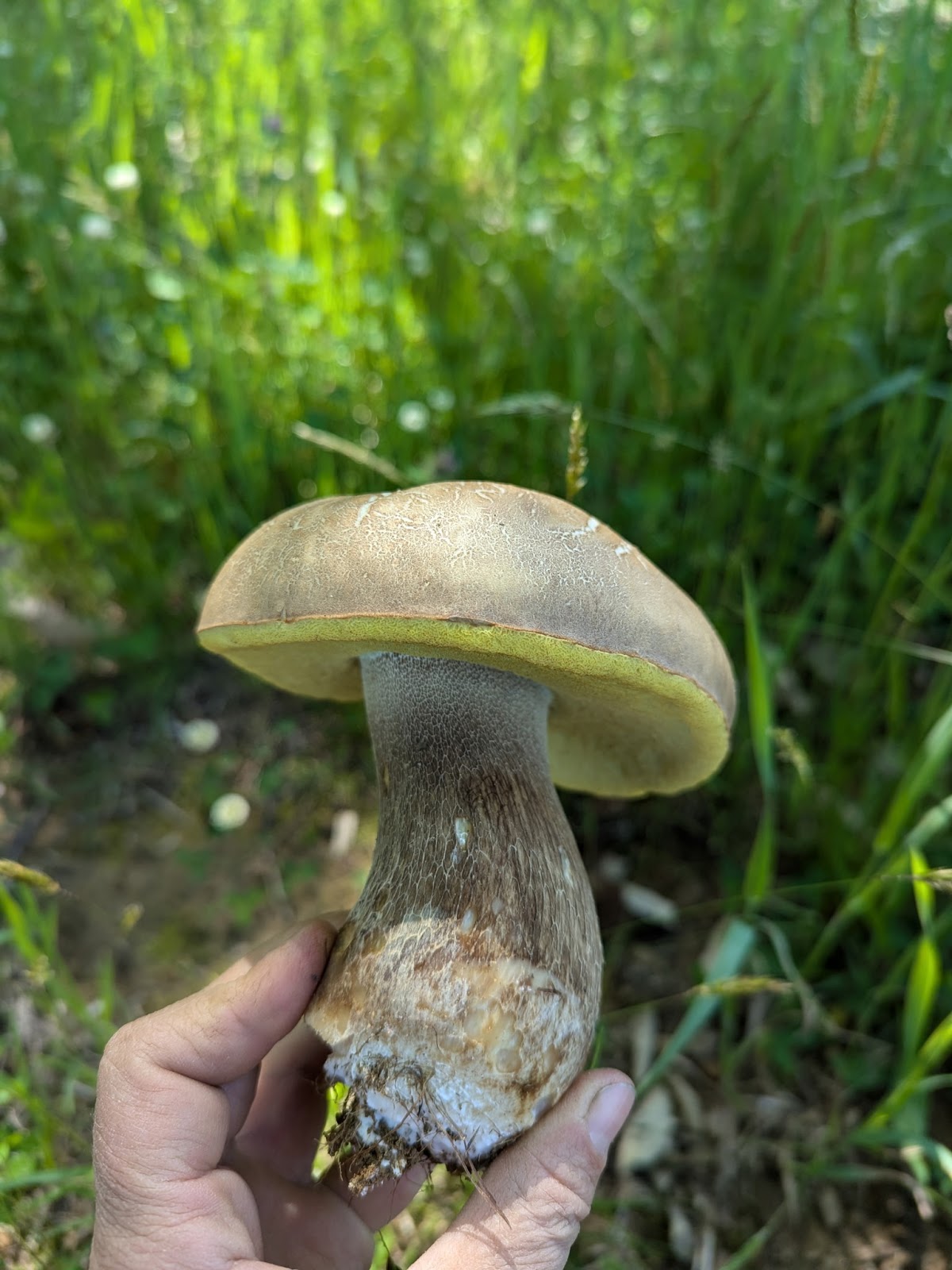
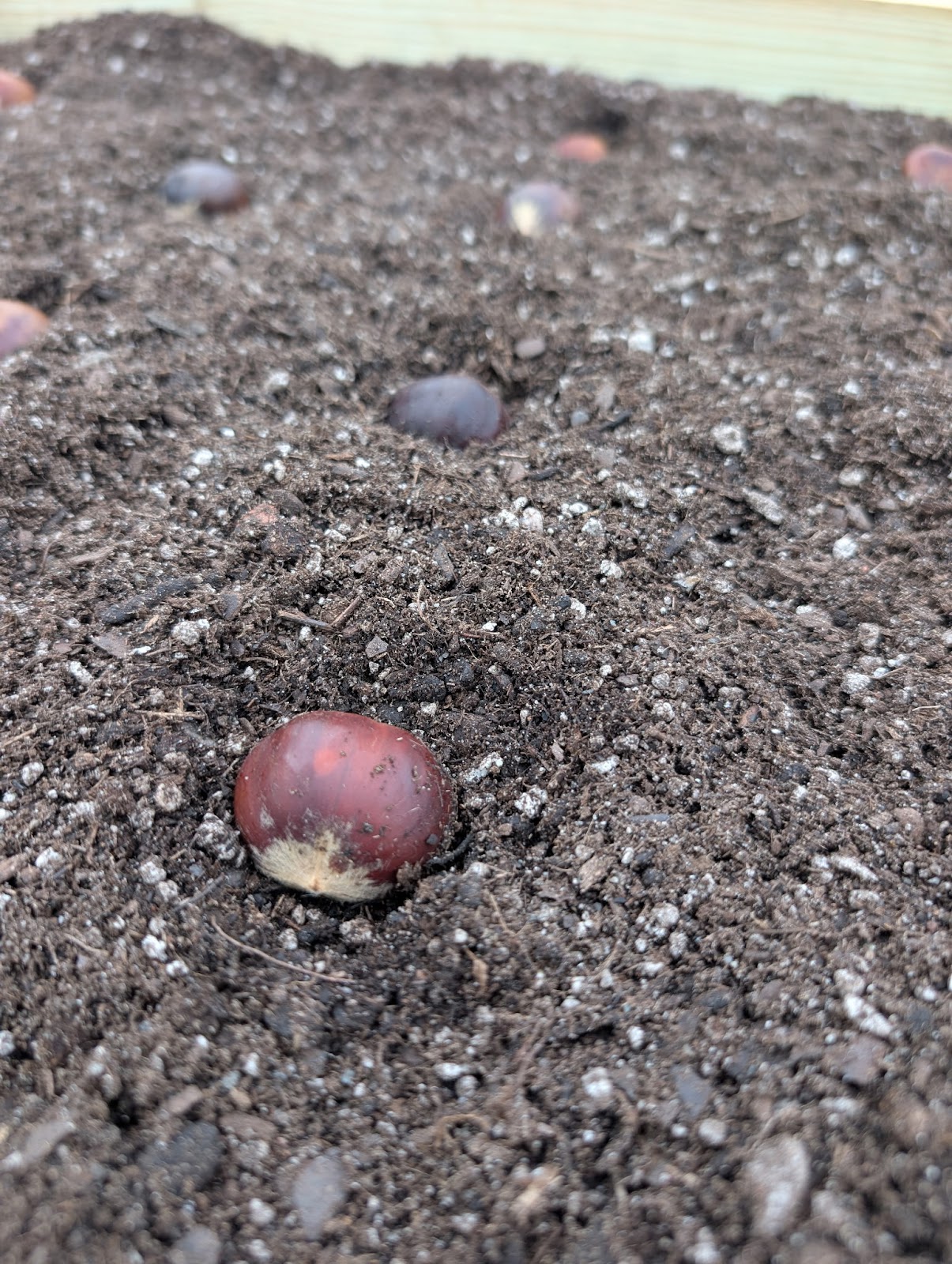
We have fully prepared to inoculate Chinese chestnut seedlings using the Mother Tree Treatment. In March, we will be planting stratified chestnuts that should be just beginning to germinate (these seeds are currently stratifying in a refrigerator in peat moss). These will be seeded two per planting site in a grid pattern, underneath a two adjacent rows of 10 chestnuts trees each (20 trees total), all of which are on a 20′ by 20′ spacing. This small area is part of a larger chestnut orchard that is completely protected by permanent metal deer fencing. This contiguous block of 20 “Mother Trees” was observed in June and October 2025 to have flushes of mushrooms growing underneath, presumably in ectomycorrhizal association with their roots. We believe those mushrooms are Boletus variipes fagicola, the Dark Brown Bolete, one of the tasty porcini species identified in the infographic shared on porcini species in Ohio. In this same site, the Cooper Orchard, other mushroom species that have been observed fruiting are what we believe to be Amanita muscaria guessowii, American Yellow Fly Agaric, and Baorangia bicolor, Two-Colored Bolete.

The June flush of Boletus variipes fagicola was larger than the October flush, by a long shot. The size of the flushes appeared to be linked to the weather. In 2025 leading up to early June, Carroll County Ohio had enjoyed steady precipitation levels of 1″ to 2″ per week. Later, a summertime drought meant we were surprised there was any porcinis at all in October.

Steps we have taken to prepare for the Mother Tree Treatment:

-We have signed an MOU with the owners of the mother tree treatment site/Cooper Orchard. Stephanie and Carl Cooper are the orchard owners and are members of the chestnut growing Route 9 Cooperative.

-We have purchased “milk carton” style tree tubes, from SpecTrellissing, to protect the seedling chestnuts in this planting from rabbit damage. Because of the deer fence, and because of the deer fence around the site where these seedlings will be transplanted in an open field for further study, temporary rabbit protection was all that we thought was warranted.

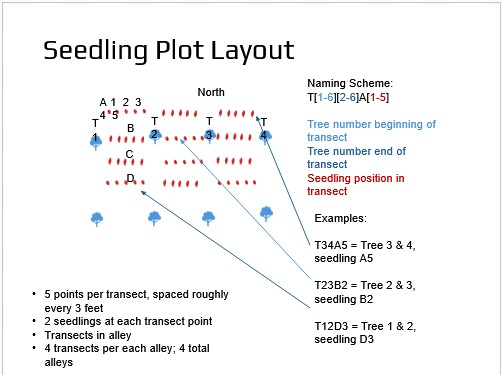
-We have developed a planting layout for seedlings in the Mother Tree Treatment. We will be planting two freshly germinated nuts per planting space in March. At first each milk carton will be labeled. After the seeds sprout, we will return in June to label all seedlings individually, for redundancy.
-We have submitted a sample of the October flush of mushrooms from the Cooper Orchard to Mycota Lab. The goal in working with Mycota is to use their inexpensive, high-throughput DNA barcoding program to get these mushrooms genotyped, and thus have the species identity of our Chinese chestnut-compatible Boletus genetically confirmed. Why is this important? Well, we want to be sure, for a plethora of reasons. Since many of the different species of Boletus have been revealed by genotyping to be sold, purchased and eaten under the false pretense of being B. edulis, we want to have transparent, honest, verified labeling of our porcini product in the future. “Eat Your Local Porcini” might become our marketing slogan. Additionally, since none of us have been to China and seen the Boletus bainiugan growing under Chinese chestnut in Yunnan, it could be possible that this somehow traveled with the Chinese chestnut here, and it would be good to rule that out. B. bainiugan is quite commonly sold under the name of Boletus edulis in the spice trade.

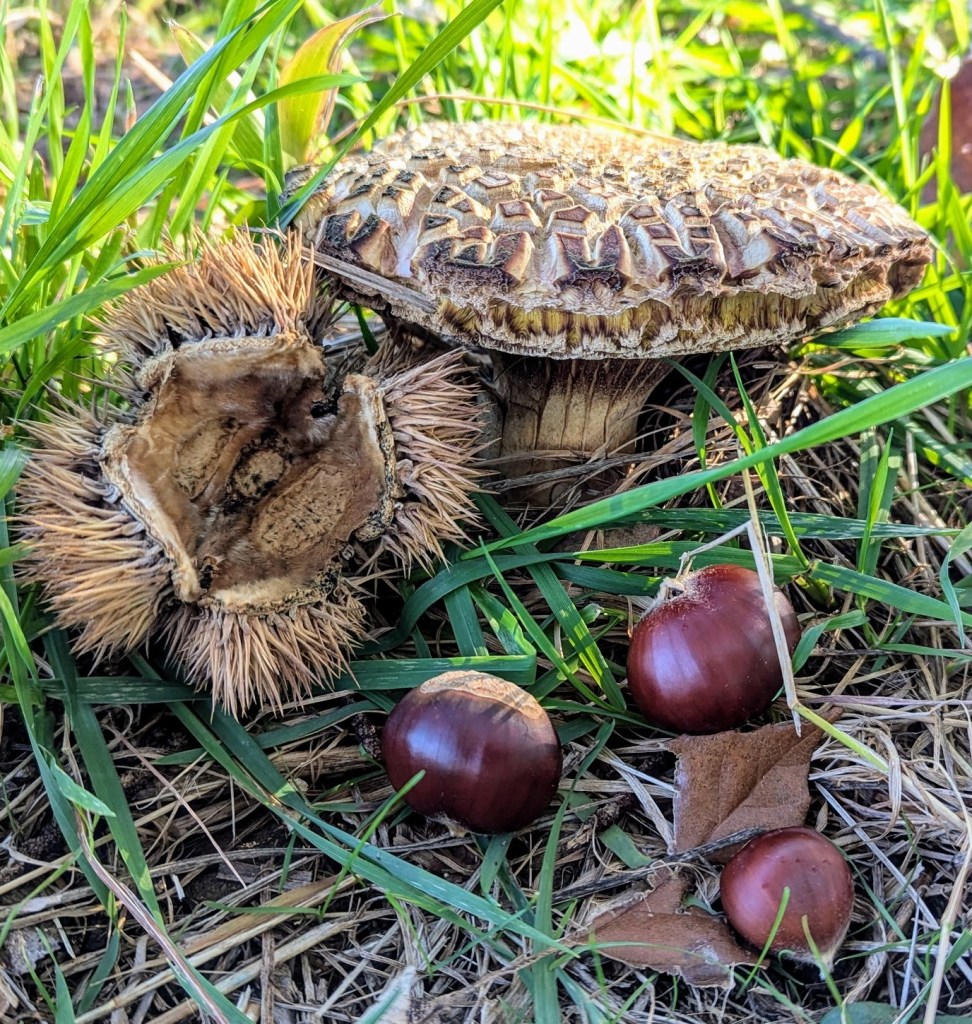
Mycota Lab deserves a plug for their assistance on this project, and really for their work in general. They are facilitating an amazing amount of citizen science, through the Continental Mycoblitz project. If you want to have a mushroom identified and genotyped, participation is easy. Read more about it on their website, but basically you make an observation of the mushroom on iNaturalist, you dry a sample of the mushroom, and then you print the specimen labels (including the iNaturalist ID number of your observation), and the team at Mycota will take it from there. See their website for details! Below is a picture of the mushroom we sent in from the October 2025 flush, a little over the hill but hopefully still usable for sequencing.


Liquid Mycelial Culture

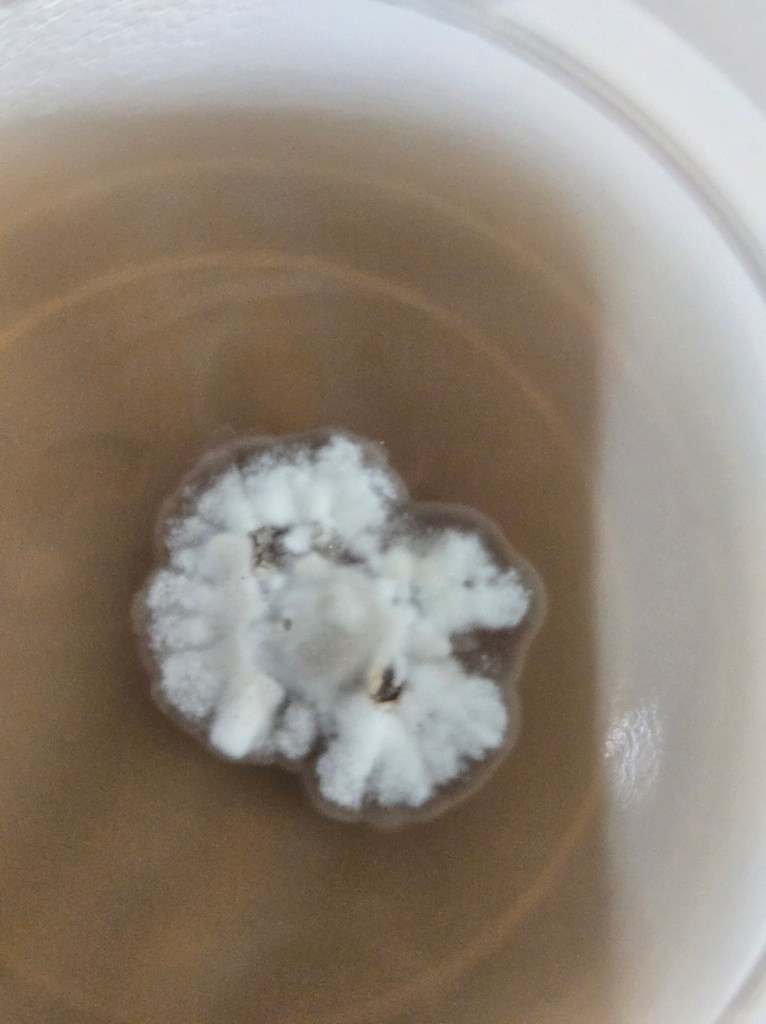
Mycota also received one of our slow-to-colonize Petri dishes from the June fruiting. Truly, the mycelium has grown tortuously slow on Even though We think both of those will come back from the lab, confirming it was the same porcini species growing under the Castanea mollissima trees for both fruitings, namely, Boletus variipes fagicola. While this is not the type species of the genus, it is sold commercially to high-end restaurants and used interchangeably with Boletus edulis. There is no doubt in anyone’s mind that B. variipes is native to Ohio, unlike B. edulis, which as far as we’ve been able to determine has not been seen confirmed as growing in association with any native or Chinese hardwood trees in Ohio. We are happy to be using a native species of mushroom for this project. However, the liquid mycelial culture we are seeking to produce for this experiment is looking less promising than we might have hoped. Thomas says that the literature did report the mycelium can be quite slow to grow on plates, and our experience bares this out. The mycelium from the June fruiting is growing slower than anything Thomas has attempted to grow before, including Tuber canaliculatum, a native truffle species which some people are excited for as a candidate mycosilviculture crop.

We’re not sure that the liquid mycelial culture couldn’t still work, but we may need to go back to the drawing board in terms of the nutrient recipe. Also, picking the porcini when it’s still in the dense, early button stage, before any worms or discoloration or bacterial composition sets in, seems like a crucial step to ensuring the purity of the strain. Thomas thinks there may be contamination on his June plates, though he has employed various procedures to clean up the plates of suspected unwanted mold, with some success.
Spore Solution Treatment

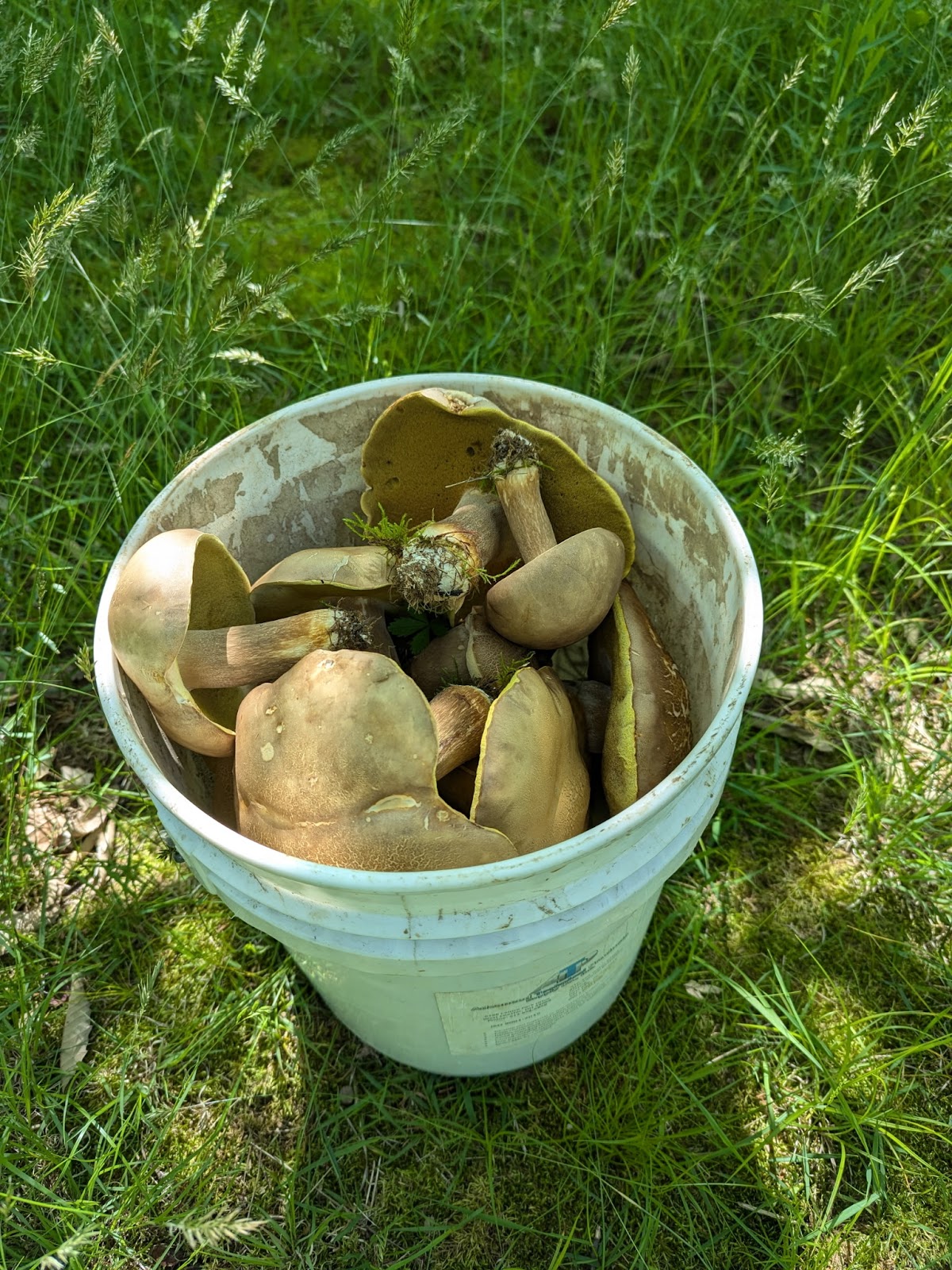
Perhaps our biggest gaff in the project so far was that the large flush of mushrooms in June, which we had intended to use in the spore solution treatment on chestnut seedlings grown in autoclaved soil, was eaten before the pickers realized we needed the whole batch, and not just a sample to send to Thomas at MidAm Mushrooms and Stephen at Mycota Lab. There was some confusion with the autoclaved soil being fully of weedy seeds about a rational next step, as we had intended to introduce the spores as to chestnut seedlings growing in demonstrably sterile potting medium, which it turned out we just didn’t have access to without a steam wagon (large-batch sterilizer, sometimes used in fish canneries). To prevent the mushrooms from going bad, Amy decided to freeze the large haul of mushrooms for later use. Dietrich pointed out that freezing the mushrooms almost certainly would have adversely effected the viability of the spores from those mushrooms, much to our chagrin. Thus Amy ended up sharing those mushrooms as a feast with the Route 9 Cooperative members. That is to say, for the first time, Ohio’s chestnut farmers as a community had an ad hoc culinary experience with the porcini that were harvested from beneath their very own trees. The good news from this is they were reportedly delicious, and furthermore the Boletus variipes fagicola were indistinguishable from Boletus edulis strico sensu. Additionally, none of the porcini taste testers noticed any adverse gastrointestinal effects or other negative symptoms from consuming the stir-fried mushrooms. While Ohio Mushroom Society newsletters have shared Boletus recipes in the past, it is helpful to get confirmation of the delectability and inoffensiveness of our candidate native porcini crop species. Below is an image of the stir-fried B. variipes fagicola from the Cooper Orchard.

Conclusion

We will continue to strive towards comparing the three inoculation methods (mother tree treatment, liquid mycelial culture treatment, spore solution treatment). At this point, the liquid mycelial culture treatment would benefit from starting with a fresh button-stage mushroom from the Cooper Orchard, to reduce the chances of contamination. This would also give Thomas more chances to test for different growing medium which the B. variipes fagicola could colonize more expeditiously. Meanwhile the liquid mycelial culture treatment is also dependent on another flush of mushrooms from the Cooper Orchard. This time, the same day that the flush is observed, Badger will take the mushrooms to Cincinnati, and use them to apply a spore slurry to several air pruning beds full of Castanea mollissima seedlings that we have growing already. While the growing medium their in was never autoclaved, it was in pure pine bark fines with some minimal fertilization that should have washed out or been absorbed, entirely, by this point. We believe this low nutrient, acidic environment can be a reasonable environment for the spore solution to take hold. All treatments will be followed up with testing the seedling root tips for the presence of living Boletus variipes fagicola mycelium. We’d like to thank North Central SARE for their support of this project.

Post Script (2025.01.29)

After sharing this research update in the Facebook group Chestnuts as a food crop – Castanea species nut trees, we heard a few interesting things that are related to chestnuts and mycoforestry. Namely, Stubby Brittlegill/Lobster Mushroom, as well as Truffle species, have indicator plant species that have been found growing abundantly in chestnut orchards. This co-occurrance of understory plant with culinary mushroom is similar to how moss on the soil surface seems to be a prerequisite to finding King Bolete mushrooms nearby. This is turning into a useful body of lore. It seems like this should be written down somewhere, so I am taking note of it here for later consideration.

-It was reported that in Vermont, there is a non-native orchid species that has been found growing beneath chestnut trees. A botanist identified the orchid as Epipactis helleborine, broad-leaved helleborine. This species of orchid is dependent on mycorrhizal fungi. Of interest to mycoforestry, broad-leaved helleborine has been identified as a significant indicator species for truffle mycelium (Tuber sp.) living underground. When you pair that fact with recent research on multi-cropping edible truffles (a genus of many different gourmet culinary species) with chestnut trees., it begs the question if this non-native orchid might be pointing to truffles growing spontaneously in existing chestnut orchards.


-Another strange plant growing abundantly in some chestnut orchards, that may have a connection to future mycoforestry research, is Ghost Pipe, Monotropa uniflora. Ghost Pipe has been reported in that group to grow abundantly in some chestnut orchards in Pennsylvania. Ghost Pipe is a non-photosynthetic plant, a mycoheterotroph that gets its energy from the ectomycorrhizal fungal species known as the short-stemmed russula or stubby brittlegill, Russula brevipes. It is known that stubby brittlegill is edible, and while initially it has a bland or bitter flavor, these mushrooms “become more palatable once parasitized by the ascomycete fungus Hypomyces lactifluorum, a bright orange mold that covers the fruit body and transforms them into lobster mushrooms.” I have eaten lobster mushrooms, these are delicious. So Ghost Pipe growing in a chestnut orchard would seem to point to the presence of palatable species of ectomycorrhizal fungi. It should be noted that extracts of Ghost Pipe are being used by contemporary herbalists as a folk remedy, taken for relieving pain, grief and anxiety.


2025.06.24 #1 research update on “Chinese chestnut seedling mycorrhization with porcini”

Introduction 

Supported by SARE, the Southern Ohio Chestnut Company has begun a farmer-led research project. “Chinese chestnut seedling mycorrhization with porcini”. This is our first update to the public.

Porcini mushrooms go by many names. This project works with porcini specifically –Boletus edulis– and also a group of other closely related “King Bolete” mushroom species from the Boletus genus. In practice, King Boletes are all harvested, traded and cooked rather interchangeably. They are all high-dollar culinary mushrooms. King Boletes are different from most other cultivated mushrooms in that they don’t normally break down logs or wood chips or bags of grain for their nutrients. Instead, they symbiotically trade resources with host trees- energy from the tree is traded for soil nutrients and water, between the ectomycorrhizae of the King Bolete and the fine roots of the tree. Because of this foraging strategy, would it surprise you to know that most King Bolete mushrooms are harvested from the soil surface? Yes, King Boletes are harvested in chestnut, conifer and oak woodlands, plantations and orchards. 

There has been successful inoculation of chestnuts and conifers in Europe and Asia. More research is needed into the basic biology of porcini as it relates to the inoculation of Chinese chestnut seedlings, however. To our knowledge, no chestnut grower in North America has derived significant income by selling the ectomycorrhizal mushrooms from their orchards. We hope to be the first! If this is exciting to you, follow these updates to learn along with us!

What have we learned and accomplished so far?

King Bolete identification and nomenclature

At Martha Bishop’s recommendation, Badger Johnson and Aly Gordon attended a spring 2025 foray with the Ohio Mushroom Society (OMS) in Lake County, OH. OMS is a chapter of the North American Mycological Association (NAMA), and puts out “The Mushroom Log” as a bimonthly newsletter. We suggest to everyone reading this, if you haven’t already,  join NAMA and your local chapter! It is of good value, for learning mushrooms on forays, in newsletters, and with many exclusive online classes and lectures. We search the Mushroom Log for King Boletes identification guidelines. Here is some of what we learned:

“Current research indicates that genus Boletus in N. America will eventually be whittled down to include only the “kings” –Boletus edulis, Boletus variipes, Boletus separans, & a few others.” -David Wasilewski

“This group (editors note: this group consists of the King Bolete group referred to above) is characterized by having a pure white pore surface in the young fruitings, which changes to yellow and finally greenish olive. The flesh is white and does not bruise. The stem is typically reticulate but mostly near the top… reticulation is white.” 

-Dick Grimm

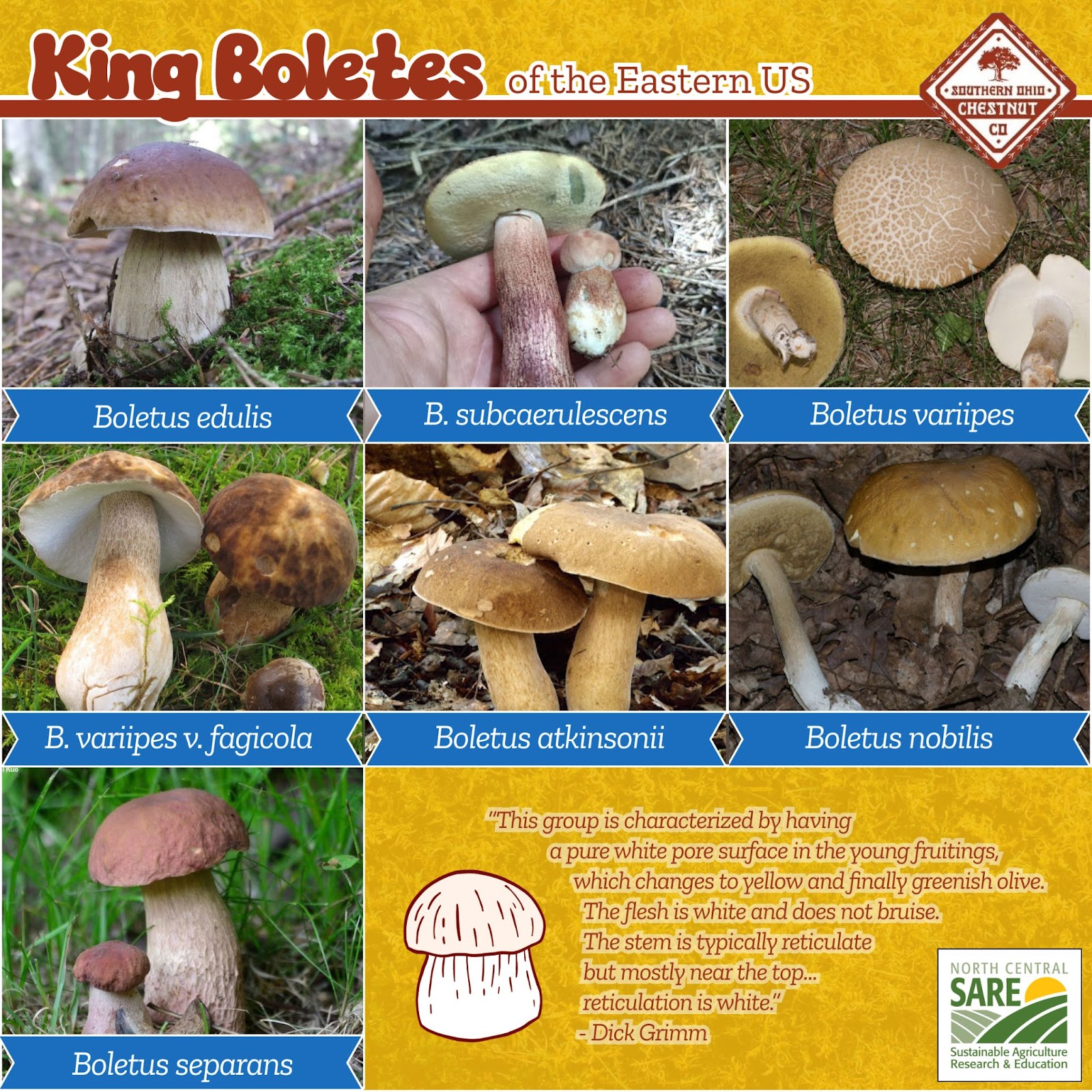
This trend that Mr. Wasilewski described, of geneticists reclassifying every species from genus Boletus that doesn’t look like a King Bolete, has held constant ever since. In the eastern US, genus Boletus now includes only Boletus edulis, Boletus subcaerulescens, Boletus variipes, Boletus separans, Boletus variipes var. fagicola, Boletus atkinsonii and Boletus nobilis– all of which are culinarily considered King Boletes. This is a favorable situation for farmers, field biologists & foragers- all are choice edibles! Dr. Bryn Dentinger lays it out nicely in the chart below in his talk “ Boletus edulis update presented by Dr. Bryn Dentinger (UMNH) via Zoom on November 17 2022”. We made an infographic for the species native to the eastern US.

An accidental successful inoculation and annual harvest of King Bolete in Ohio

Martha introduced us to Walt Sturgeon. Walt is a mushroom field identifier and teacher of great renown in OMS. Walt is also the author of “Appalachian Mushrooms: A Field Guide”. He is a native of East Palestine, OH. More than 10 years ago, Walt inadvertently inoculated Norway spruce trees in his neighbor’s backyard with King Bolete. The inoculation occurred from spreading shavings and rinse-water outdoors, which he produced from mushrooms that he foraged and ate. Every summer, from under those Norway Spruce, he now harvests King Boletes where there where none before, under just three medium-sized yard trees! These pictures are from Walt’s iNaturalist observations, from this remarkable accident.


Indicator Species


We learned about “indicator species” for King Boletes. Fly Agaric Amanita muscaria mushrooms and ground-growing moss species including Delicate Fern Moss Thuidium delicatulum are good indicator species, if these are growing under host trees for King Boletes. These are used as rapid site compatibility clues by professional Tom Patterson, such that without ground-growing moss, a site is often not worth looking at.  Ian R. Hall has said “Boletus edulis is commonly found with Amanita muscaria… in China, England, New Zealand, and the USA, an association also noted… in France and…  in Austria. This may be because (Amanita) have similar ecological requirements and fruit at similar times of the year or it might reflect a biological association.” Tom said something like “When you see that Amanita muscaria is coming up in your King Bolete honeyholes, come back every three days to check for King Boletes.” Dr. Giovanni Gamba (University of Turin, Italy) told us about a Boletus edulis liquid mycelial inoculation for Castanea sativa (Myco Chest), which includes the edible Amanita caesarea. Mentioning edible Amanita should not detract from the “scare factor” of the deadly poisonous Amanita mushrooms that do exist, and which every forager should learn to identify and avoid. Take-away: King Boletes travel with Amanita mushrooms and ground-growing moss.

Timing Tips and Foraging for King Boletes on Abandoned Christmas Tree Farms

“The best months to forage for King Boletes in Southeast Ohio vary year to year. It depends on having enough rain (1-2 inches/week) and temps in the 80’s. On an average year, from best to worst: September, October, August, May/June, July.” -paraphrasing Homer Elliot

In May, these conditions occurred in Athens County, OH. With permission, we visited a 20+ year old Norway spruce planting, a commercial Christmas tree farm. We found Amanita muscaria had been flushing for week+, and that Boletus subcaerulescens was coming up.

Starting Chinese Chestnut seedlings, foraging King Boletes for inoculum

In late May & early June, Tom Patterson and Amy Miller shipped freshly foraged King Bolete mushrooms overnight to Thomas Lodge’s lab. Our specific mushrooms came from over-mature Christmas tree plantations in PA and a unique Chinese chestnut orchard that sits on a former oak woodland in OH. We have tentatively identified Boletus variipes from the OH site. Genotyping with bioinformatics analysis will be necessary to confirm this identification.

Thomas says that our King Boletes are successfully growing on the Petri dishes, see his video explanation here. Chris Smyth at Deer Orchard Nursery in Cincinnati has been watching the late-planted chestnuts begin to germinate. He tried a delayed germination technique to make the trees to order, such that the seedlings would not have been growing for very long before we could expect to see King Boletes in spring 2025. Chestnut seedlings started germinating but the germination rate to date has been much lower than when germinating chestnuts early in spring.

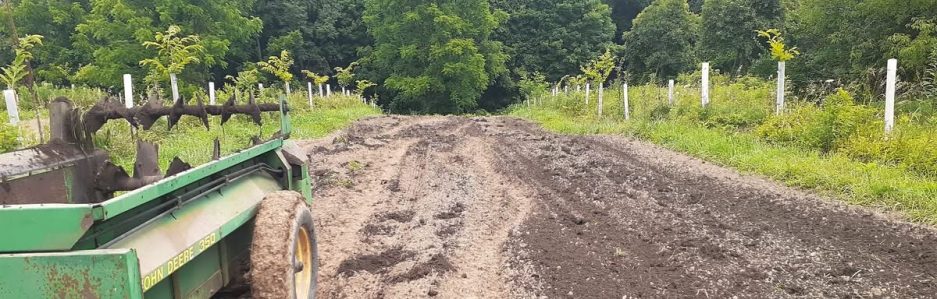
Chris built air-pruning beds and filled each with an autoclaved potting mix, and observed weed seeds germinate later. The pasteurization was not completely effective, as Dave Moore predicted. Soil is notoriously difficult to sterilize. Thomas says we could try a soil pasteurization wagon. Here are pictures of the potting mix, transported from by pickup truck in sealable, stackable plastic crates. You can see the freshly planted chestnuts in air-pruning beds, following methods from Perfect Circle Farm and Yellowbud Farms.

The potting mix was sourced from Nathan Rutz of Tilth Organic Living Soil. He designed this mix for us based on lengthy conversations about the need for some nitrogen in the form of dead organic matter, good water-handling capabilities, an acidic pH of less than 6.5, and reviewing the literature for what others had used. Others may raise their eyebrows at the addition of compost, but given the hard to predict nature about when our King Bolete inoculants would be ready, we decided that some rich compost could be an important source of nitrogen for ectomycorrhizal fungi to enzymatically break apart and disperse to chestnut seedlings.

Sand: 5%

Compost: 15%

Perlite: 20%

Pine Bark: 20%

Peat: 40%

Lesson Learned

With a goal of inoculating new chestnut seedlings, we should have developed the inoculant in sufficient quantity, and then autoclave the soil, and then germinate the chestnut seedlings at the first good opportunity. This order of operations would reduce the opportunity for other soil microorganisms to accidentally be introduced through the air into the autoclaved potting medium, and allow enough chestnut seedlings to be available simultaneously. Thus, we may delay inoculating chestnut seedlings until spring 2026, with a goal of germinating chestnut seedlings earlier in the spring.

A Mother Tree Site

Members of the team visited a Norway Spruce where Boletus edulis fruiting bodies have come up the last few autumns to assess where chestnut seedlings could be planted for the “mother tree method” of inoculation. The type species of the King Bolete genus- B. edulis– is said to almost exclusively fruit under Norway Spruce in North America, but fruits in association with virtually every deciduous and coniferous tree species in Europe except European larch. Why it would be host-specific on one continent and generalist in the US is an area of research for the Dentinger Lab.Interestingly enough, B. chippewaensis, which is found under some hardwoods, turns out to be genetically identical to B. edulis despite appearing phenologically distinct!

Dr. Dietrich Epp Schmidt shared a summary of where the project is at, more broadly.

“Scientifically, we’re still a long ways away from being able to say anything definitive about inoculating chestnuts with King Bolete based on our own experiment. But, there’s a lot of learning that has already shaped the project. There are a few key insights that surfaced during our proposal writing, and which I found to be exciting. First, our back of the envelope calculation suggests that during good years the market value of the King Bolete yield could easily eclipse the market value of the chestnut crop. This is a huge benefit to the farmer! Our proposal is focused on providing an incremental improvement to farm financial viability by increasing the growth rate and resilience of seedlings, thereby (hopefully) decreasing the time to market by a few years for newly planted orchards. However, the economic value of the mushrooms themselves offers a long-term vision of multiple revenue streams for the farmer from one cropping system. We love to see it!

Along the same lines, our proposal was focused on producing mycorrhized seedlings. However, we found evidence that suggests that it is likely that mature trees can successfully be inoculated, and that the development time for the mushrooms on mature trees is significantly shorter. If true, this is a huge development! It means that from the mushroom’s perspective, the main limitation for fruiting is having a tree partner that is able to supply sufficient carbon. From a production system perspective, it also means that mature chestnut orchards could also cash in on the King Bolete inoculants we develop, and start producing their own King Bolete. It further opens the possibility that we can develop the methods to inoculate mature hazelnut and pecan orchards with culinary mushrooms as well.”

Thank you to our sponsors, collaborators and fellow travelers. Please get in touch if you’d like to discuss this with us.

Controlling ginseng diseases in your commercial ginseng planting

People frequently ask me how to control disease in ginseng, particularly damping off disease (caused by Rhizoctonia solani ), foliar leaf disease (caused by Phytophthora cactorum ) and black root rot (caused by Cylindrocarpon destructans). Because this is an FAQ, here is an answer. Start by checking out this paper for the background. As you can see, the first two diseases don’t effect goldenseal or black cohosh, the last disease only effects seeds/seedlings of these herbs. So for people who want to prevent these diseases from impacting yields on their ginseng forest farm, I suggest spacing out your ginseng beyond what the “rake and scatter” method sometimes results in. Using the extra vacant space, you now have room for interplanted goldenseal, which can grow into a barrier around your ginseng. While goldenseal seed is perhaps an under-utilized forest farming resource (I have been saying this for years), in our scenario where damping off disease may actually already be present, in lethal quantity, in the exact spaces where ginseng seed was planted but failed to establish… deploying a goldenseal rhizome seems advisable. This topic is pretty well covered by Adrianne Sinclair and Paul M. Catling in an obscure publication that has been reproduced with permission by the NRCS. One forest farmer they interviewed called ginseng and goldenseal “‘the king and the queen,’ the ‘queen’ (goldenseal) being more robust and reliable.” At some point you will harvest the ginseng, and then the goldenseal can be left to fill in those spaces.

Details:

  1. For planting the ginseng seed, I use a Dr. Ming’s ginseng seed planter. The picture below shows a friend of mine planting ginseng seed with this planter. This tool allows you to achieve good seed singulation, which saves money, as you can plant plant just 25% the weight of seed you would using the rake and scatter method. Think about it- 3 or 4 lb seed/acre vs 15 or 16 lb seed/acre. $105/lb for ginseng seed that’s a big difference!
  2. Because you have precise control over seed spacing, plant the ginseng seed on a 1.5′ to 2′ grid in the late autumn.
  3. The following summer, observe where the ginseng has and has not germinated. Mark spots for replanting with one color of surveyor flag, and spots equally spaced between the rhizome seedlings as well.
  4. After the ginseng leaf senescence in the autumn, and once the soil moisture is adequate, replace each flag with a goldenseal rhizome. Rhizome should be 2-3″ inches in length and have multiple buds and rootlets. Take care not to damage buds.

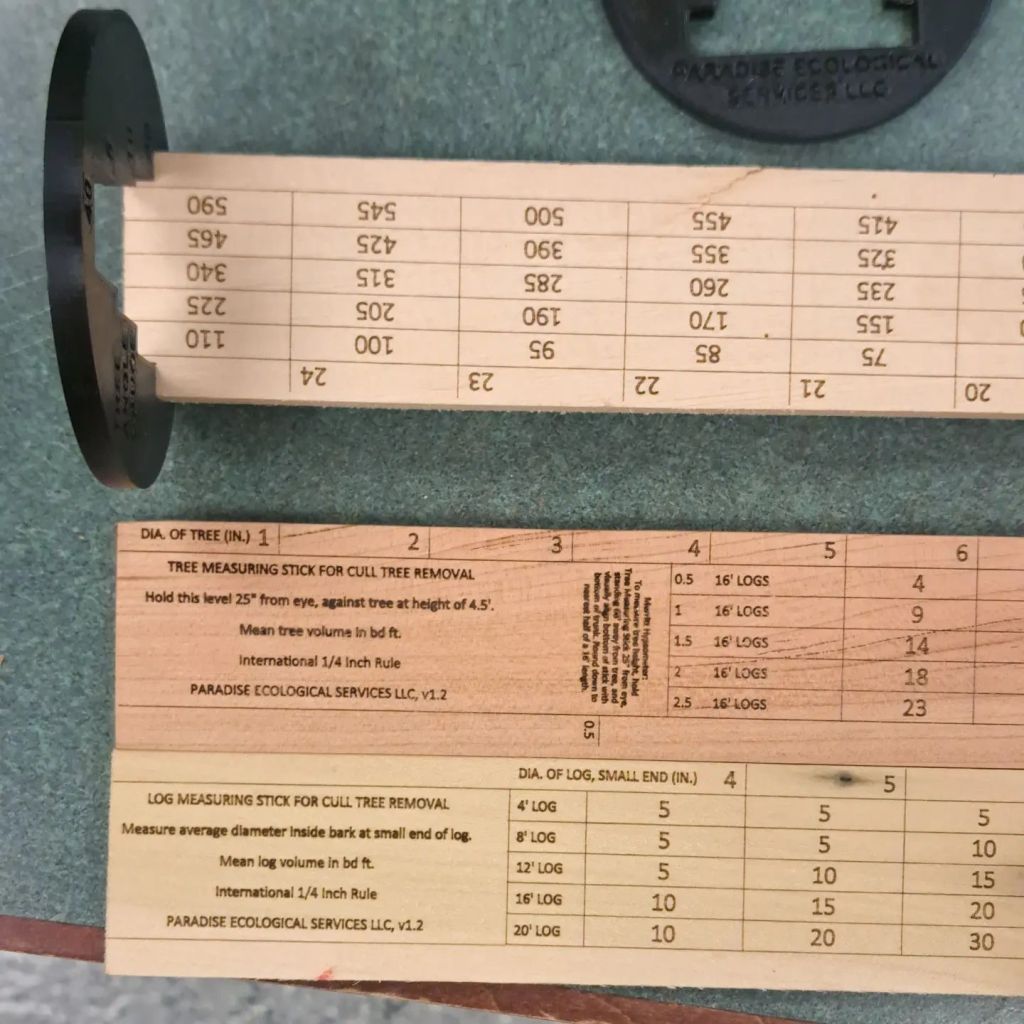
Agroforester’s Tree and Log Measuring Stick with Cruising Prism

I have a tool to share. It is used in a similar way as the classic forestry tools known as the Biltmore stick and the cruising prism. But it is used for different purposes. My adaptations are designed with other agroforesters in mind, as well as consulting forestry clients managing their private non-industrial forest.


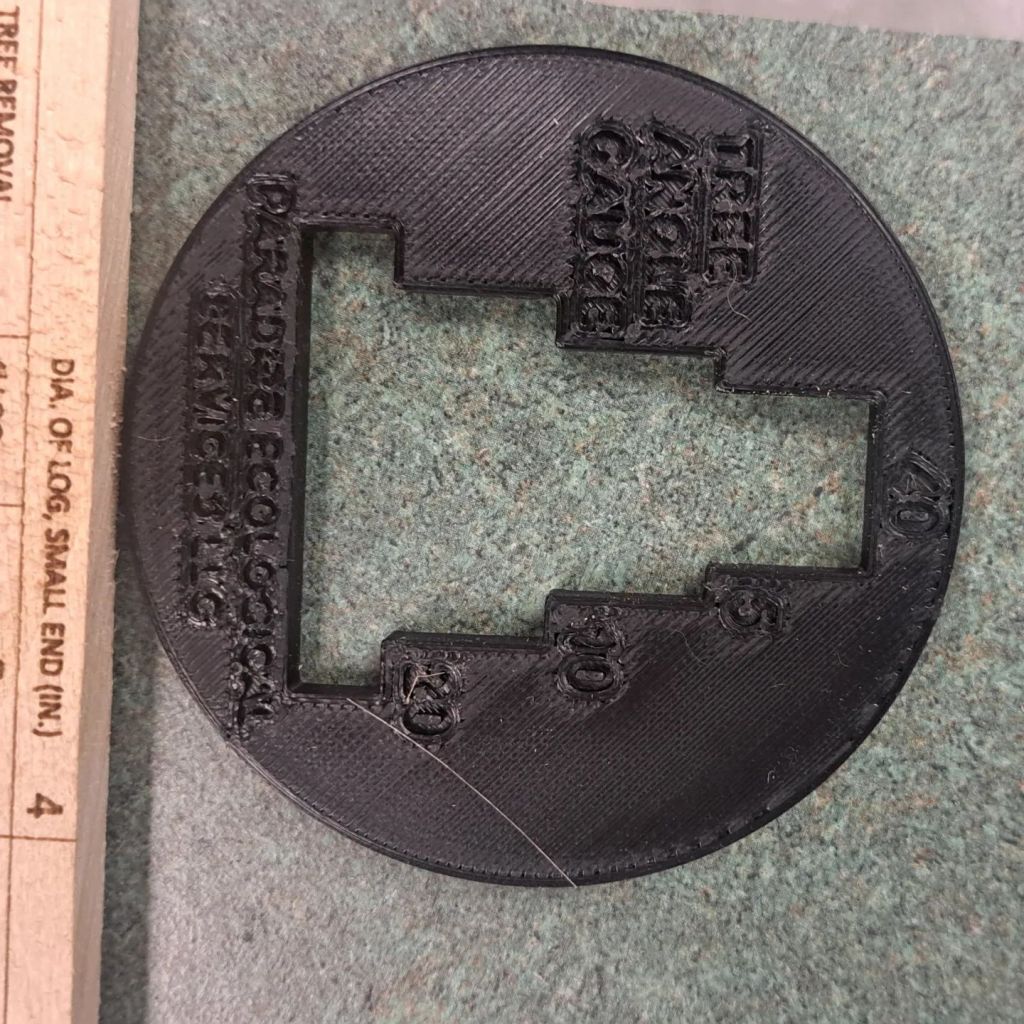
These tools are for people who do forest stand improvement, & for whatever reason want to measure “waste wood” from these treatments. For agroforesters pursuing forest farming, this tool is handy. You might find yourself thinning overstocked oak woodlands in order to better cultivate sun-adapted NTFP herbs, such as black cohosh. Cutting trees out without selling to a logger means cutting small diameter trees to make growing space for healthy larger trees. These cull trees may be suppressed, they may be of a species that isn’t part of the plan, or maybe there are just too many trees and competition between them has grown fierce. Either way, logs from this light-on-the-land management have many uses. Timber-framing elements are useful in green building, with the smaller logs useful for mushroom bolts, and the even smaller poles useful for various crafts and as fuelwood.


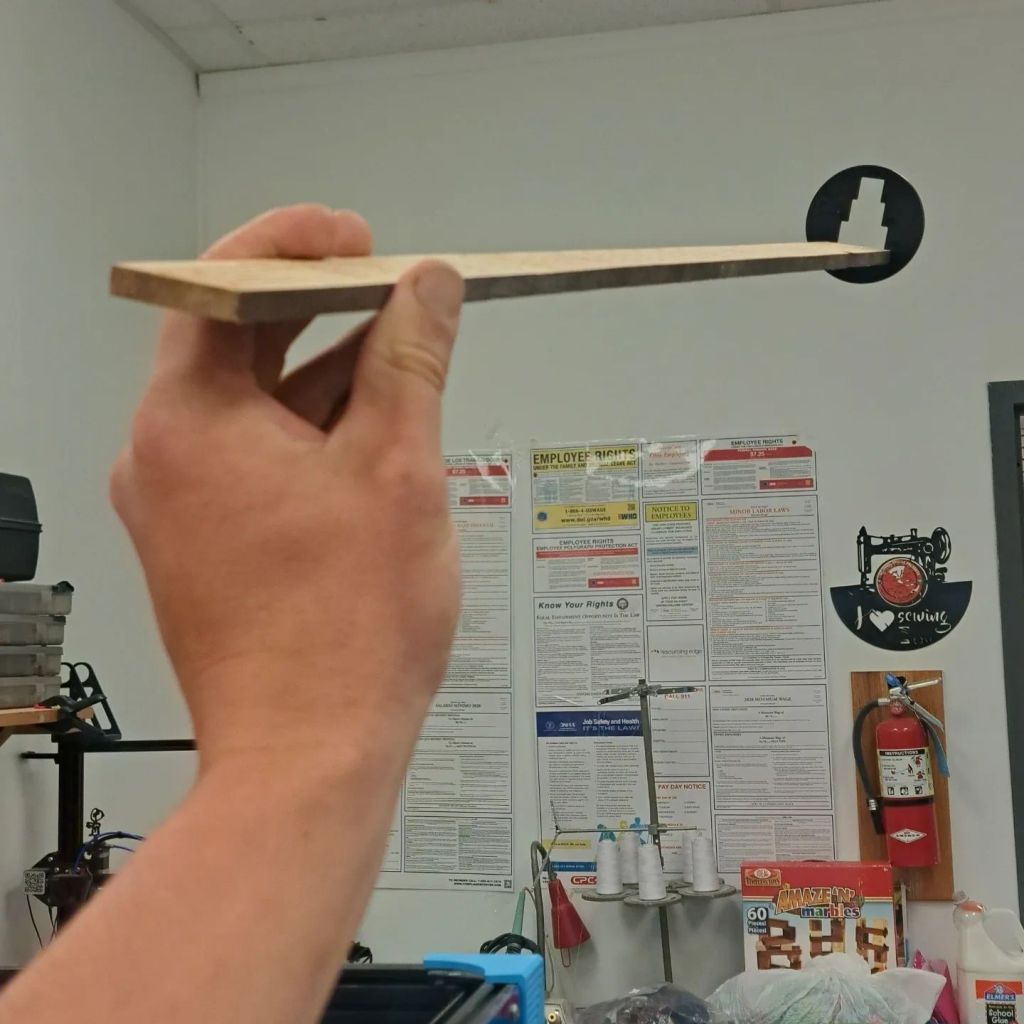
This was manufactured by me and friends working together at the Athens Makerspace, with design sessions happening in our homes. Special thanks to Asa Peller (A-STUDIO) and Henry Hellbusch, as well as Pauline Phillips (our Makerspace guardian angel). It is because of these specialized uses for small roundwood that we started this project, because now the board foot scale on both sides of the measuring stick goes down to half a 16′ sawlog, and uses the International 1/4 Rule- rather than Doyle Rule. Thus we avoid underestimating timber volume from the narrower & shorter logs, which is a classic problem with tree measuring sticks. Because we didn’t need our stick to be 36″ long to measure the diameter of small roundwood, we made it 25″ long. This allows us to attach a 3-D printed angle gauge (a type of crusing prism), for variable radius plot cruising.

The 25″ length of the stick is the same distance that the angle gauge must be held from one’s eye. Thus you can hold the stick up to your face and look through the angle gauge, at the precisely correct distance from your face for conducting forest inventory.

I hope users will find adapting and combining these inventory tools to be very useful. If you would like to purchase one of these, please reach out to me through this website.


Badger Johnson for Paradise Ecological Services LLC

Carya illinoiensis


Carya illinoinensis, “hardy pecan”
Juglandaceae

Gregory Ormsby-Mori of the University of Missouri Center for Agroforestry posing with a wild pecan tree at HARC in New Franklin, MO. Right picture is of seedlings coming up on loess-capped River Hills pasture, on top of a ridge, near the Missouri River. Dr. William Reid wrote a good piece for UMCA a few years ago on growing pecans in Missouri, you can check it out here. Mid-MO is sometimes called “Little Dixie” because of the influx of Kentuckians who initially moved into the area during colonization, and these Southerners brought their fondness for nuts (pronounced “pee cans”) with them. Boone County is near the northern edge of this plant’s productive range.

Best grown in humusy, rich, moist, well-drained soils in full sun. Difficult to transplant because of its deep taproot. It is for this reason that (according to Aaron Templemire, president of the Missouri Nut Growers Association) pecans that come up on their own in Nevada and Brunswick, MO grow faster and more reliably than planting potted seedlings. People typically top work (graft) scion wood of particular cultivars onto these wild seedlings.

There’s a great piece on Kansas pecan orchards in “Braiding Sweetgrass“.

If grown for nut production, plant at least two different varieties for best cross-pollination. Nut production can be sparse in the northern part of its growing range, particularly when spring is late and summer is cool. May be grown from seed, but it normally takes 8-10 years for a young tree to bear a nut crop.

A large deciduous lowland tree that is the largest of the hickories. It typically grows 75-100’ (infrequently to 150’) tall with a large rounded spreading crown. Trunks mature to 2-4’ in diameter. It is native from Iowa, Illinois, Indiana and Ohio south to Alabama and Mexico, being primarily found in the Mississippi River valley and the valleys of its principal tributaries. Pecan features medium green, odd-pinnate, compound leaves, with each leaf having 9-17 pointed leaflets. Leaflets range from 2-7” long. Leaves mature to yellow green in summer, eventually turning yellow brown in fall. Non-showy, monoecious greenish yellow flowers appear in April-May, the male flowers in pendulous catkins (to 4” long) and the female flowers in short spikes. Female flowers give way to sweet, edible nuts. Each nut is encased in a thin husk which splits open in four sections when ripe in fall. Pecans are an important commercial nut crop in the U.S. Most pecan commercial plantings are located in the southern U.S., from North Carolina to Florida west to Arizona and California. Many cultivars are available.

Genus name comes from the Greek word karya used for walnut trees.

Specific epithet means of Illinois, which is part of its native range.

(Missouri Botanical Garden)