Tripsacum dactyloides


Tripsacum dactyloides, “Eastern Gamma Grass”
Poaceae

A premier native forage species for domesticated ruminants, this warm season grass also has maize-like edible seeds. Until the government told them they couldn’t slaughter their own animals onsite (and it is pretty onerous to have to load bison in a truck and take them anywhere, they’re huge and wild), there was an exemplary silvopasture in northern Missouri using bison, Tripsicum and hardy pecan (Carya illinoiensis).

Last I heard, the Land Institute is trying to cross T. dactyloides with other species to make a new perennial crop. Thanks Neal Humke for the tip. In the words of the inimitable Eric Toensmeier, “Corn (Zea mays) has perennial relatives and can also be crossed with hardy perennials including Eastern gammagrass (Tripsacum dactyloides). Work at the Land Institute has made substantial progress towards developing perennial corn. Land Institute breeders report that with sufficient funding a perennial corn could be ready for field tests in as little as ten years. One challenge is that the perennial rhizomes that overwinter the plants are not cold hardy, so breeding is focused on deeper rhizomes that survive below the frost line. Of course this consideration is not important in the tropics where millions of people rely on corn as a staple.”

Eastern gamma smells like cucumber if you break the base and has beard coming of sides of joints.

Perennial, with short stout rhizomes, forming clumps.

Stems 70-250 cm, base of culms flattened.

Leaf sheaths rounded to keeled on back, glabrous, ligule is a short membrane with a fringed margin. Leaf  blades 10-70 cm long x 7-20 cm wide, glabrous or somewhat hairy at base, midvein white and noticeably thickened, margins saw-toothed.

Inflorescences consisted of 1-4 dense, spike-like racemes. Staminate and pistillate spikelets in the same inflorescence, staminate ones toward tip and pistillate ones toward base. Glumes hardened and bony, somewhat resembling corn kernels. Blooms early-mid summer.

In Missouri, found in upland prairies, glades, savannas, less commonly in woodlands, roadsides, fields.

(Hybrid MOFEP/National Park Fire Ecology Manual)

Ceanothus americanus


Ceanothus americanus, “New Jersey Tea”, “red root”
Rhamnaceae

First pic from roadside at MOFEP (outside of Winona, MO), second pic from my the buffalo clover patch in Mount Airy Forest (Cincinnati, OH).

In my experience, this plant likes some sun.

Shrub to 3 feet. Leaves broadly egg-shaped, with 3 prominent veins arising  from base. All veins deeply impressed (distinctive pattern even in the tiniest of seedlings). Base heart-shaped to rounded. Upper surface hairy, lower surface densely and velvety hairy and grayer. Twigs flexible, densely hairy, dark gray-green. White flowers in May-June, showy and fragrant. Upland woodlands or prairies, glades, thickets.

(Hybrid MOFEP/National Park Fire Ecology Manual)

The leaves are safe and nutritious and tastey to drink as a tea.

It has been used as an expectorant (help you cough up mucous and phlegm), and as a mouthwash and gargle for sore throats, as well as being useful as a douche for leucorrhea. The tea is also used to lower blood pressure. Contains tannins, ceanothin, and the flavonoids afzelin, quercitrin and rutin.

(“Medicinal Plants of the Heartland”, Kaye and Billington)

Echinacea tennesseensis

Echinacea tennesseensis

Echinacea tennesseensis, “Tennessee purple coneflower”
Asteraceae

Snapped this picture at Missouri Botanical Garden in summer 2018 with Madeline Wright and Derick Asahl.

Edemic to the cedar glades of the central portion of Tennessee. It has been hypothesized that an ancestral Echinacea species spread into middle Tennessee during the hypsothermal period following the last ice age, when conditions were drier and prairies extended into much of the central eastern U.S. that is now forested. As conditions became wetter, the Echinacea populations became isolated on the prairie-like habitat of the cedar glades which were eventually surrounded by forest. This isolation resulted in divergence and speciation of E. tennesseensis.

A noticeable characteristic is its generally erect ray flowers, in contrast to the more drooping rays of its most similar congener, E. angustifolia (widespread throughout the prairie of the central U.S.) and other common Echinacea species such as E. purpurea.

The Tennessee coneflower was once a federally listed endangered plant species and its recovery has been aided by the purchase of habitat by TNC and the State of Tennessee. The Fish and Wildlife Service proposed that this plant be removed from the endangered species list because all the former threats to the species are eliminated or reduced. The Tennessee coneflower was delisted in 2011.

(Wikipedia)

Echinacea purpurea

Echinacea purpurea

Echinacea purpurea, “eastern purple coneflower”
Asteraceae

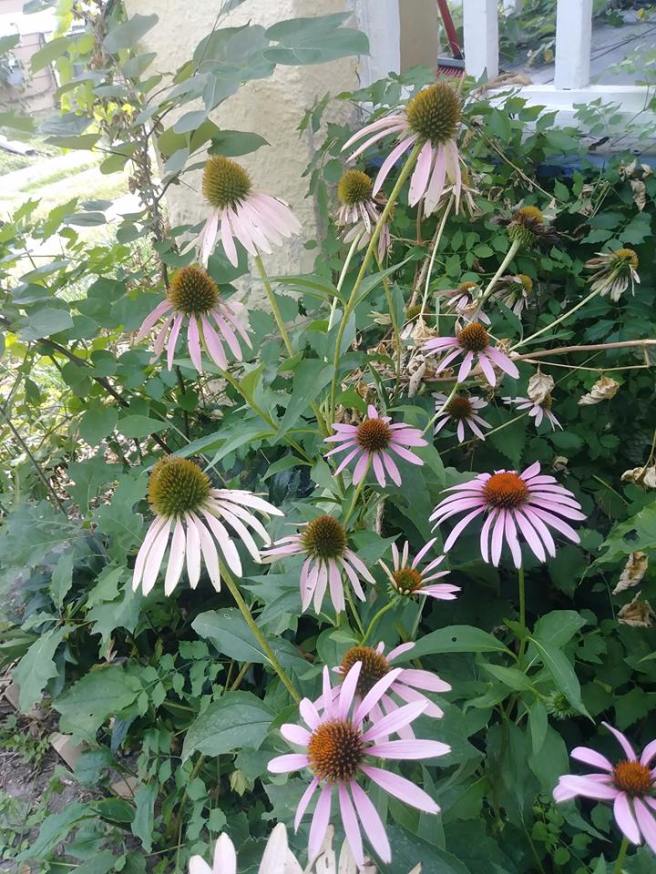
That purple coneflower that’s growing in so many front yards (including Dan Bugnitz’s Columbia, MO yard in this picture) turns out to be one of the most popular herbal remedies in the US. It’s commonly used for Rhinovirus and influenza. It’s not at all hard to grow or maintain. It goes great in a rain garden or pollinator garden and propagates easily through root division. You can dig it up, tincture it in Everclear in the dark for 30 days and take a shot every few hours as soon as you notice your body just about to get sick (that takes some bodily self-awareness). Don’t forget to get a bunch of sleep, as well as and stopping activities that would otherwise compromise your body’s immune system!

Echinaceas are heavy phosphorous feeders and will bloom prolifically after a dormant season prescribed fire.

“While there is some controversy about which of the constituents of Echinacea contribute to the immunostimulatory activity, there is a consensus that the lipophilic alkylamides, as well as the polar caffeic acid derivative, probably make the primary contribution to the activity of alkoholic extracts by stimulating phagocytosis of polymorphonuclear neutrophyl granulocytes. In addition to these constituents, polysaccharides are implicated in the activity of the expressed juice and aquaeous extracts, and in the response to the powdered whole drug.” (VAVERKOVÁ and VAVERKOVÁ 2006)

“If the E. purpurea seeds are from a wild source (not cultivated material), a period of cold, moist stratification at 43 degrees for thirty days is recommended…. If grown from seeds, expect flowers in the second or third year. When other plants succumb to droughty conditions, echinaceas will withstand the dry weather with little attention. They do well in any average, well-drained garden soil and prefer a lightly alkaline to neutral pH. Good drainage is essential. Echinaceas do not favor highly enriched, wet soils. Full sun is preferable, though E. purpurea does well under dappled shade. Yield of up to a ton of dried root and tops per acre can be expected.” (United Plant Savers, 2013)