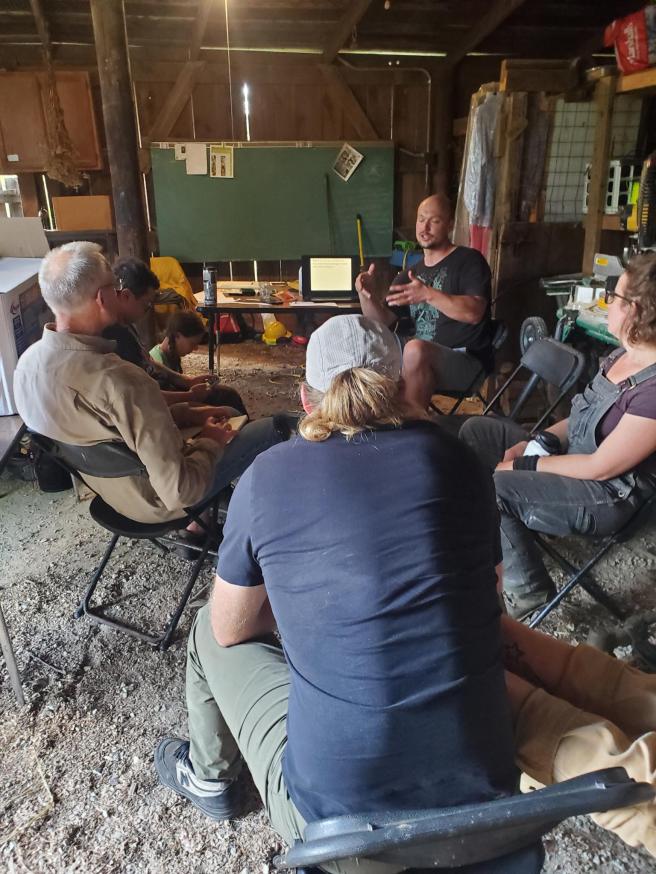
For the last few years, I have volunteered to teach people about prescribed fire. I am an Ohio Certified Prescribed Fire Manager, so part of my motivation is develop a client base, as well as a pool of gig workers to staff my fires. The teaching is pretty straightforward. We spend a few hours in the classroom looking at maps, plans and slides, and then I host several “learn and burn” events to get peoples feet wet. I am happy to say that as of yesterday, there are (144) people who have participated and are on the Google Group. My hope is that one day, people from this mailing list will coalesce and help found a Prescribed Burn Association (PBA) in Appalachian Ohio.
What is a A Prescribed Burn Association (PBA)? It’s a group of landowners and other proactive, ordinary people that form a partnership to conduct prescribed burns. Association members pool their knowledge, labor and equipment to help other people in their association conduct prescribed burns. I think at some point, the people in Appalachian Ohio should start a PBA. Why? There is safety in numbers when it comes to staffing a fire. Mutual Aid between land owners/managers/stewards is a powerful force. The more resources on a fire, the less likely something will go wrong. If people are willing to play tit for tat, it can keep the labor costs down.

Where are PBA’s a thing? At the time of writing, states that have at least one regional PBA are Virginia, North Carolina, South Carolina, Georgia, Florida, Alabama, Louisiana, Arkansas, Texas, Illinois, Missouri, Kansas, Oklahoma, Nebraska, South Dakota, North Dakota, Washington, Oregon, California. None of these states have complete coverage. PBA’s are usually at the county or multi-county level, sort of sub bio-regional.
One of the slides for the classroom portion of my intro workshop includes a national map of Prescribed Burn Associations (PBA’s). I make it a point to check the Great Plains Fire Science Exchange website annually, to see what has changed for PBA’s nationally. Here are the changes I saw this year:
-Between this time last year and now, Washington and North Dakota both picked up a PBA, whereas these states had zero before!
-But in that same period, Colorado and Mississippi went from having one PBA to zero, not sure why.
-Illinois picked up one PBA, but lost another.
-Coverage of Missouri and Texas improved.
Notably, there are currently no PBA’s in Minnesota, Wisconsin, Indiana, Kentucky, Michigan, Ohio, Tennessee, West Virginia, Pennsylvania or New York. I will tell you this. The oak, hickory, yellow pine and chestnut (such as it is) in these states misses the fire that a PBA could offer. The nut trees will continue to fade away without prescribed fire, replaced by other species. As a habitat manager, the slow decline of trees that produce hard mast for wildlife is a huge concern. This is part of my motivation for helping people learn prescribed fire. If you’d like to connect to the people who have taken my class and learn and burns, and now help each other burn on each others properties, I’d like to introduce you. Please contact me.
 Paradise Ecological Services