Ideating additional pathways for chestnut mycoforestry

Chestnut roots are colonized spontaneously by many species of edible ectomycorrhizal fungi, not just King Bolete/Porcini. Also for the people who are really into Chestnut-King Bolete mycoforestry, it’s relevant to know that King Boletes co-occur with certain other culinary species of ectomycorrhizal fungi. There’s a complex picture emerging as we learn more, which suggests many possible directions to take follow-up research to our Chestnut-Porcini project. Your input on these ideas is certainly welcome!

Before we begin, I want to restate “The Compatible Genera Generalization”, which led us to look for and discover the association between Castanea mollissima and Boletus variipes fagicola in the first place! Stated plainly, if one species in an EMF genus is known to pair with one species in a tree genus, it follows that pairings of other species from those two genii will most likely be possible, and most likely be feasible if the EMF species is a generalist. In Asia, the King Bolete species Boletus bainiugan associates with the Chinese chestnut. This postulate from mycoforestry community of practice should be applied to all the genii that we discuss below.

Without further ado, let’s talk about moss. Then let’s talk about Sweetbread Mushrooms, Shrimp Brittlegills, Amethyst Deceivers, Weeping Milkcaps. Then let’s get into the complex topics regarding the following: Truffles and Broadleaf Helleborine; Stubby Brittlegills, Lobster Mushrooms and Ghost Pipes; Shrimp-of-the-Woods and Honey Mushrooms. Finally, we’ll touch on a controversial topic- an edible species known as the Blusher, in the generally dangerous or deadly genus of Fly Agaric.

Moss, a facilitator of strong mushroom fruiting!– what’s the deal with seeing moss and Boletus together? Is it just easier to notice brown Boletes across a green background of moss? Possibly, but also, Delicate Fern Moss grows where it’s moist and shady, and forms a dense biological layer acts as a physical shield that blocks direct airflow and sun exposure at the soil surface, slowing down water evaporation from the earth underneath. This would help make the soil under oaks and chestnuts be more suitable for mushrooms to fruit, because normally soil under oak trees is pretty dry in the wild which is bad for mushroom fruiting.

Thuidium delicatulum, “Delicate Fern Moss” is a non-fungus indicator species for King Boletes in the Route 9 Cooperative chestnut orchards. We have also seen different moss species associated with King Bolete observations of Boletus, on iNaturalist, in Ohio. For instance, we have seen Spoon-leaved Moss, Bryoandersonia illecebra; Lesser Smoothcap Atrichum angustatum; Seductive Entodon Moss Entodon seductrix– identifications of moss accidentally captured in iNaturalist observations of Boletus were made for us by members of the Ohio Moss and Lichen Association.

If we find Boletus spontaneously in the forest, or wish to inoculate it there, it might makes sense to start growing moss on the surface of the soil in the surrounding area, in order to maintain a favorable soil moisture regime, which I would hypothesize could facilitate stronger edible ectomycorrhizal fungi fruiting events- in the future. I’m not aware of people growing moss for this purpose, but people do get moss patches started for other reasons- ecological restoration, beautification, etc. I should note this observation from an ecologist Bill Borovicka at Vinton Furnace Experimental Forest. To paraphrase: “I usually see moss on the ground in a line, where the moss used to be growing on a downed tree, and that tree has entirely decomposed into the soil, leaving a living moss mat on top.”

Click to access Resource001310_Rep1715.pdf

Lamarre, J., Joudrier, J., & Rochefort, L. (2023). A propagation technique for native tundra bryophytes for Arctic ecosystem restoration. Arctic Science, 9(4), 819-832.

Formuzis, J., & Titus, J. H. (2010). Moss and soil substrates interact with moisture level to influence germination by three wetland tree species. Wetlands, 30(2), 241-250.

Sweetbread Mushroom, aka the Miller, aka the Spy. An EMF known as The Miller, The Spy, or The Sweetbread Mushroom- Clitopilus prunulus– is considered a strong indicator species for the King Boletes in Europe and the Pacific Northwest. The Spy has a grey to white cap, decurrent gills, and pink spores.

Shrimp Brittlegill. Russula xerampelina, “Shellfish-Scented Russula” These are distinctive brittlegills- there are not other species that both have the reddish coloration on the stem, and also smell like shrimp. Choice edible, growing in Ohio chestnut orchards at Route 9 Cooperative.

Amethyst Deceiver Laccaria ochropurpurea or Laccaria amethystina. The caps of these charismatic mushrooms are considered choice edibles by some. This species has been found to grow on the roots of American Chestnut, and has been found in the Route 9 Chestnut orchards. Laccaria laccata has also been found in these orchards. Sometimes the purple fades over time, and the Amethyst Deceiver just looks like a Deceiver. The Deceiver’s cap is edible too.

The Bradley, or the Weeping Milkcap. As the inimatable Walter Sturgeon said: “Lactarius and Lactifluus are two genera of macro fungi that exude a liquid (latex) when the gills or upper stem are cut. They are closely related to the Russula genus. They form a symbiotic relationship with various trees including oaks, beech, and conifers. They fruit from May to October and are most abundant in July through September. Until recently they were all considered to be in the genus Lactarius. Tasting the latex of a milk mushroom is a feature in identification. The mild tasting species are edible (Badger emphasis added). There are some good edibles here and unlike their Russula cousins, they are usually free of larvae. The brownish orange capped Leather Back or Bradley, Lactifluus volemus has abundant, mild, sticky, tasting, whitish latex which will stain most surfaces (including hands) brown. The flesh and latex have a fishy odor which disappears during cooking.  An edible lookalike, Lactifluus hygrophoroides, has gills that are distant to subdistant. Another similar edible species is Lactifluus corrugis, which has a darker, wrinkled cap and has gills that are darker as well. All three of these occur with oaks. Lactifluus hygrophoroides also occurs with hemlock often along streams.” Does this species grow with Chinese chestnut? Well, it appears to grow abundantly in Ohio with oaks, and abundantly in Greece with European chestnut… Here’s the citation: Diamandis, S. & Perlerou, C. (2001), “The mycoflora of the chestnut ecosystems in Greece,” Forest Snow and Landscape Research 76(3): 499–504. The paper lists Lactarius volemus among the mycorrhizal fungi recorded in chestnut ecosystems; its methods state that mycorrhizal specimens were collected in pure chestnut stands. Lactarius volemus is the former name for Lactifluus volemus. This supports an ecological association with chestnut stands, though it is not, by itself, molecular confirmation of a direct root-level partnership. There is also evidence that chestnut roots being colonized by Lactifluus can prevent ink disease, which is caused by the soil-borne fungus Phytophthora. This is a bigger deal for European/Sweet Chestnut and American Chestnut more than it is Chinese chestnut, but it’s still worthy to note that this mycorrhizal association is effectively part of the chestnut’s immune system.

Tuber- truffle- these things are a bit of a vampire on the tree but they’re more prevalent than originally thought. Vermont chestnut orchards with Epipactis helleborine, broad-leaved helleborine, indicator species for truffle mycelium (Tuber sp.), implications for multi-cropping edible truffles. When you see the helleborine in your orchard, there are probably truffles growing already, secretly. It takes a specially trained dog or pig to find these truffles ordinarily. If you know anyone with a truffle dog who might like to work with us, please help get us in touch..

Lobster Mushrooms and Ghost Pipe-The unusual mycoheterotrophic plant known as the Ghost Pipe, Monotropa uniflora, has been seen abundantly in Pennsylvania chestnut orchards by our friend Noah Vincent. Ghost Pipe is often getting its photosynthate nutrition from a fungus in the Russula genus- Brittlegill Mshrooms. Usually or at least quite often, it’s the short-stemmed Russula aka the Stubby Brittlegill, Russula brevipes, that the Ghost Pipe is hooked up to. The already edible Stubby Brittlegill can be parasitized by a bright orange mold, Hypomyces lactifluorum, and transformed into the much tastier Lobster Mushroom. This is pretty much the same thing as we see happening with Aborted Enteloma turning Honey Mushrooms into the more palatable Shrimp of the Woods. Meanwhile, Ghost Pipe tincture is being used and sold by contemporary herbalists for relieving pain, grief and anxiety. So one could start by inoculating chestnut seedlings with Stubby Brittlegill or other Brittlegills, then when the mushrooms come up you can scatter Ghost Pipe seeds and spray the fruiting bodies of the Brittlegill with a slurry of the Lobster Mushroom. This sounds like a really fun project, doesn’t it?

Shrimp-of-the-Woods. Entoloma abortivum. Shrimp-of-the-Woods are delicious, choice mushrooms, that are actually parasitized forms of Honey Mushrooms Armillaria mellea. The aborted forms are called carpophoroids (fun word). Because Honey Mushrooms are parasitic on tree roots, Shrimp-of-the-Woods are probably not necessarily a good choice for mycoforestry in a nut-focused orchard, because their host is a pathogen of Fagaceae trees and could weaken Chinese chestnut roots. Armillaria mellea growth rate is negatively impacted by Entoloma abortivum infection. White oaks, red oaks and sugar maples are all valuable hardwood trees that are more susceptible to Honey Mushroom parasitization when stressed. Perhaps Shrimp-of-the-Woods could be introduced to timber stands or orchards where Honey Mushrooms infestation is already problem, in order to check the proliferation of Honey Mushrooms and produce this choice edible. “-Entoloma abortivum, “Shrimp-of-the-Woods” if there are Armillaria mellea, “Honey Mushrooms” present. “Entoloma is infecting Honey Mushrooms, and those odd-shaped fungi are actually malformed Honeys. The ecological role of this interaction hasn’t yet been confirmed, but it’s possible that Entoloma abortivum serves as a natural, biological control for Armillaria species, which cause a fatal tree disease called Shoestring Root Rot… Shrimps are mild-tasting and nice pan-fried to a golden brown or cooked in your favourite broth or soup, where they’ll absorb the flavors.” Quote from https://www.pei-untamed.com/post/shrimp-of-the-woods

The Blusher- use caution!- controversial! Only the most risk-tolerant members of Ohio Mushroom Society will cook up a Blusher. We only mention it because it’s closely related to the classic fungal “indicator species” for King Boletes- Fly Agaric, Amanita muscaria, and Caesar’s Mushroom Amanita caesarea. There is is mycoforestry product in Italy (Myco Chest) includes the edible Amanita caesarea and Boletus edulis together. These species may or may not occur in Ohio. We have observed Amanita muscaria var. guessowii on the roots of Chinese chestnut, and we’ve seen the fruiting bodies appear in the chestnut orchard. This is not an edible, is poison, and can make you delerious, though of course there is a strong ethnobotanical record of human usage for visionary experiences. I suspect Amanita amerirubescens “The American Blusher” has been found in association with Boletus in North America, but at this point this is only a hunch since I haven’t yet observed it. This is a blushing amanita in the A. rubescens– which Europeans enjoy eating, and which I harvested from a European Beech and European Chestnut area in the Basque country on our trip to Iberia. The Blusher is of this sub-grouping of Amanita that bruises reddish-pink when touched or injured. If you are examining Amanita found near Boletus to key it, you can double check for this reddish-pink bruising.

We have talked about a lot of different pathways for further mycoforestry research and practice. I hope this conversation helps articulate various trailheads that we could take together, or that others can take. Please get in touch if you would like to collaborate on these or other mycoforestry efforts!
Thinning and Burning in a Mycoforest

I am increasingly studying mycoforestry, and I have been writing up a storm about this topic. Most of these writings aren’t published yet. I’m writing prescribed fire plans with mushrooms in mind. I’m writing stuff for the current SARE grant, and the next SARE grant. Some powerful ideas have emerged that I just feel like sharing. So without further ado, here’s a short excerpt from a broader Community Food Forest Management Plan, written with other people at Rising Appalachia.

“Choice edible species of ectomycorrhizal fungi are an important layer of rural community food forests. IMHO these fungi have been almost entirely neglected in the community food forest literature. The neglect can probably be explained by the largely urban context of this movement, and also because the ability of foresters to shift underground fungal dynamics via timber stand improvement is not widely understood by foresters in the US. But whether foresters recognize this lever or not, we’ve already got our hand on it. TSI that benefits conifers and Fagaceae (chestnuts, oaks, beeches) at the expense of trees like red maple, can increase mushrooms yields for a huge diversity of delicious edible fungi.

Already in the Sugar Creek Community Forest, we have observed Smooth Chanterelle, Black Trumpet, Lilac Bolete, Indigo Milkcap, and Amethyst Deceiver- all of which are choice edible ectomycorrhizal species. These ecto mushrooms are growing in association with the nut trees- there are no conifers here. It should be noted that while there are many endomycorrhizal fungi that associate with tulip poplar, sourwood (well, that’s arbuscularmycorrhixal, different can of worms), wild cherry, red and sugar maples, there are no known choice edible endomycorrhizal fungi species in Ohio (or elsewhere). By steering the above-ground community towards oak-hickory dominance, and increasing the footprint of these nut trees, we plan on increasing the edible ecto mushroom footprint. Now, there are areas where American hophornbeam, a native shrub or small tree, is present at waist height. These areas are being excluded from prescribed fire, which is generally good for the nut trees at the expense of the maples. We’re sparing the flame for the American hophornbeam because invariably dense populations of this shrub coincide with “honey holes” of heavy chanterelle production. It is thought that the American hophornbeam is the host of the chanterelles.

We aim to temper our fire intensity so as to save dead wood in in the >8” diameter size class. Some of our favorite edible mushroom species are decomposer species growing on dead wood, whether fallen logs or old stumps, so maintaining this dead wood means more decomposer mushrooms to harvest. We plan to conduct prescribed fires on days when the leaf litter will burn, but heavy down dead woody debris will mostly not burn. Refraining from burning up the big woodies maintains food supply/habitat for decomposer/saprophyte type mushrooms. We observe and hope to increase yields of Oysters, Splitgills, Beefsteak, Eastern Cauliflower, Turkey Tail, American yellow morel, and Hedgehog mushrooms.

That’s the delicate balance we’re going for with our prescribed fire program at Rising Appalachia. The large down dead woody debris also provide refugia for salamanders. Fallen logs serve as microsite refugia for eastern box turtles during low-intensity prescribed fires and active-season wildfires. Rising Appalachia goes out of its way to be a turtle-friendly organization.”

2026.01.31 #2 research update on “Chinese chestnut seedling mycorrhization with porcini”

Introduction

Supported by SARE, the Southern Ohio Chestnut Company is mid-way through our farmer-led research project. “Chinese chestnut seedling mycorrhization with porcini”. This is the second research update to the public. We had intended for this to be a quarterly research update. Our progress, dependent on fluctuating weather and mushroom fruiting cycles, has not been the quickest version imaginable. However, we have still made significant research progress. Here is a summary of what we have accomplished, and what is coming up.

For starters, our prediction that novel species pairings between Boletus and Castanea would be feasible, vis a vis what we call the Compatible Genera Generalization, appears to have been correct. That is, if one species in an EMF genus is known to pair with one species in a tree genus, then pairings of other species from those two genii will probably work, especially if the EMF species is a generalist. In Asia, the King Bolete species Boletus bainiugan associates with the Chinese chestnut species Castanea mollissima. This fact supports our hypothesis that a North American King Bolete species can also pair with C. mollissima. Dr. Dietrich shared the Compatible Genera Generalization as a postulate from the broader mycosilviculture research community.

Mother Tree Treatment

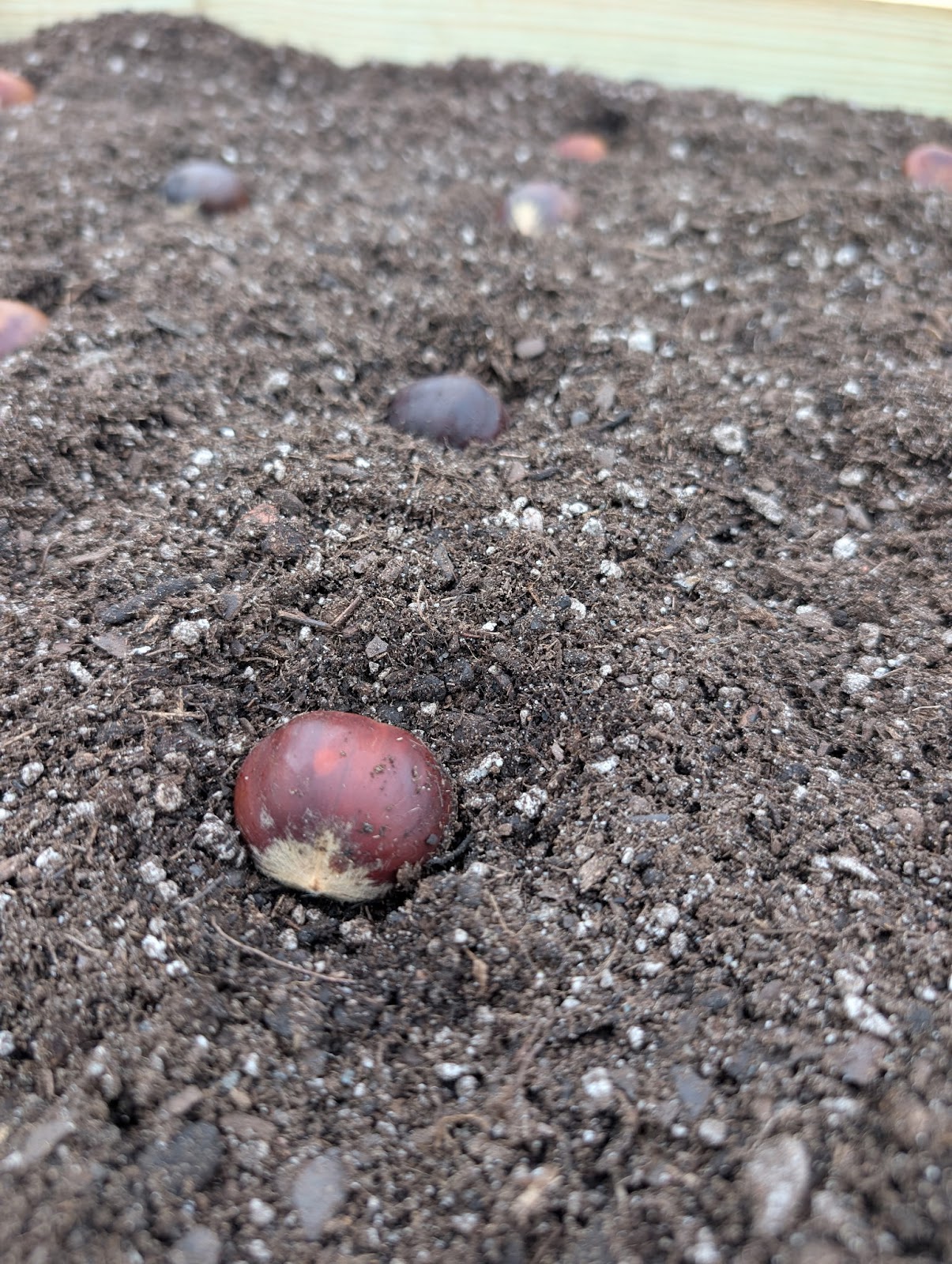
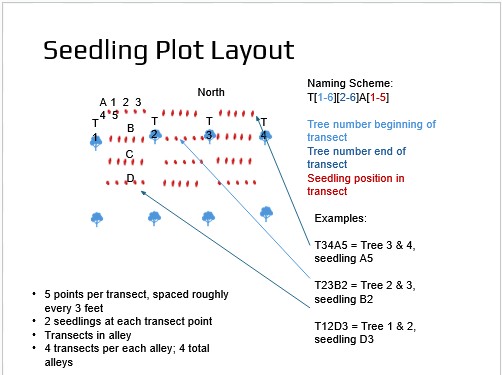
We have fully prepared to inoculate Chinese chestnut seedlings using the Mother Tree Treatment. In March, we will be planting stratified chestnuts that should be just beginning to germinate (these seeds are currently stratifying in a refrigerator in peat moss). These will be seeded two per planting site in a grid pattern, underneath a two adjacent rows of 10 chestnuts trees each (20 trees total), all of which are on a 20′ by 20′ spacing. This small area is part of a larger chestnut orchard that is completely protected by permanent metal deer fencing. This contiguous block of 20 “Mother Trees” was observed in June and October 2025 to have flushes of mushrooms growing underneath, presumably in ectomycorrhizal association with their roots. We believe those mushrooms are Boletus variipes fagicola, the Dark Brown Bolete, one of the tasty porcini species identified in the infographic shared on porcini species in Ohio. In this same site, the Cooper Orchard, other mushroom species that have been observed fruiting are what we believe to be Amanita muscaria guessowii, American Yellow Fly Agaric, and Baorangia bicolor, Two-Colored Bolete.

The June flush of Boletus variipes fagicola was larger than the October flush, by a long shot. The size of the flushes appeared to be linked to the weather. In 2025 leading up to early June, Carroll County Ohio had enjoyed steady precipitation levels of 1″ to 2″ per week. Later, a summertime drought meant we were surprised there was any porcinis at all in October.

Steps we have taken to prepare for the Mother Tree Treatment:

-We have signed an MOU with the owners of the mother tree treatment site/Cooper Orchard. Stephanie and Carl Cooper are the orchard owners and are members of the chestnut growing Route 9 Cooperative.

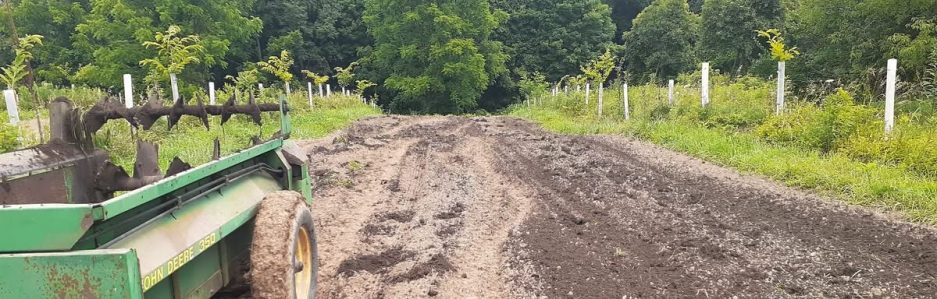
-We have purchased “milk carton” style tree tubes, from SpecTrellissing, to protect the seedling chestnuts in this planting from rabbit damage. Because of the deer fence, and because of the deer fence around the site where these seedlings will be transplanted in an open field for further study, temporary rabbit protection was all that we thought was warranted.

-We have developed a planting layout for seedlings in the Mother Tree Treatment. We will be planting two freshly germinated nuts per planting space in March. At first each milk carton will be labeled. After the seeds sprout, we will return in June to label all seedlings individually, for redundancy.

-We have submitted a sample of the October flush of mushrooms from the Cooper Orchard to Mycota Lab. The goal in working with Mycota is to use their inexpensive, high-throughput DNA barcoding program to get these mushrooms genotyped, and thus have the species identity of our Chinese chestnut-compatible Boletus genetically confirmed. Why is this important? Well, we want to be sure, for a plethora of reasons. Since many of the different species of Boletus have been revealed by genotyping to be sold, purchased and eaten under the false pretense of being B. edulis, we want to have transparent, honest, verified labeling of our porcini product in the future. “Eat Your Local Porcini” might become our marketing slogan. Additionally, since none of us have been to China and seen the Boletus bainiugan growing under Chinese chestnut in Yunnan, it could be possible that this somehow traveled with the Chinese chestnut here, and it would be good to rule that out. B. bainiugan is quite commonly sold under the name of Boletus edulis in the spice trade.

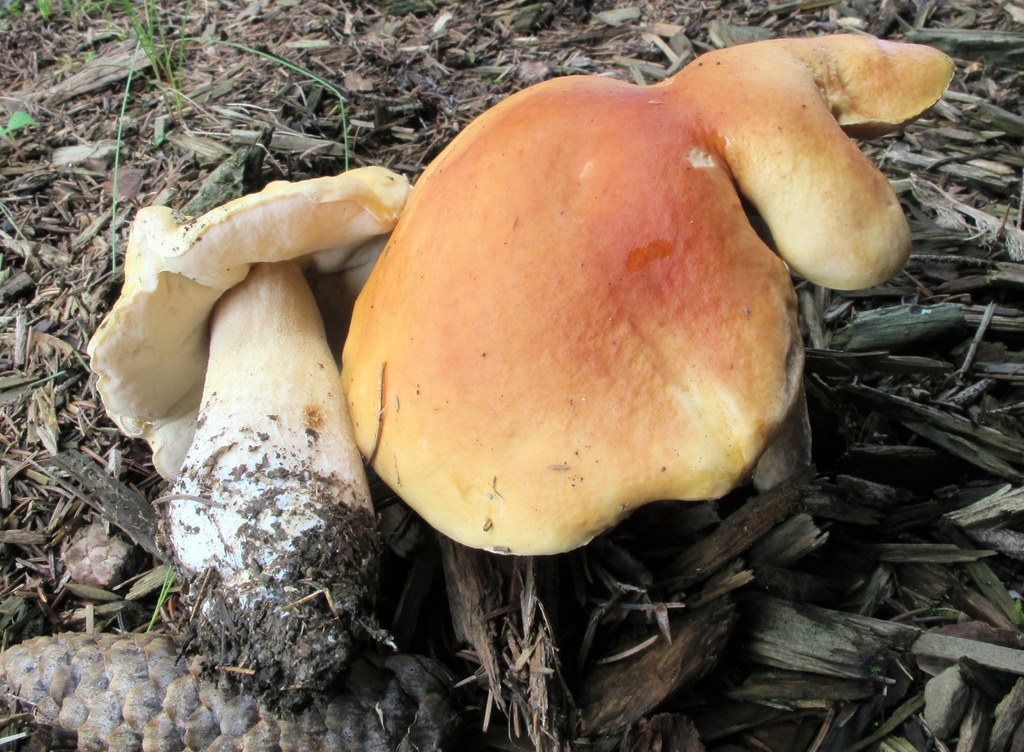
Mycota Lab deserves a plug for their assistance on this project, and really for their work in general. They are facilitating an amazing amount of citizen science, through the Continental Mycoblitz project. If you want to have a mushroom identified and genotyped, participation is easy. Read more about it on their website, but basically you make an observation of the mushroom on iNaturalist, you dry a sample of the mushroom, and then you print the specimen labels (including the iNaturalist ID number of your observation), and the team at Mycota will take it from there. See their website for details! Below is a picture of the mushroom we sent in from the October 2025 flush, a little over the hill but hopefully still usable for sequencing.


Liquid Mycelial Culture

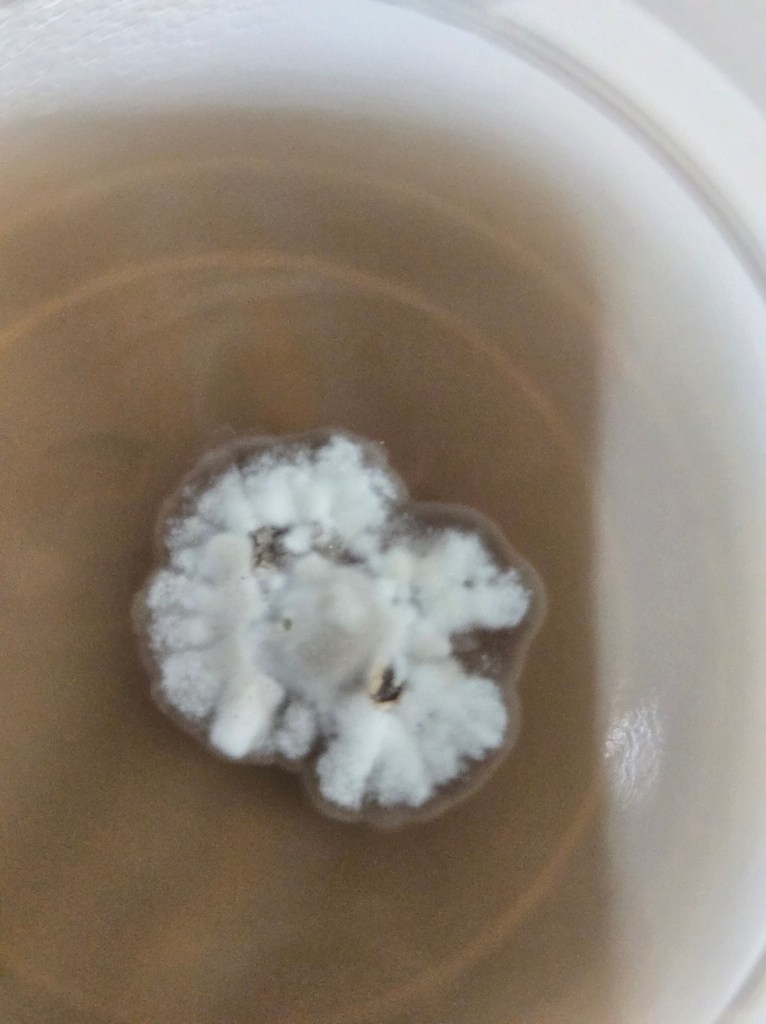
Mycota also received one of our slow-to-colonize Petri dishes from the June fruiting. Truly, the mycelium has grown tortuously slow on Even though We think both of those will come back from the lab, confirming it was the same porcini species growing under the Castanea mollissima trees for both fruitings, namely, Boletus variipes fagicola. While this is not the type species of the genus, it is sold commercially to high-end restaurants and used interchangeably with Boletus edulis. There is no doubt in anyone’s mind that B. variipes is native to Ohio, unlike B. edulis, which as far as we’ve been able to determine has not been seen confirmed as growing in association with any native or Chinese hardwood trees in Ohio. We are happy to be using a native species of mushroom for this project. However, the liquid mycelial culture we are seeking to produce for this experiment is looking less promising than we might have hoped. Thomas says that the literature did report the mycelium can be quite slow to grow on plates, and our experience bares this out. The mycelium from the June fruiting is growing slower than anything Thomas has attempted to grow before, including Tuber canaliculatum, a native truffle species which some people are excited for as a candidate mycosilviculture crop.

We’re not sure that the liquid mycelial culture couldn’t still work, but we may need to go back to the drawing board in terms of the nutrient recipe. Also, picking the porcini when it’s still in the dense, early button stage, before any worms or discoloration or bacterial composition sets in, seems like a crucial step to ensuring the purity of the strain. Thomas thinks there may be contamination on his June plates, though he has employed various procedures to clean up the plates of suspected unwanted mold, with some success.

Spore Solution Treatment

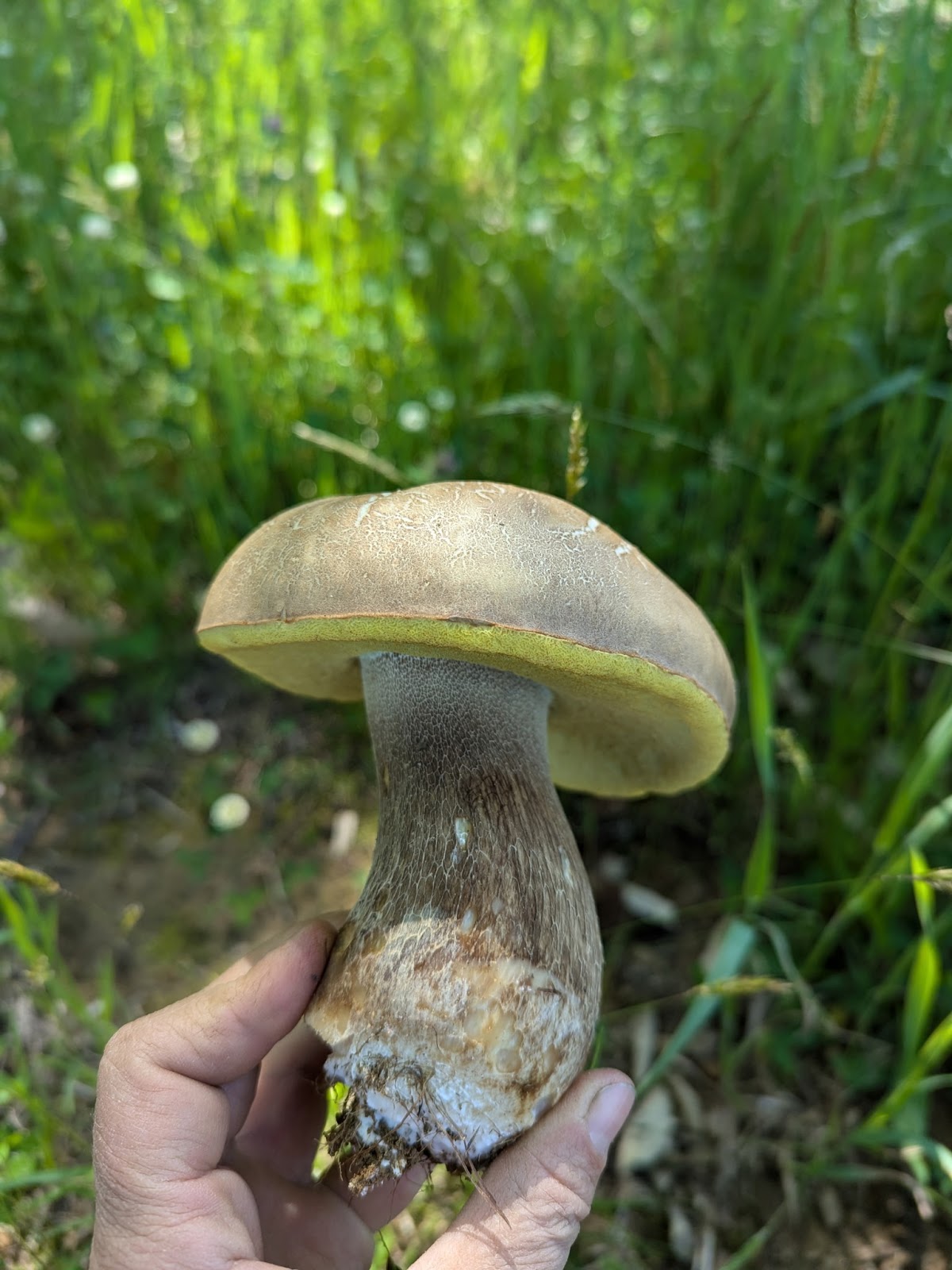
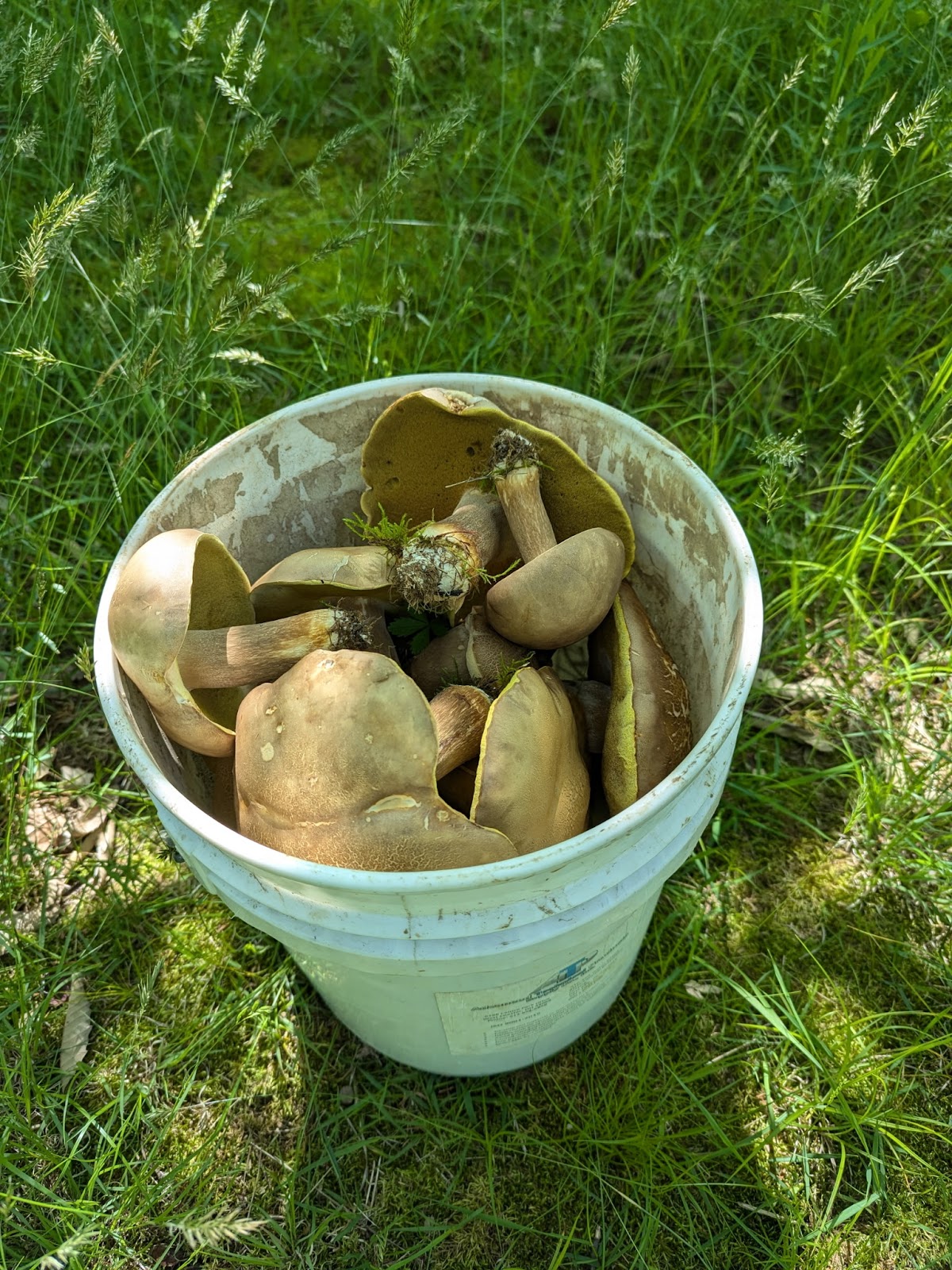
Perhaps our biggest gaff in the project so far was that the large flush of mushrooms in June, which we had intended to use in the spore solution treatment on chestnut seedlings grown in autoclaved soil, was eaten before the pickers realized we needed the whole batch, and not just a sample to send to Thomas at MidAm Mushrooms and Stephen at Mycota Lab. There was some confusion with the autoclaved soil being fully of weedy seeds about a rational next step, as we had intended to introduce the spores as to chestnut seedlings growing in demonstrably sterile potting medium, which it turned out we just didn’t have access to without a steam wagon (large-batch sterilizer, sometimes used in fish canneries). To prevent the mushrooms from going bad, Amy decided to freeze the large haul of mushrooms for later use. Dietrich pointed out that freezing the mushrooms almost certainly would have adversely effected the viability of the spores from those mushrooms, much to our chagrin. Thus Amy ended up sharing those mushrooms as a feast with the Route 9 Cooperative members. That is to say, for the first time, Ohio’s chestnut farmers as a community had an ad hoc culinary experience with the porcini that were harvested from beneath their very own trees. The good news from this is they were reportedly delicious, and furthermore the Boletus variipes fagicola were indistinguishable from Boletus edulis strico sensu. Additionally, none of the porcini taste testers noticed any adverse gastrointestinal effects or other negative symptoms from consuming the stir-fried mushrooms. While Ohio Mushroom Society newsletters have shared Boletus recipes in the past, it is helpful to get confirmation of the delectability and inoffensiveness of our candidate native porcini crop species. Below is an image of the stir-fried B. variipes fagicola from the Cooper Orchard.

Conclusion

We will continue to strive towards comparing the three inoculation methods (mother tree treatment, liquid mycelial culture treatment, spore solution treatment). At this point, the liquid mycelial culture treatment would benefit from starting with a fresh button-stage mushroom from the Cooper Orchard, to reduce the chances of contamination. This would also give Thomas more chances to test for different growing medium which the B. variipes fagicola could colonize more expeditiously. Meanwhile the liquid mycelial culture treatment is also dependent on another flush of mushrooms from the Cooper Orchard. This time, the same day that the flush is observed, Badger will take the mushrooms to Cincinnati, and use them to apply a spore slurry to several air pruning beds full of Castanea mollissima seedlings that we have growing already. While the growing medium their in was never autoclaved, it was in pure pine bark fines with some minimal fertilization that should have washed out or been absorbed, entirely, by this point. We believe this low nutrient, acidic environment can be a reasonable environment for the spore solution to take hold. All treatments will be followed up with testing the seedling root tips for the presence of living Boletus variipes fagicola mycelium. We’d like to thank North Central SARE for their support of this project.

Post Script (2025.01.29)

After sharing this research update in the Facebook group Chestnuts as a food crop – Castanea species nut trees, we heard a few interesting things that are related to chestnuts and mycoforestry. Namely, Stubby Brittlegill/Lobster Mushroom, as well as Truffle species, have indicator plant species that have been found growing abundantly in chestnut orchards. This co-occurrance of understory plant with culinary mushroom is similar to how moss on the soil surface seems to be a prerequisite to finding King Bolete mushrooms nearby. This is turning into a useful body of lore. It seems like this should be written down somewhere, so I am taking note of it here for later consideration.

-It was reported that in Vermont, there is a non-native orchid species that has been found growing beneath chestnut trees. A botanist identified the orchid as Epipactis helleborine, broad-leaved helleborine. This species of orchid is dependent on mycorrhizal fungi. Of interest to mycoforestry, broad-leaved helleborine has been identified as a significant indicator species for truffle mycelium (Tuber sp.) living underground. When you pair that fact with recent research on multi-cropping edible truffles (a genus of many different gourmet culinary species) with chestnut trees., it begs the question if this non-native orchid might be pointing to truffles growing spontaneously in existing chestnut orchards.


-Another strange plant growing abundantly in some chestnut orchards, that may have a connection to future mycoforestry research, is Ghost Pipe, Monotropa uniflora. Ghost Pipe has been reported in that group to grow abundantly in some chestnut orchards in Pennsylvania. Ghost Pipe is a non-photosynthetic plant, a mycoheterotroph that gets its energy from the ectomycorrhizal fungal species known as the short-stemmed russula or stubby brittlegill, Russula brevipes. It is known that stubby brittlegill is edible, and while initially it has a bland or bitter flavor, these mushrooms “become more palatable once parasitized by the ascomycete fungus Hypomyces lactifluorum, a bright orange mold that covers the fruit body and transforms them into lobster mushrooms.” I have eaten lobster mushrooms, these are delicious. So Ghost Pipe growing in a chestnut orchard would seem to point to the presence of palatable species of ectomycorrhizal fungi. It should be noted that extracts of Ghost Pipe are being used by contemporary herbalists as a folk remedy, taken for relieving pain, grief and anxiety.


2025.06.24 #1 research update on “Chinese chestnut seedling mycorrhization with porcini”

Introduction 

Supported by SARE, the Southern Ohio Chestnut Company has begun a farmer-led research project. “Chinese chestnut seedling mycorrhization with porcini”. This is our first update to the public.

Porcini mushrooms go by many names. This project works with porcini specifically –Boletus edulis– and also a group of other closely related “King Bolete” mushroom species from the Boletus genus. In practice, King Boletes are all harvested, traded and cooked rather interchangeably. They are all high-dollar culinary mushrooms. King Boletes are different from most other cultivated mushrooms in that they don’t normally break down logs or wood chips or bags of grain for their nutrients. Instead, they symbiotically trade resources with host trees- energy from the tree is traded for soil nutrients and water, between the ectomycorrhizae of the King Bolete and the fine roots of the tree. Because of this foraging strategy, would it surprise you to know that most King Bolete mushrooms are harvested from the soil surface? Yes, King Boletes are harvested in chestnut, conifer and oak woodlands, plantations and orchards. 

There has been successful inoculation of chestnuts and conifers in Europe and Asia. More research is needed into the basic biology of porcini as it relates to the inoculation of Chinese chestnut seedlings, however. To our knowledge, no chestnut grower in North America has derived significant income by selling the ectomycorrhizal mushrooms from their orchards. We hope to be the first! If this is exciting to you, follow these updates to learn along with us!

What have we learned and accomplished so far?

King Bolete identification and nomenclature

At Martha Bishop’s recommendation, Badger Johnson and Aly Gordon attended a spring 2025 foray with the Ohio Mushroom Society (OMS) in Lake County, OH. OMS is a chapter of the North American Mycological Association (NAMA), and puts out “The Mushroom Log” as a bimonthly newsletter. We suggest to everyone reading this, if you haven’t already,  join NAMA and your local chapter! It is of good value, for learning mushrooms on forays, in newsletters, and with many exclusive online classes and lectures. We search the Mushroom Log for King Boletes identification guidelines. Here is some of what we learned:

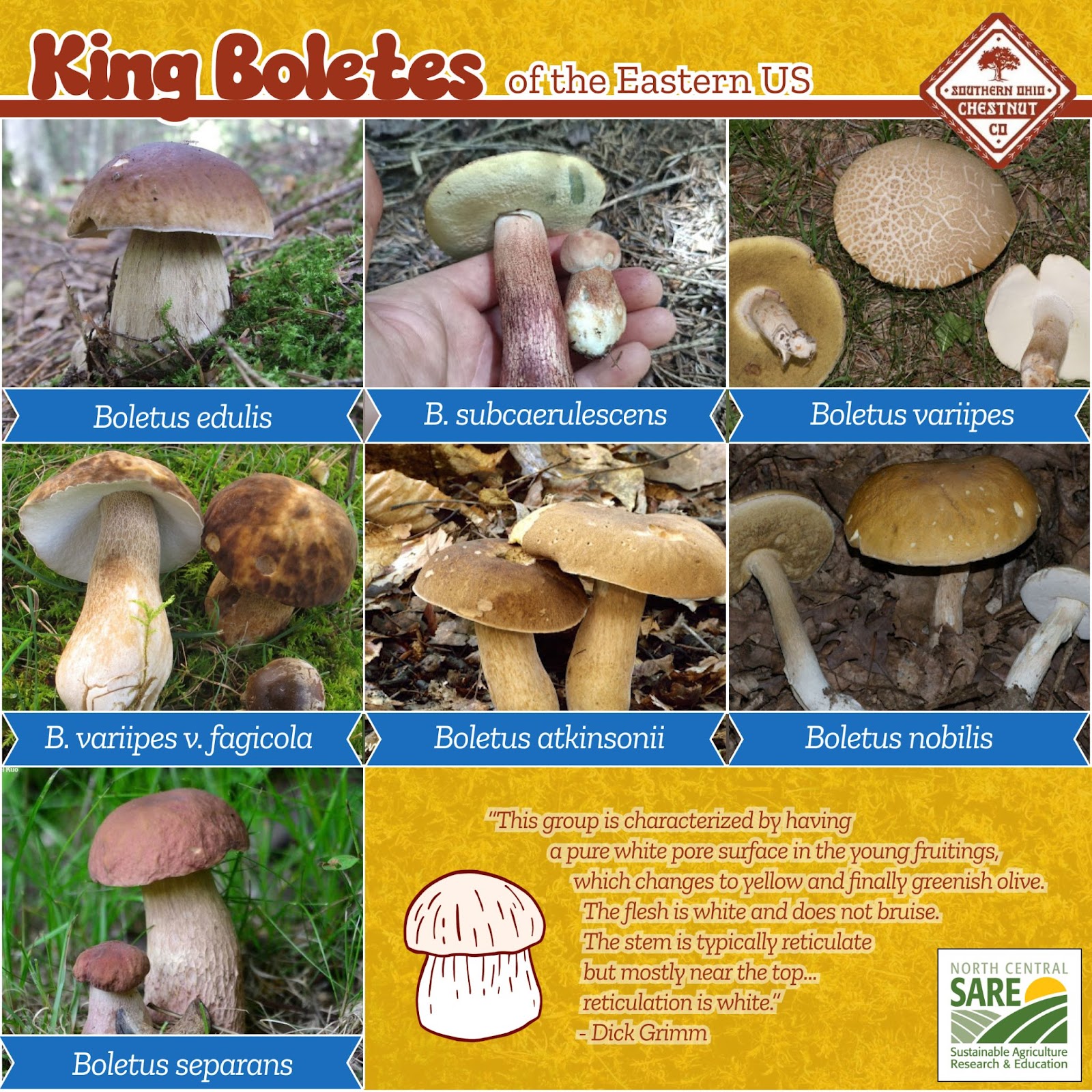
“Current research indicates that genus Boletus in N. America will eventually be whittled down to include only the “kings” –Boletus edulis, Boletus variipes, Boletus separans, & a few others.” -David Wasilewski

“This group (editors note: this group consists of the King Bolete group referred to above) is characterized by having a pure white pore surface in the young fruitings, which changes to yellow and finally greenish olive. The flesh is white and does not bruise. The stem is typically reticulate but mostly near the top… reticulation is white.” 

-Dick Grimm

This trend that Mr. Wasilewski described, of geneticists reclassifying every species from genus Boletus that doesn’t look like a King Bolete, has held constant ever since. In the eastern US, genus Boletus now includes only Boletus edulis, Boletus subcaerulescens, Boletus variipes, Boletus separans, Boletus variipes var. fagicola, Boletus atkinsonii and Boletus nobilis– all of which are culinarily considered King Boletes. This is a favorable situation for farmers, field biologists & foragers- all are choice edibles! Dr. Bryn Dentinger lays it out nicely in the chart below in his talk “ Boletus edulis update presented by Dr. Bryn Dentinger (UMNH) via Zoom on November 17 2022”. We made an infographic for the species native to the eastern US.

An accidental successful inoculation and annual harvest of King Bolete in Ohio

Martha introduced us to Walt Sturgeon. Walt is a mushroom field identifier and teacher of great renown in OMS. Walt is also the author of “Appalachian Mushrooms: A Field Guide”. He is a native of East Palestine, OH. More than 10 years ago, Walt inadvertently inoculated Norway spruce trees in his neighbor’s backyard with King Bolete. The inoculation occurred from spreading shavings and rinse-water outdoors, which he produced from mushrooms that he foraged and ate. Every summer, from under those Norway Spruce, he now harvests King Boletes where there where none before, under just three medium-sized yard trees! These pictures are from Walt’s iNaturalist observations, from this remarkable accident.


Indicator Species


We learned about “indicator species” for King Boletes. Fly Agaric Amanita muscaria mushrooms and ground-growing moss species including Delicate Fern Moss Thuidium delicatulum are good indicator species, if these are growing under host trees for King Boletes. These are used as rapid site compatibility clues by professional Tom Patterson, such that without ground-growing moss, a site is often not worth looking at.  Ian R. Hall has said “Boletus edulis is commonly found with Amanita muscaria… in China, England, New Zealand, and the USA, an association also noted… in France and…  in Austria. This may be because (Amanita) have similar ecological requirements and fruit at similar times of the year or it might reflect a biological association.” Tom said something like “When you see that Amanita muscaria is coming up in your King Bolete honeyholes, come back every three days to check for King Boletes.” Dr. Giovanni Gamba (University of Turin, Italy) told us about a Boletus edulis liquid mycelial inoculation for Castanea sativa (Myco Chest), which includes the edible Amanita caesarea. Mentioning edible Amanita should not detract from the “scare factor” of the deadly poisonous Amanita mushrooms that do exist, and which every forager should learn to identify and avoid. Take-away: King Boletes travel with Amanita mushrooms and ground-growing moss.

Timing Tips and Foraging for King Boletes on Abandoned Christmas Tree Farms

“The best months to forage for King Boletes in Southeast Ohio vary year to year. It depends on having enough rain (1-2 inches/week) and temps in the 80’s. On an average year, from best to worst: September, October, August, May/June, July.” -paraphrasing Homer Elliot

In May, these conditions occurred in Athens County, OH. With permission, we visited a 20+ year old Norway spruce planting, a commercial Christmas tree farm. We found Amanita muscaria had been flushing for week+, and that Boletus subcaerulescens was coming up.

Starting Chinese Chestnut seedlings, foraging King Boletes for inoculum

In late May & early June, Tom Patterson and Amy Miller shipped freshly foraged King Bolete mushrooms overnight to Thomas Lodge’s lab. Our specific mushrooms came from over-mature Christmas tree plantations in PA and a unique Chinese chestnut orchard that sits on a former oak woodland in OH. We have tentatively identified Boletus variipes from the OH site. Genotyping with bioinformatics analysis will be necessary to confirm this identification.

Thomas says that our King Boletes are successfully growing on the Petri dishes, see his video explanation here. Chris Smyth at Deer Orchard Nursery in Cincinnati has been watching the late-planted chestnuts begin to germinate. He tried a delayed germination technique to make the trees to order, such that the seedlings would not have been growing for very long before we could expect to see King Boletes in spring 2025. Chestnut seedlings started germinating but the germination rate to date has been much lower than when germinating chestnuts early in spring.

Chris built air-pruning beds and filled each with an autoclaved potting mix, and observed weed seeds germinate later. The pasteurization was not completely effective, as Dave Moore predicted. Soil is notoriously difficult to sterilize. Thomas says we could try a soil pasteurization wagon. Here are pictures of the potting mix, transported from by pickup truck in sealable, stackable plastic crates. You can see the freshly planted chestnuts in air-pruning beds, following methods from Perfect Circle Farm and Yellowbud Farms.

The potting mix was sourced from Nathan Rutz of Tilth Organic Living Soil. He designed this mix for us based on lengthy conversations about the need for some nitrogen in the form of dead organic matter, good water-handling capabilities, an acidic pH of less than 6.5, and reviewing the literature for what others had used. Others may raise their eyebrows at the addition of compost, but given the hard to predict nature about when our King Bolete inoculants would be ready, we decided that some rich compost could be an important source of nitrogen for ectomycorrhizal fungi to enzymatically break apart and disperse to chestnut seedlings.

Sand: 5%

Compost: 15%

Perlite: 20%

Pine Bark: 20%

Peat: 40%

Lesson Learned

With a goal of inoculating new chestnut seedlings, we should have developed the inoculant in sufficient quantity, and then autoclave the soil, and then germinate the chestnut seedlings at the first good opportunity. This order of operations would reduce the opportunity for other soil microorganisms to accidentally be introduced through the air into the autoclaved potting medium, and allow enough chestnut seedlings to be available simultaneously. Thus, we may delay inoculating chestnut seedlings until spring 2026, with a goal of germinating chestnut seedlings earlier in the spring.

A Mother Tree Site

Members of the team visited a Norway Spruce where Boletus edulis fruiting bodies have come up the last few autumns to assess where chestnut seedlings could be planted for the “mother tree method” of inoculation. The type species of the King Bolete genus- B. edulis– is said to almost exclusively fruit under Norway Spruce in North America, but fruits in association with virtually every deciduous and coniferous tree species in Europe except European larch. Why it would be host-specific on one continent and generalist in the US is an area of research for the Dentinger Lab.Interestingly enough, B. chippewaensis, which is found under some hardwoods, turns out to be genetically identical to B. edulis despite appearing phenologically distinct!

Dr. Dietrich Epp Schmidt shared a summary of where the project is at, more broadly.

“Scientifically, we’re still a long ways away from being able to say anything definitive about inoculating chestnuts with King Bolete based on our own experiment. But, there’s a lot of learning that has already shaped the project. There are a few key insights that surfaced during our proposal writing, and which I found to be exciting. First, our back of the envelope calculation suggests that during good years the market value of the King Bolete yield could easily eclipse the market value of the chestnut crop. This is a huge benefit to the farmer! Our proposal is focused on providing an incremental improvement to farm financial viability by increasing the growth rate and resilience of seedlings, thereby (hopefully) decreasing the time to market by a few years for newly planted orchards. However, the economic value of the mushrooms themselves offers a long-term vision of multiple revenue streams for the farmer from one cropping system. We love to see it!

Along the same lines, our proposal was focused on producing mycorrhized seedlings. However, we found evidence that suggests that it is likely that mature trees can successfully be inoculated, and that the development time for the mushrooms on mature trees is significantly shorter. If true, this is a huge development! It means that from the mushroom’s perspective, the main limitation for fruiting is having a tree partner that is able to supply sufficient carbon. From a production system perspective, it also means that mature chestnut orchards could also cash in on the King Bolete inoculants we develop, and start producing their own King Bolete. It further opens the possibility that we can develop the methods to inoculate mature hazelnut and pecan orchards with culinary mushrooms as well.”

Thank you to our sponsors, collaborators and fellow travelers. Please get in touch if you’d like to discuss this with us.